Indeed, while UECC is wholly responsible for operations in Pasajes and Berge Maritima oversees management of the car terminal in Santander, the two came together in 2001 to launch a joint venture company, Termicar, with terminal operations in both Vigo and Bilbao.
The decision to open a new terminal at Vigo was prompted by a tender issued by logistics company Gefco to handle the overseas despatch of up to 190,000 cars a year on behalf of Citroen and Renault. Up until December 2002, the Suardiaz company held an effective monopoly in new vehicles trade at the port, which is the second busiest car export facility in Spain. However, it failed to secure a vital three-year renewal contract with logistics company Gefco, which was equivalent to half the traffic on offer, thereby letting UECC back into a market it had been forced out of 25 years previously.
Suardiaz is, perhaps understandably, a little shy about discussing its present situation in any detail. Nevertheless, it notes that its Bouzas facility in the port accounted for 220,000 vehicles in 2003, of which the vast majority were generated by Citroen, with some additional consignments handled on behalf of BMW and Toyota. These were carried on three of the company’s vessels, operating four weekly services to the French port of Saint-Nazaire. A spokesperson noted that this type of rolling maritime motorway service should act as a model for the future development of short-sea services between France and Spain.
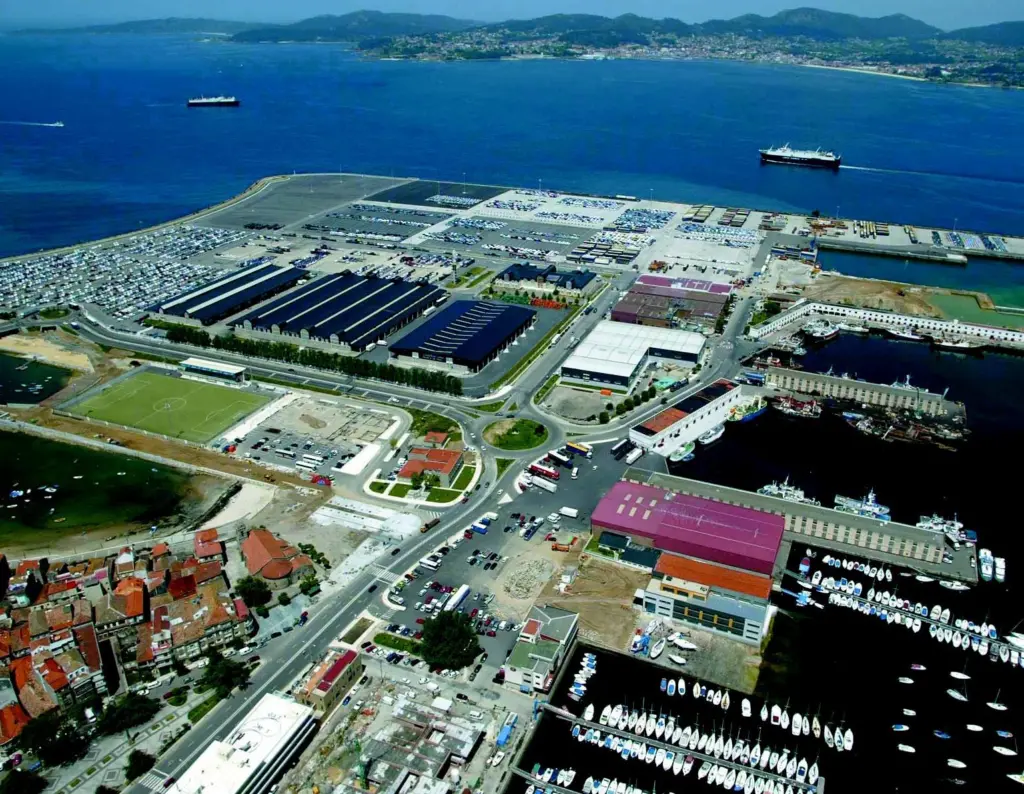
Within the Bouzas dock area, Suardiz’ vessels can call at one of four ro-ro berths. Alongside draught varies between 8 and 9.5 metres while maximum permitted vessel length is in the order of 200 metres. “The availability of four ramps allows us to unload vehicles via the ships’ sterns although we can also manoeuvre vessels to use the laterals, too. A fifth ramp is due to enter service in May, which will allow us to handle even larger ships, ” notes the company, adding that onshore storage space totals 120,000 sq metres.
Meanwhile, Captain Juan Sierto, Termicar’s manager in Vigo, notes his facility handled nearly 200,000 vehicles last year; 180,000 of these being the result of the Gefco contract, plus an additional 20,000 of imported cars generated by contracts with Ford, Toyota and Hyundai. Significantly, UECC also uses Vigo as a transhipment hub, swapping vehicles between vessels whenever bad weather delays adversely affect scheduling.
“We believe that eventually we could develop into a true transhipment operation on the lines of what Autoterminal has in Barcelona. However, for 2004, we forecast a growth in traffic in the region of 15%, all of which will come from increased imports from our non-Gefco traffic. For example, Ford will continue to import a lot of new cars through here from Turkey, while Toyota is making use of Vigo to distribute vehicles throughout Portugal.”
SEEKING SPACE TO INVEST IN ADDED VALUE SERVICES Key to the company’s future is an improved terminal site within the actual port itself. At present, Termicar occupies a 55,000 sq metre terminal within the adjacent free zone which is nearly 1km from ro-ro ramp-equipped quays. Main rival Suardiaz is somewhat closer to the docking area and therefore has a temporary advantage. Nevertheless, Termicar has asked the port authority to allocate to it part of a new 80,000 sq metre infill site within the Bouzas dock area.
“In order to be able to invest in value added services we need a positive answer. That would allow us to develop a real distribution operation in Vigo, offering such services as damage repair, cleaning and valeting, ” emphasises Sierto who believes that improved road and rail infrastructure should also allow Vigo to compete for vehicle imports from the Far East bound for Madrid, given that it is at a similar distance from the Spanish capital as is Barcelona and no further than either Santander or Pasajes.
Vigo’s considerably lower tariffs when compared to Barcelona could give it the edge in the future although Sierto emphasises that to win additional traffic, Termicar will have to be able to demonstrate that it can offer a first class service. In part this is already provided through the use of the present IT system which allows main client Gefco to monitor movements of all cars handled by Termicar and UECC who log receipt and despatch of each car by using portable terminals equipped with barcode readers.
Asked if Termicar Vigo is currently profitable, Sierto says it must be, although points out that for UECC terminal operations are viewed as cost centres, rather than profit generators per se.
Understandably, he therefore sees his main role as one in containing overall costs.
To date, UECC has been able to justify calling at Vigo with two main services. The weekly Bremerhaven-Zeebrugge- Southampton-VigoLivorno-Piraeus service is operated by four vessels, calling on Mondays to pick up vehicles bound for the eastern Mediterranean, then returning on Thursday, dropping off imports from Turkey and taking on board exports for northern Europe. The second service makes use of two 2,000-vehicle capacity ships, which shuttle between Vigo, Sheerness, Bremerhaven and back to Vigo.
70,000 UNITS NEEDED FOR PROFITABILITY While business at Termicar Vigo is thriving the organisation in Bilbao has yet to reach even a minimum threshold of traffic. In 2002, only 8,000 vehicles were handled, rising to 15,000 last year and terminal manager Rafael Garcia emphasises that to be profitable an annual base figure of 70,000 units needs to be established. “At the moment, we are handling imported Ford cars on a regular basis, as well as a few ad hoc shipments of Opel Corsas. However, we are talking to other manufacturers too. Nevertheless, while traffic will rise in 2004, it is unlikely we will reach our minimum target level, ” he stresses.
The operation in Bilbao was set up to some extent to offer relief to car terminals operating in the nearby ports of Pasajes and Santander. But to date, there has been little sign of traffic diverting from either port to Bilbao. In part, the problem lies in the current Termicar terminal in the port which occupies a restrictive area of just 60,000 sq metres and is served by a single ro-ro ramp, albeit capable of handling loads of up to 100t, thereby allowing trailers as well as individual vehicles to be disembarked. The company has a 10-year concession on the site but has also signed an agreement with the port authority which will allow it to move to the larger Muelle 3, where up to 250,000 sq metres of land are available.
To date, therefore, Termicar has felt unable to pour vast investment sums into the existing site, especially given the paucity of traffic.
According to Garcia, the plan is to firstly establish a base traffic of 70,000 vehicles, thereby ensuring the overall profitability of the operation and then sink substantial funding into the new site which should enable the company to offer a full range of services to potential clients, as well as acting as a fully fledged distribution centre.
“In Spain, both Barcelona and Santander already offer these features and we believe a case exists to upgrade Bilbao into something similar, ” says Garcia. “Until now this has not been necessary because none of our clients has requested value-added services. This is not to say that Bilbao cannot be profitable functioning simply as an import/export facility. Pasajes, which offers no value-added services is a highly profitable, ” he stresses, “so there is still scope for Termicar to make short terms profits.”