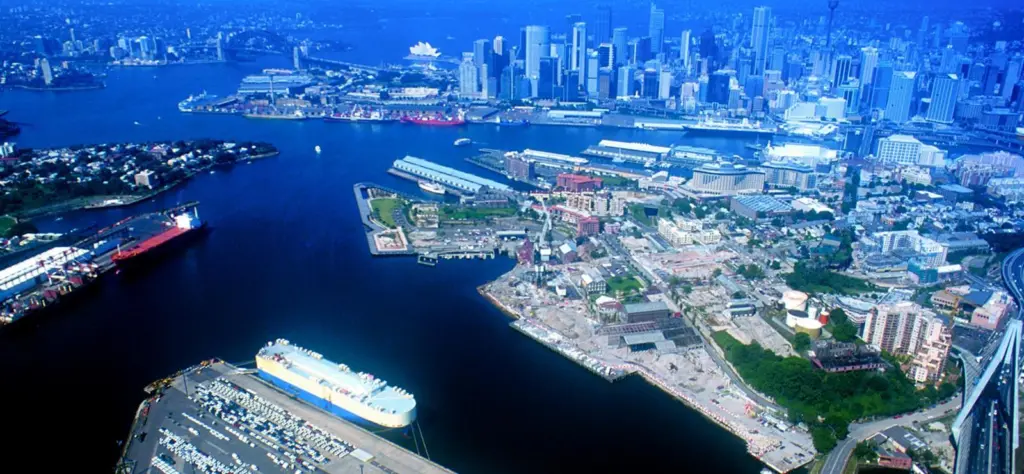
The New South Wales government’s 20-year plan for its ports looks like neatness itself. Sydney Harbour’s general cargo trade is to be lured to job-hungry Port Kembla to the south once the last general cargo berth leases on the scenic city shores, at Darling Harbour, expire in early 2006.
Sydney’s port facilities will then become a series of monocultures: cars at Glebe Island, where they will become Sydney Harbour’s last major non-oil cargo; and all containers at Port Botany on Botany Bay.
And once Port Botany runs out of capacity in 2025, then container growth will migrate north to the state’s other hard-pressed regional centre of Newcastle.
But through the cracks in this plan fall the shipping lines who do more than one thing on the same ship. Wallenius Wilhelmsen, Spliethof, and Swire’s China Navigation, and others have all made good niches out of mixing machinery, plant, paper and steel cargoes with core auto, general cargo and container operations.
These cargoes are as important to Sydney’s import mix as the more high-profile boxes and cars. Up until now they have used either Patrick’s Darling Harbour berths, or the White Bay facilities which P&O Ports gave up in late 2003. P&O Ports now cohabits in Darling Harbour with Patrick as a prelude to a move by both into shared general cargo facilities in Port Kembla.
But the carriers involved say that they are being shut out of Sydney and left with an alternative that is almost unworkable. They argue that landing their general cargo in Port Kembla, as the state plan devoutly hopes they will, would leave the car and container cargo stowed with it instantly uncompetitive against the pure box and car carriers still using Sydney.
Dutch multi-purpose specialist Spliethof for example has a good business in earth moving machinery carried on hatchcovers over its steel cargoes. But if it has to take its steel to Port Kembla, it will have a tougher job competing for earth mover cargoes against car/truck carriers with strengthened decks, and able to sail directly to Sydney’s Glebe Island.
Spliethof makes around four inbound calls a month with steel as well as machinery cargoes. Ken Fitzpatrick of Spliethof’s Australian agent Asiaworld believes that Port Kembla would use three times the amount of trucking than a Sydney call. “It’s been tried with steel cargoes, and it is not economic”, he says.
HUGE INCREASE IN LANDSLIDE COSTS Likewise, if Wallenius Wilhelmsen discharges its paper and other general cargo in Port Kembla, it faces a huge increase in landside costs on its vehicle shipments for the Sydney market.
The one other chance, for Wallenius Wilhelmsen at least, is for the stevedores to find more room at Glebe Island to handle general cargo as well as cars. Such a development is possible, but depends on more long-term certainty on the lease than the state government has so far been willing to give.
Now the issue has been forced. Wallenius Wilhelmsen has applied to lease the now unused berths in Sydney Harbour’s White Bay saying that it does not believe that even Glebe Island in its present form has the capacity to take everything from Darling Harbour in 2006.
The only response to the lease bid has been repeated public reminders by Sydney Ports Corp chief executive Greg Martin and NSW transport minister Michael Costa that the state ports plan prohibits renewed general cargo or container handling at White Bay. P&O Ports also makes it clear that a new lease to Wallenius Wilhelmsen would breach the understanding with government under which the stevedore had given up the White Bay facilities.
Few industry sources believe Wallenius Wilhelmsen would make money at White Bay, or indeed avoid the renewed fury of residents who plagued P&O Ports’ last years there.
Nevertheless, the ro-ro giant has proposed several options, including using White Bay as a periodic overflow facility restricted to cars, which might pass muster in the port plan. It has also suggested building a dedicated link road between Glebe Island and White Bay to make the two facilities even more inter-operable.
Wallenius Wilhelmsen’s current stevedore, Patrick, has taken the point and is looking to see how the line can be accommodated at Glebe. The minimum requirement would be a 5,000 sq metre shed for paper and other bulk products. Patrick’s director of general and auto stevedoring Don Smethwick, says that adding the shed would also mean expanding Glebe by another berth and investing in a multi-story car parking facility as well.
The all-up cost would be US$14.5m. But Australian Amalgamated Terminals (AAT) – the joint venture between Patrick and P&O Ports which acts as a common user facilities manager at Glebe – would want security of tenure there through all the options in the current lease to 2017, and preferably to 2023, in order to amortise the investment. “We are reluctant to invest without knowing the life of the facility”, says Smethwick. “The shorter the time at Glebe Island, the more Port Kembla becomes an alternative.”
There is considerable suspicion that the state government will do nothing on the lease, simply to see the car carrier lines gradually eased down to Port Kembla. In the meantime, there will be considerable competition for whatever space at Glebe is available. Major Japanese car importers Toyota, Mitsubishi and Nissan do their import car detailing on-wharf at Glebe for direct delivery to Sydney dealers, and would suffer a major impact if they had to prematurely move to Port Kembla. Other car importers also make it clear that they do not want the cost of two car terminal facilities in New South Wales.
All in all, there will be only reluctant movers to Port Kembla, with concern not reduced by the fact that AAT will manage the facilities in either case – as well as Glebe, AAT is preferred tenderer to manage Port Kembla’s multi-purpose terminal.
The presence of AAT should in reality increase competition for stevedoring work. The joint venture was created to avoid overinvestment through managing shared facilities, upon which any common-user stevedore can operate.
Some stevedoring sources point out that lines like Spliethof that are reluctant to leave Sydney are only looking at the immediate impact. In the longer-run, working in Sydney can only get much more expensive than it is now – the land market valuations on the existing stevedoring premises underscore that.
To other sources, there is a wider issue. They lament that Sydney’s port has lost the power to facilitate trade in favour of wider political and waterfront land issues. “Historically we looked at ports to be service providers for trade. That decision making power has been taken away for strategic reasons, ” said one.