It was almost inevitable that France’s leading Atlantic Coast container port of Le Havre would suffer from chronic congestion this summer.
Throughput last year, for example, was up a worrying 15.3% to 1.98m TEUs, stretching already finite resources to the absolute limit. Traffic in 2004 continues its seemingly unstoppable growth, increasing by 8% in the first six months alone. Fewer dockworkers during the key months of July and August, ailing cranes and even greater volumes to be handled when compared to last summer, have all meant that the port has understandably struggled to cope.
Nevertheless, the port authority was adamant that things would return to normal by September.
However, a senior manager for a local shipping agent and maritime services company told PS that scope still exists to sweat existing assets even further. “Average productivity of 20-22 moves per crane hour, ” he argues, “is less than it was when I began working at the port some 30 years ago, despite the fact that we now have completely modern computer-aided equipment.”
The problem, which is not wholly peculiar to France, is that while terminals are managed by private sector stevedores, their assets are operated by port authority employees. Since higher productivity could mean fewer jobs, efficiency on the dock remains languid.
To make matters worse, lifting equipment in Le Havre has been dogged with both niggling and sometimes serious mechanical problems. New state-of-the-art quayside gantries acquired from ZPMC, for example, have undergone teething problems with spare parts having to be brought in from China. More serious has been the performance of locally produced Callaird gantries. These were acquired in the early 1990s but are clearly under-engineered for modern quayside duties and prone to disgrace themselves when pushed to the 33limits of their design capacity. The port authority nevertheless insists that they can be salvaged. Indeed, recent mechanical interventions have enabled at least four of the five to remain more or less in service throughout the summer but longer downtime may well be necessary if they are to have a more secure future.
On a brighter note, the ZPMC units have been fitted with twin spreaders (one manual, the other automatic), which should eventually result in higher quayside productivity even in the face of employee recalcitrance.
Unfortunately, the port’s much touted Port 2000 implementation schedule continues to slip with the first four berths not now expected to become fully operational until sometime late next year, at least six months later than timetabled.
Maersk Sealand and CMA CGM are committed to move activities to the new 1400 metre long quay. A further two berths will be added later; with up to 12 projected if traffic so warrants it.
The extra space will enable the port to handle additional transhipment traffic. Boxes rotated in and out of the port by sea are already on the increase: 26.4% of throughput came from transhipped boxes in 2002, rising to 30.4% last year.
According to the local port community, once the new Port 2000 berths become available, it is expected that MSC, which already tranships a part of its Western European traffic at Le Havre, will then transfer other boxes to the port that it currently tranships at Felixstowe. This could mean throughput at the port doubling in the next few years.
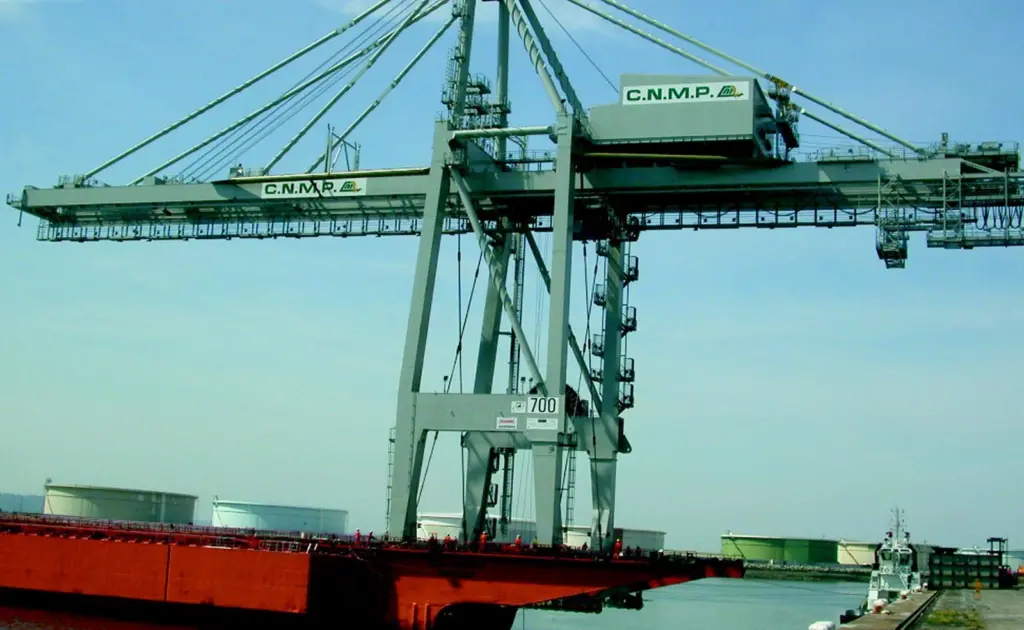
It is therefore unlikely that the existing container handling facilities will become redundant, with the port authority helping to implement an across-the-board upgrading plan to increase the number of available quayside cranes. Eight new post-Panamax gantry cranes have already been put into operation this year bringing the overall complement to 27, which will have risen to 35 by the beginning of 2006. Of the new cranes, three from ZPMC and two from FantuzziReggiane have been delivered to SETO, while two others from the Italian manufacturer are now in service with Europe-Atlantique Terminal and a third with CNMP.
BARGE TRAFFIC SEEN AS ROUEN’S FUTURE A further 80km upstream on the River Seine, Rouen is struggling to retain direct calls from deepsea lines despite being the fourth largest box port in France. Even before congestion became a serious issue at Le Havre, a number of lines cut back services from Rouen to Le Havre, preferring instead to barge containers to and from the river port, in effect saving two days of sailing time. Reported throughput therefore dived 12.3% in 2003 to 144,177TEUs, although barged containers, which are not habitually included in official figures, grew from 8,712 to 28,172TEUs.This trend towards more barged containers and fewer deepsea containers continues into 2004.
With the dominance of Le Havre on the Atlantic coast, and the presence of Zeebrugge and Antwerp in neighbouring Belgium, Dunkirk has been forced to become a major innovator just simply to stay in the container market. The setting up in 1991 of a joint venture company, North France International Container Terminal (NFTI) involved both the port authority and IFB from Belgium creating an integrated operator. The success of the venture is reflected in the phenomenal build-up in box traffic that has ensued. From a low of around 30,000TEUs, NFTI has grown the business substantially over recent years reaching 162,000TEUs in 2003. For the current year, throughput continues to grow, up around 16% at the half-year, with Daniel Deschodt sales and marketing director confidently predicting that the terminal could end 2004 having handled 200,000TEUs.
“For us, everything began happening in a big way in June. On June 15, we opened the terminal’s 600 metre quay extension which has alongside draught for vessels drawing up to 17.5 metres.
Then, on June 18, Maersk Sealand switched its AE2 service from Le Havre to Dunkirk in order to avoid seasonal congestion. At the same time the company announced it would commence indefinite calls on August 19 with 6,000TEU vessels on its AE7 string, ” notes Deschodt with considerable pride.
However, the port is cognisant that with Marseilles and Le Havre firmly entrenched at the top of France’s box handling league, Dunkirk, in third place, is still a long way behind in terms of throughput, although is targeting traffic of 500,000-600,000TEUs over the next five years.
DUNKIRK VIEWED AS POTENTIAL OFFSHORE UK TERMINAL . . .
Part of an expanded traffic base will have to come from additional deepsea services. Shipping lines with whom NFTI is currently in negotiations are said to view Dunkirk as a potential offshore UK container terminal with the Channel Tunnel just 40km away. With this in mind, substantial building of new logistics facilities such as warehousing, is taking place in and around the port while a shortsea terminal adjacent to the NFTI facility already attracts services to Dartford and Dover, as well as a weekly feeder to Felixstowe.
Parisian traffic is also a target. This is currently monopolised by Le Havre which is geographically just a little closer. Nevertheless, with Dunkirk guaranteeing truck turnaround times of no more than an hour (compared to the several hours of waiting time occasionally faced by truckers at either Le Havre or Antwerp), the port authority believes that the actual port to end-user transit time could actually be more competitive via Dunkirk.
“The problem is now one of convincing haulage companies to set up the necessary services, ” points out Deschodt, noting that to do this means having to end a mindset in northern France that remains unnaturally fixated on Le Havre as the deepsea option in the region.
Higher productivity levels at Dunkirk are nevertheless appealing.
Current contracts specify a baseline commitment from the port of 20-25 moves per hour depending on the service although Deschodt emphasises that much higher upper limits are being achieved. If traffic so warrants it, two to three more quayside gantries will also be brought in to reinforce the current battery of five of which two are Panamax, two post-Panamax and one super-post-Panamax. This additional lifting power would nip any potential quayside congestion in the bud and allow Dunkirk to continue selling itself as one of the few Northern Range ports where presently vessels enjoy few, if any, berthing problems.
The dominance of Le Havre has also meant that ports such as Brest, Bordeaux and Nantes-Saint Nazaire have had to develop niche business in order to attract container traffic. “You cannot compare Nantes-Saint Nazaire with Le Havre, ” insists Nantes operations director Thierry Fournier. “At present we are not able to accommodate any vessel over 3,800TEUs, which makes it difficult to compete for east-west traffic except via feeder; liner vessel sizes on such trades are in the 6,000TEU-8,000TEU range. Nevertheless, we do see container traffic as a significant market for our port and are working to add lines.”
The port’s Montoir Container Terminal (MCT) is nevertheless having some success in boosting traffic, which went up 8% in 2003 to reach 119,385TEUs. Lines manager, Gerard Jahoo, points out that much of this increase was in the form of additional boxes carried by established feeder and deepsea customers. To date, year-end projections for 2004 suggest that throughput will reach at least 125,000TEUs, but with luck might break the 130,000TEU mark.
At present, CMA CGM, Maersk Sealand and Marfret link Nantes with the French West Indies. Delmas calls at ports in West Africa, while CMA CGM, Delmas and DAL offer a combined service to the Indian Ocean. Closer to home, a ro-ro service provides Nantes with up to four calls a week to Vigo, while weekly feeders are operated by Maersk Sealand (into Rotterdam), MSC (into Le Havre) and CMA CGM (into both Antwerp and Le Havre).
. . . AND NANTES-SAINT NAZAIRE AS SUPERMARKET HUB Given draught limitations, Jahoo therefore believes that Nantes-Saint Nazaire could become a stronger player in niche north-south trades, in particular to the USA and South America where vessel sizes are smaller. The port has seen strong growth too in the transport of containerised timber as well as having eked out a significant role in the handling of reefer containers, thanks to Nantes having become a major terrestrial hub for supermarket distribution. Indeed, the area behind MCT is to be developed as a logistics zone in order to attract more traffic of this type. Plans also exist to connect Nantes with Bilbao as part of a sea motorway scheme.
“In general, ” says Jahoo, “the decision by supermarket chains to use one port or another is dependent on price and the quality of service provision on offer. They therefore put pressure on intermediaries as a means of driving down prices. Whether they use our container facilities or not is therefore heavily dependent on the number of shipping lines calling here and how much it costs to handle containers in the port. So, although we are relatively congestion free and can offer a 20-minute turnaround time for trucks, as well as being significantly more flexible than other ports in this region, global sourcing means ever greater numbers of containers are arriving from the Far East, where our draught limitation mitigates against us capturing a major share of that market, although we do have reasonable feeder connections.”
Nevertheless, when promoting Nantes to lines he does have an ace up his sleeve in the form of the impressive productivity achieved by the MCT, which averages 28 moves per crane hour, significantly higher than regional rivals, despite the plethora of competing stevedoring companies using the facility, whose presence Jahoo claims helps keep prices highly competitive.
In terms of infrastructure, the existing 750 metre long quay on the container terminal is being extended by a further 250 metres, which will enable simultaneous berthing of up to four vessels, while the provision of a ramp permits ro-ro or ro-lo ships to be better served. The impending purchase of a fourth post-Panamax gantry will also help to boost Nantes-Saint Nazaire’s image as a port that is aggressively pursing new box trade.
Two other ports also handle boxes on France’s Atlantic coast;
however neither Bordeaux nor Brest can effectively compete with Le Havre for major volumes. Last year, the two box terminals at Bordeaux generated a combined throughput of 46,385TEUs, down 2.5% on 2002, although traffic is rising this year. Meanwhile, Brest’s multi-purpose terminal handled just 20,000TEUs in 2003, albeit a rise of 50% over 2002.