The repair and maintenance of quay facings and their fixtures, fixed navigational markers, moorings and buoyage all require the availability of some form of work vessel. Add to that diving, small-scale wreck and debris removal, minor dredging operations, bed levelling and small transportation tasks, and the case for the permanent provision of such craft, either by ownership or contracting out, can become compelling – even in some of the smallest ports.
For several decades the use of a single or twin-screw steel workboat of 14-18 metres was sufficient for many operators, often doubling up as a pilot boat or survey vessel when required. More recent developments in workboat design, particularly in the field of ‘pontoon style’ multi-purpose work vessels, have given port operators and contractors a much wider choice.
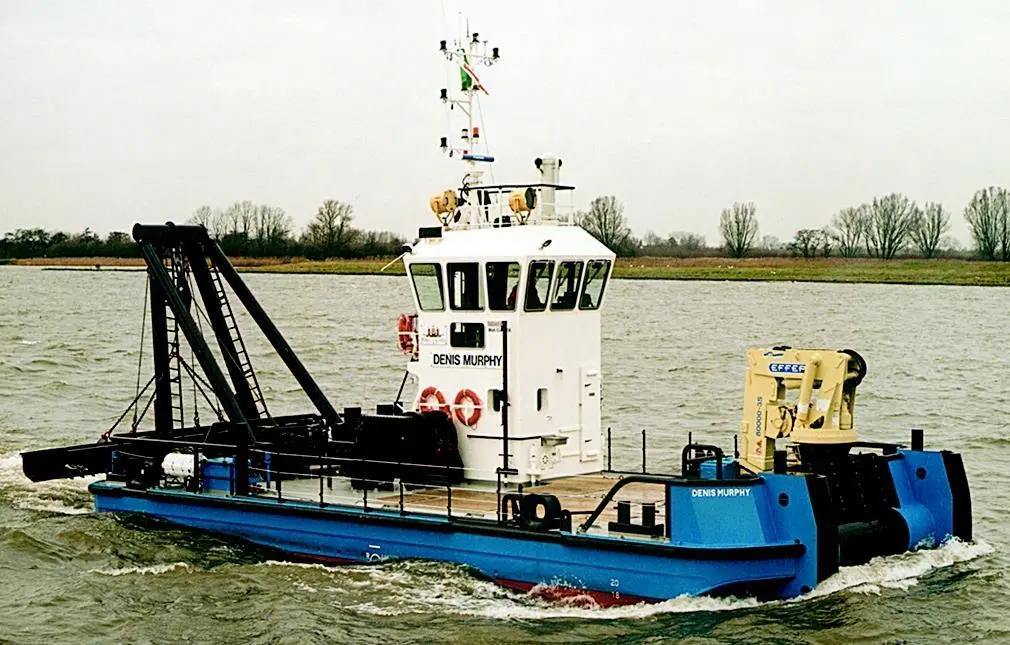
Two recent orders illustrate perfectly the scope available to port authorities and specialist maritime contractors engaged in harbour maintenance. Typical of dozens of vessels delivered to port authorities around the world is the DENIS MURPHY, a Damen Multicat 1908 delivered in January 2005 to the Port of Cork Company in Ireland. The main operational roles are described as: Towing, plough-dredging, buoy and anchor-handling. A vessel of 18.85 metres in length, it has a beam of 8.36 metres and a draft of only 2.32 metres. With a displacement of some 216 tonnes there is adequate buoyancy for lifting over bow and to operate with a crane and heavy-duty towed plough. The work deck has been kept aS clear as possible by offsetting the wheelhouse and simple superstructure to port. Although DENIS MURPHY meets the class requirements for Coastal Service, crew accommodation is configured mainly for use as a ‘day boat’.
A pair of Caterpillar main engines produce a total of 960 brake horsepower (bhp) to power twin propellers rotating within fixed nozzles. This arrangement gives the vessel a useful bollard pull of 12.4 tonnes, quite adequate for towing the 8 metre-wide heavy duty plough and barge handling. Lifting capacity is an important factor in this vessel and the winch and crane fitted have been selected to enable maximum use to be made of the crane and bow roller. Buoy handling can be accomplished by means of the crane, capable of lifting 9.5 tonnes at a reach of 8.34 metres. If necessary buoy sinkers or moorings can be dealt with by lifting over the bow, using the 20 tonne anchor-handling winch.
Such a vessel, built to a standard design and built using modern series production methods, is a relatively inexpensive option in terms of capital expenditure and running costs. Versatility is an important aspect for most operators and to a large extent, this is governed by the level of equipment installed.
A DIFFERENT APPROACH Jersey Harbours in the UK Channel Islands have taken a different approach and are about to take delivery of a sophisticated new flagship, a 26 metre Damen Shoalbuster tug designed to undertake a wide range of duties. The new vessel replaces the 33 year-old tug DUKE OF NORMANDY, built for towage and general port maintenance duties in 1972. The new vessel is destined to bear the same name and intended to transform and extend the services undertaken by Jersey Harbours. With four times the power of the earlier tug, the new vessel is one of the new generation of Damen Shoalbuster 2609 vessels with a good towing performance and a wide range of facilities for lifting and dredging with a towed plough. A twin-screw shallow draft vessel of 26.02 metres with a beam of 9.10 metres, the tug will be fitted with two Caterpillar 3508B TA main engines producing a total of 2,200 bhp. In keeping with other vessels of its type it will have a powerful 140 tonnes/metre hydraulic crane, a large clear working deck, stern roller and bow thruster.
The new DUKE OF NORMANDY will be capable of assisting the new breed of large ferries to berth in bad weather and deal with emergencies such as drifting vessels and oil pollution around the Channel Islands. With its shallow draft, the tug will be able to approach casualties in danger of grounding to make a towing connection, unlike larger tugs from France and the UK that are often of limited use in the shallow local waters. Major savings are expected, particularly in the maintenance of buoys and seamarks, dredging and general port maintenance tasks. Equipment will be fitted to enable the vessel, using her crane, to lift and replace buoys and their sinkers much more efficiently than before. During buoy handling and similar operations the new tug will use substantially less manpower and obviate the need to hire in resources from Trinity House and elsewhere. The tug is also expected to earn revenue by carrying out charter work and similar tasks for the other islands.
Using the tug to carry out dredging is expected to result in a decrease in the frequency of major harbour dredging operations. The towed plough will enable bed levelling and silt to be moved out through the harbour entrance. It is anticipated that the need to dredge St Helier harbour will be reduced to every 15 years instead of the present 10.
On announcing the order Deputy Harbour Master Captain Peter Moore said: “When we went out to tender some 13 yards approached us but it was not difficult to choose the Damen proposal. The Shoalbuster is a tried and proven design and so 95 % of the new DUKE is virtually off the shelf, saving us both time and money. Some crew retraining and familiarisation will be carried out, initially at the Damen yard and local shipping companies Commodore and HuelinRenouf have readily agreed to co-operate with us in practising berthing large vessels.”
The Duke of Normandy is due to be delivered to Jersey Harbours in June and will be displayed at the ‘seawork’ event in Southampton.
Damen arranged to take the existing tug in part exchange and a buyer has already been found in Ireland.