
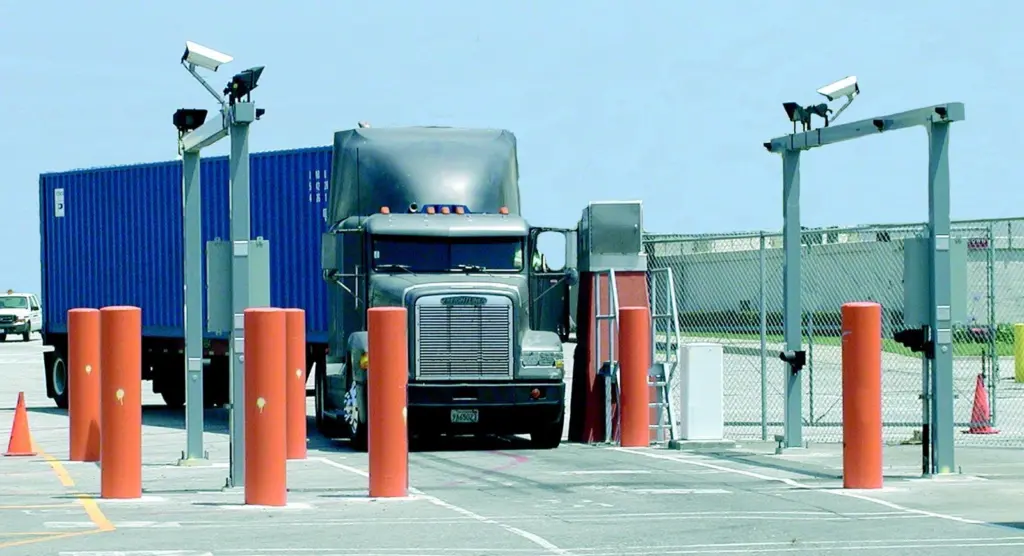
As seen in the previous article, the era of the gate tallyman manually logging box numbers and vehicle license plates is most certainly coming to an end. Following breakthrough agreements with organised labour on the US West Coast, automation of procedures is here to stay and becoming ever more widespread.
San Diego-based APS Technology Group (APS) claims to have more automated terminal systems in place than the rest of its competitors combined. This includes having supplied equipment for the world’s largest automated gate system which is operated by APM Terminals at Los Angeles. The Pier 400 Marine Container Terminal which opened in 2002, has an integrated OCR system capable of automatically capturing 5,000 container, chassis and license plate numbers each day. This information is then forwarded by XML to the Navis Express Terminal Operating System.
Previously this task was undertaken by eighteen seated clerks who used remote cameras to access the relevant numbers which were located on three different parts of the truck. Now, just eight clerks monitor the 56 entry and exit lanes, saving APM Terminals US$1m a year. Not only are trucks nowadays processed more rapidly, but accuracy levels have been improved too, while system redundancy ensures virtually all information can be gathered in most ambient conditions.
APS’ chief technical officer, Lee Scheppmann, claims that terminal operators active on the US West Coast are looking at a full return on their investment in a period of months, given the high level of labour rates being paid there.
According to his brother, APS CEO Russ Scheppmann: “An ROI is definitely achievable in less than 12 months. An ROI of more than a year would be too long for some of these terminals. On average, we would cite a figure of between 10 and 12 months, although we are aware of cases where the initial capital investment has been recouped in as little as eight months.”
Lee Scheppmann stresses that this would be for terminals adopting purely OCR technology and that ROI figures being quoted here are not claims being made just by APS, but are the direct result of feedback from the terminals themselves.
Indeed, the two brothers are able to explain in some detail how such ROIs are possible. A basic marine clerk employed by a West Coast terminal would not untypically be on a salary of around US$150,000. Many terminals nowadays operate a three-shift pattern, meaning that filling one post involves total salary payments in the region of US$450,000 per year. So, in a terminal able to reduce from 20 to 8 the number of clerks on one shift, a headcount saving of 36 clerks a year becomes possible. In that kind of situation, the Scheppmann brothers calculate that an ROI would be achieved within 3-4 months!
“When the TransPacific Container Company (TraPac) introduced pedestals at its terminals, they saw a return within three months, ” says Lee, noting that each pedestal would cost no more than US$75,000 to buy.
John Rosen, director of product marketing of Santa Clara (California)-based WhereNet Corp, is broadly in agreement with the Scheppmann brothers. He stresses that it is not beyond the stretch of imagination for a freight terminal adopting a positional location system based on low-powered active radio frequency transmitter (RFID) technology to make a return on investment within 12 months of operational switch over. Nevertheless, he concedes that, on the US West Coast, even with new agreements in place, labour issues tend to mitigate against such fast returns.
However, he views the three-year ROI cited by Ed DeNike for SSA Marine’s Pacific Coast terminals as probably being at the “conservative end” of expectations.
“Active RFID technology gives a container terminal so much more functionality than a pure GPS system does, all of which means that it is easier and faster to generate a return on the initial capital outlay, ” says Rosen, noting that APL terminals on the West Coast have also adopted WhereNet technology, albeit with a slightly different functional application to that in use by SSA Marine. Here, containers are primarily stored on chassis, all of which are equipped with WhereTags. So, by associating containers with individual chassis, the location of every box can be easily monitored using the tags.
Rosen is perhaps uniquely placed to appreciate the operational improvements that WhereNet technology has brought to SSA Marine, given that he was previously an employee of that company’s IT subsidiary, Tideworks, which developed the terminal management systems nowadays in use at SSA terminals. Indeed, WhereNet’s own software effectively interfaces with those systems, with Rosen emphasising the ease with which it can also be integrated into virtually any other terminal system.
“While SSA Marine has decided to place its OCR and WhereNet readers in specially designed portals, this is by no means the only way in which these devices can be used. They work just as well when placed externally on poles, ” he stresses, explaining that this additional protection was added for reasons of security.
When quizzed as to the overall accuracy that terminal operators should expect of an automated gate system, Rosen says that achieving 100% is perhaps currently an unrealistic aspiration. He cites a reasonable goal of 99.9%, which would give one misread for every 1,000 gate movements, well within tolerance levels.
Nevertheless, while acknowledging that a switch from a joint OCR/WhereNet system to one where identification of both vehicle and container is undertaken using active tags would be feasible, the industry has a challenge in coordinating widespread implementation of the tags. He points out that active tag-based yard tracking using WhereTags generates only minimal daily running costs and that it was incumbent on the industry itself to demonstrate its faith in this technology through broader implementation.
“We believe that virtually any size of container terminal can achieve a significant return on investment by switching to WhereNet technology. However, we have to remember that restrictions on investment may mean that operators prefer to commence automation on their largest terminals, since this is where the biggest savings can be made, ” points out Rosen.
He dismisses suggestions that, in a fast moving industry, equipment being sold in by WhereNet might perhaps be considered as “disposable”. Indeed, he notes that WhereTags and readers should be seen as having life spans in the region of at least five to seven years.
Finally, while Rosen concedes that perhaps the major benefits from adopting tag- rather than GPS-based terminal automation systems come from terminal-wide applications, WhereNet technology can also confer real benefits even when use is simply confined to the gate, where the logging of trucks and containers can be achieved through the placement of a pair of antennae, with the caveat that such a system would not aim to obtain real-time location tracking.