Prior to the bidding deadline, the port authority intimated that there were in the region of a dozen parties prepared to bid for the concession, either alone or as part of consortia. In the event, just three bids were submitted. Two of these came from the port’s established box operators, TCB and Tercat; the former bid in isolation, while the latter did so in partnership with Hutchison Port Holdings (HPH). The other bid came from P&O Dover Holding (effectively DP World) in conjunction with French shipping line CMA CGM.
Significantly, terms and conditions governing the concession effectively predicated against organisations trying to secure the award on financial grounds alone. DP World’s bid, in this respect, was rumoured to be significantly higher than that tabled by the other two.
The financial aspect, however, only counted for 30% of the points awarded during the assessment process. The remaining 70% depended heavily on future throughput guarantees and, crucially, on the overall operational system chosen. It is these last two conditions that almost certainly scared away other international stevedoring groups and all but one of the shipping line operators originally courted.
The throughput guarantees demanded by the port authority are onerous. Given that all the various terminals at the port of Barcelona handled a combined 1.916m TEU last year, the new terminal alone will have to guarantee a minimum throughput of 1m TEU after five years in operation, increasing by 5% year-on-year thereafter. This coupled with challenging productivity benchmarks will almost certainly result in some form of automated yard operation having to be adopted, claim industry sources, especially since costly, employee-controlled stevedoring cooperatives ensure that labour rates remain ridiculously high.
In performance terms, it is known that the standards set out in the concession documentation are near ground breaking in European terms and as such meeting these would also have proved a particular concern to a number of potential bidders. Achieving what has not been achieved before in other European ports on a regular basis is obviously a potential cause for concern, particularly if penalties kick-in when the stipulated standards are not met.
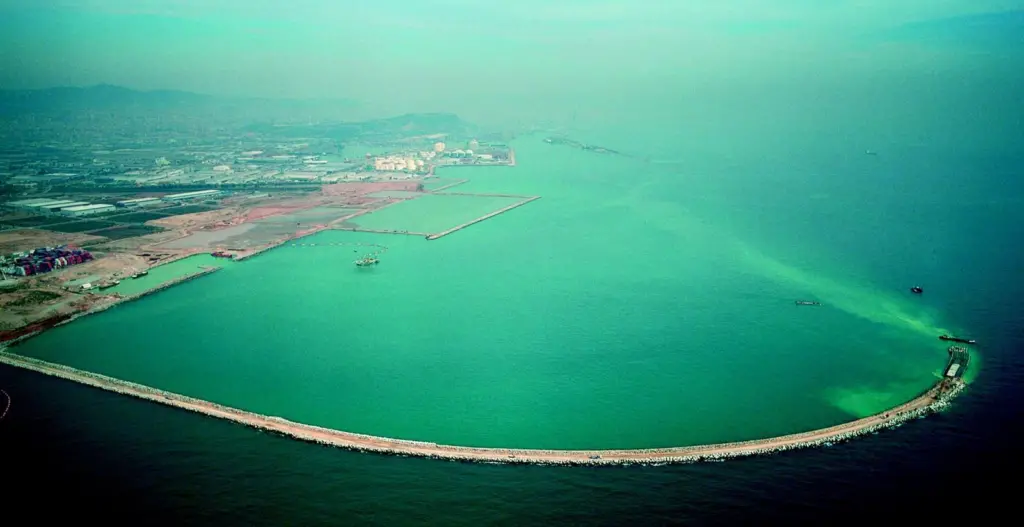
TCB moved quickly to secure its own advantage via a multi-pronged strategy. First, it was able to field a written undertaking from six of the ten leading shipping lines to increase traffic at the port if it was awarded the concession. Second, it announced a ?550m investment plan for the new terminal with this including expenditure of ?345million on new cargo handling equipment, ?180m on civil works and ?25m on I.T. systems. Third, it declared its intention to create a joint venture company with Tranfesa, a logistics operator, in order to increase rail’s market share of the total containers moved inland to/from the port of Barcelona up to a level of 23%. Establishing six major rail services underpins this idea, three of them international, to enlarge the area of influence of the port to the south and centre of Europe as well as increase traffic between the port’s hinterland and North Africa.
THE “CASCADE” ISSUE To prevent a near monopoly in box handling being established, no operator was allowed to control more than one container terminal in the port. However, if neither TCB nor the Tercat/HPH bid had been successful then the port would have been effectively left with three competing container terminals. While on the face of it this sounds like a good option, in fact it would be a disaster for the port.
The problem lies in the location of Tercat adjacent to Barcelona’s two new vehicle terminals, Setram and Autoterminal. Business in the car sector is booming and the Tercat site is needed to enable further expansion to go ahead. However, had Tercat/HPH not won the concession for the El Prat Quay, then it would have been within its rights to keep operating on its existing site for ten more years. The only place Tercat could be relocated to was the existing TCB container terminal if it had been this company that won the El Prat concession.
In the event, the problem was solved by the award to Hutchison/Tercat – an outcome forecast by various industry insiders.