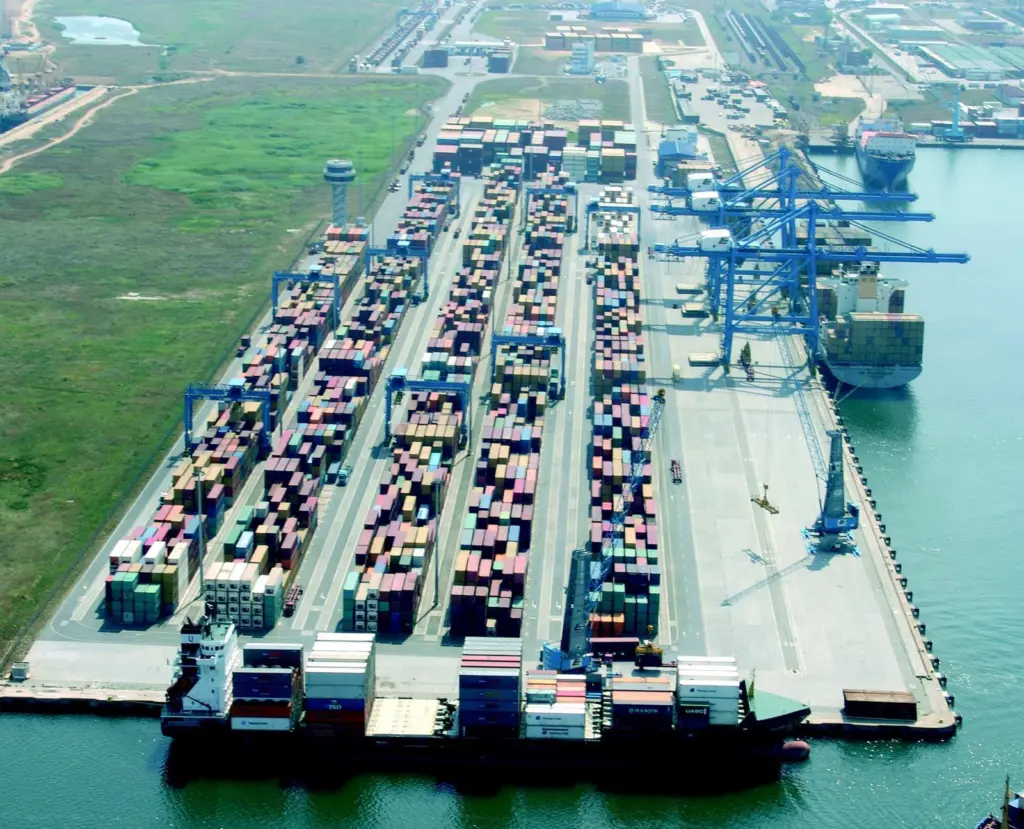
Of all the ports serving the Black Sea area, Constantza, in Romania, has carved out an important role as the region’s main hub port. In part, this has been due to the setting up of Constantza South Container Terminal (CSCT), nowadays part of the DP World empire. This facility alone reported a 450% increase in container traffic last year on reaching 585,535 teu. Of this, 178,591 teu was essentially import/export traffic, while the lion’s share, 406,944 teu, came in the form of transhipment boxes.
According to commercial manager Raluca Daraban, the main reasons for the huge increase in last year’s traffic was the staggering growth in transhipment volumes. “A whole raft of new services started at the end of 2004 and at the beginning of 2005, which resulted in major increases in transhipped boxes flowing through into the Black Sea market. In this respect, we saw a lot of additional containers being shipped into the Ukraine from here. This is because the Ukraine reduced its import dues as result of that country’s negotiations to join the WTO.”
For the current year, throughput is projected to reach 850,000 teu, with, according to Ms Daraban, additional business already secured. This is in the form of both increased local traffic and extra transhipment boxes, with several newcomers to the region offering both mainline and feeder services.
To handle the enormous increases in traffic, CSCT has already started a major expansion programme. An additional 40,000 sq m of land will have been brought into operational use by the end of October upping overall capacity to almost 1m teu. Five new RTGs are scheduled for delivery by early July, while two more super-post panamax twin-lift gantry cranes are on order from ZPMC for delivery in July 2007.
Despite the brutal hike in recent traffic, CSCT still claims a current average productivity of 25 moves-per-crane-hour when deploying gantry cranes and 18 moves on mobile harbour cranes. Ms Daraban cites a recent best of 35.75 gross hourly moves per crane when working on the MSC Vienna, which equates to berth productivity of 104 moves per hour. In all, 2,666 moves were undertaken and the ship despatched in 26.92 hours.
“No other competitor in the region has comparable productivity, ” insists Ms Daraban. “Socep, which handles CMA CGM’s Far East mainline service here in Constantza, only reaches 18-20 moves-percrane-hour, while the best ports in the Ukraine can achieve is 17-18 moves.”
Understandably, given the huge rise in transhipment business, CSCT has witnessed a significant increase in feeder calls. However, these are not necessarily connected to operators of Far East mainline services, but rather companies serving different Mediterranean hubs, such as Malta, Port Said and Gioia Tauro.