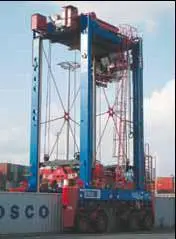
The repeated movement and lifting of heavy containers requires constant deceleration and acceleration by the straddle carriers. The NSC 644 E ECO is not just capable of storing energy from braking in the drive system (in the same way as a dynamo mounted on a bicycle). The completely new feature is ECOCap technology that receives and briefly stores braking energy. 200 double-layer condensers can cover the immediately ensuing energy requirement before the diesel electric generator again resumes full output. So the SC moves and lifts with a hybrid drive that consumes considerably less diesel fuel. The CTT terminal is a pioneer in the use of energy-saving SCs. Germany’s first such vehicles with diesel-electric propulsion, for instance, are in service at Tollerort and today constitute the bulk of the fleet at this Hamburg container terminal. The Noell SCs emit only around 380 kilograms of carbon dioxide per shift, whereas the older conventional SC deposits a carbon footprint weighing around 550 kilograms. Should the operation of the NSC 644 E ECO prove as satisfactory as expected, then its ECO-Cap technology will reduce the CO2 emissions of every new SC by almost 25,000 kilograms per year. These jumbo vehicles emit around 40,000 tons of carbon dioxide a year at HHLA and are therefore amongst the group’s largest emitters. With the use of diesel electric straddle carriers HHLA reduced CO2 emission ca. 6,500 tons p.a. ECO-Cap technology offers users the following advantages: – A further considerable reduction of the low fuel consumption of the diesel-electric Noell Straddle Carrier due to power management combining variable diesel rpm with direct drive units – As a consequence of reduced fuel consumption, CO2 emission is also significantly cut. Anticipated fuel savings of some 2 litres per hour in operation correspond to a reduction in CO2 emissions of 265,000 kg during the operating life of a straddle carrier. – The drive components, especially the diesel engine, are operated more gently and hence under less strain. This leads to an increase in operating life and a reduction of soot emissions and hence of fine particle pollution. – A beneficial side-effect is a reduction the vehicle’s noise emission