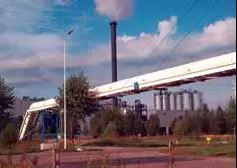
After Rotterdam and Amsterdam, the Port of Moerdijk is the fourth largest seaport in the Netherlands in size. The Port of Moerdijk is situated near the Port of Rotterdam and is the most inland-sited port that can be reached by sea-going vessels. The port and industrial area measures about 2,400 hectares and houses about 400 companies, among others, in the fields of chemistry, metallurgy, distribution, logistics, energy and recycling. Each year, about 2,000 sea-going vessels (short sea) and 10,000 inland navigation vessels dock at the Port of Moerdijk. A total of about 15,000,000 tons is stored and transferred annually. From a geographical point of view, the seaport lies hemmed in between three residential areas. With regard to the environment, this complicates managing and exploiting the port. A strategic outlook to the future is therefore very important: economic development versus the environment and surroundings (unlinking). Moreover, an agreement has been concluded with government parties and long-standing companies (collaborative venture: Sustainable Port and Industrial Estate Moerdijk DHM). On the basis of a prepared working programme 2007-2010, the sustainability of Port and Industrial Estate Moerdijk will be achieved.
Your waste – my raw material
The Dutch province of Noord-Brabant has designated the Port and Industrial Estate Moerdijk as an ‘Experimental Garden’, in which actual measures are pursued within the full scope of sustainability, which means in the fields of People, Planet and Profit. In this respect, the Moerdijk Docks Board has devised a plan with the established trade and industry to encourage industrial symbiosis in the seaport and industrial estate as much as possible. From an assessment, more possibilities have appeared, apart from the existing ‘sustainable linking’ in which residues from one company are incorporated into the production processes of other companies, proceeding from the principle ‘Your waste – my raw material’. Thus, 2 million tons of high-pressure steam can be converted into electricity. This implies about 587 million kWh, which equals the consumption of 168,000 households. Organic residual products (e.g. 3,500 tons of leftovers) can be used to generate green current by fermentation. Thus, 1 MW of green current is generated per hour. This yield is enough to provide about 2,500 households with electricity.
CO2 symbiosis
Incineration sewage sludge and re-use CO2
The Company NV Slibverwerking Noord- Brabant of Moerdijk processes sewage sludge proceeding from sewage works (about 95,000 tons of dry matter per year). During the incineration process, carbon dioxide is released. The company Omya Beheer BV can re-use that CO2 for the production of calcium carbonate (whitener/ pigment for the paper industry). Thus, an average of 50,000 tons is not emitted but re-used. The investment costs of this ‘CO2 Symbiosis Project’ amount to approximately €3 million. CO2 emission decreases on average by 50,000 tons (or the annual emission of the inhabitants of the municipality of Moerdijk). The Symbiosis Project serves as an example for synergy projects between companies. There are numerous business parks/harbour areas where similar links could be made, if desired.