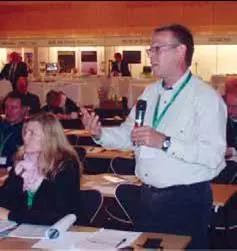
The cold weather that greeted delegates in Stockholm on 23 February 2010 was in marked contrast to the warmth of the greeting from the City and Ports of Stockholm. Our welcome in the Stockholm City Hall was memorable. Patrick Hicks, GreenPort 2010 Conference Director, opened the event on 24 February, asking delegates to take the opportunity to examine issues together and share expertise. Ulla Hamilton, Ports of Stockholm Chairman and Stockholm’s Deputy Mayor opened the conference. As Europe’s first Green Capital, it was fitting that Stockholm should host the event. Henrik Widerstahl, Ports of Stockholm CEO, stressed the importance of collective solutions to create clean and sustainable shipping.
Keynote speakers
Gun Rudeberg, Ports of Stockholm, welcomed the keynote speakers. Swedish Secretary of Trade, Gunnar Wieslander, reminded us that, 30 years on from the 1972 Stockholm Climate Conference, there was still much to address to combat climate change. He welcomed the platform the conference provided for exchange of good practice. Benny Guttman, Volvo Logistics SVP, opened his presentation with a reminder that ‘Good planets are hard to find!” As transport costs and CO2 considerations rise in customers concerns, Volvo Logistics has an ambitious target to reduce CO2 from road transport by 50% by 2020. Networking and collaboration to develop and deliver smart solutions are key ingredients and ports must play a vital part in this.
Combating Climate Change
Combating climate change is one of the port sector’s biggest challenges. The session’s speakers agreed that collaboration between stakeholders is key to making progress. Fer van der Laar provided an update from the World Ports Climate Initiative (www.wpci. nl). Tony Mason from the International Chamber of Shipping and Carl Carlsson from the Swedish Ship Owners Association emphasised the urgency of global regulation on shipping’s CO2 emissions and on ongoing initiatives such as energy efficiency. Quayside Onshore Power Supply can be an option. Susann Dutt (Port of Gothenberg) launched the WPCI OPS website (www.onshorepowersupply.org).
Henrik Kristensen, Head of CSR at APM Terminals shared their progress in carbon management and developing cooperation between Terminal Operators in the TOCOFO carbon footprinting group.
Green Initiatives: Port Authorities
Ports are increasingly at the centre of climate change initiatives. Peter Barham chaired a session reviewing some of these which included developments at the Ports of Stockholm (Gun Rudeberg) and the Ports of New York and New Jersey (Richard M. Larrabee). Organisational responsibility for sustainability and an environmental management system are an important starting point. The ESPO PPRISM project (Antonis Michail) to develop sustainability indicators may support future benchmarking. Ports must address their own operations. Energy efficiency initiatives and improving greater efficiency and effectiveness through ‘The Nautical Chain ’ (Capt. Ben van Scherpenzeel) are examples.
Ports are also “enablers” for others. These include supporting the development of sustainable land and seaward access and multi-modal options to and from the port. Incentive instruments are valuable in shaping behaviour such as port due structures for waste and fuel use; and participation in schemes such as the Green Ship Award (Jan Fransen) and the Environmental Ship Index (Fer van der Laar). Port tenants such as Terminal Operators can be influenced through environmental conditions in Lease Agreements (Prof. Theo Notteboom). Developing a Strategic Action Plan with targets agreed by relevant stakeholders can help prioritise goals (Sian John) and keep ‘ducks in a row”. This may include an aim to become Carbon Neutral (Jonathan Shopley). A key message from many of the speakers was the importance of measurement for control and improvement. It’s clear that much is going on!
Biodiversity and Natura 2000
Patrick Verhoeven (ESPO) chaired a discussion on the stakeholder process being facilitated by the European Commission. This is working to help resolve conflicts between the Birds Legislation and Habitats Legislation and the demands of port and marine business. Jose Fernandez Garcia (EC) provided an update on the ‘Working with Nature’ Guidelines and Technical Document to be published shortly. Resianne Dekker (Port of Rotterdam) stressed the need for greater legal certainty for businesses on when they have “done enough” to comply. Roger Morris (Bright Angel Coastal Consultants) emphasised the importance of a peer review by marine specialists and the danger of a ‘one fits all’ approach to diverse and dynamic coastal systems.
Vasa Museum
An intense and worthwhile first day was concluded with an exceptional evening hosted by the Ports of Stockholm, including a tour of Stockholm’s Vasa Museum, a wonderful dinner, which incorporated the now traditional “GreenPort toast” under the table, aimed at underlining the importance of inter-delegate collaborative discussions.
Inland Ports
Inland Ports have an increasingly important role in supporting seaports and the developing intermodal networks. Opening the second day, Isabelle Rykbost (EFIP) introduced three examples. Ghent in Belgium (Daan Schalck) with its extensive industrial base and good modal connections acts as a decongestant hub for Zeebrugge, Antwerp and Rotterdam into the French hinterland amongst others.
The Mantova region in Italy (Gabriele Negrini & Dario Aggio) will benefit from construction of new canal sections providing links from the Adriatic ports to Milan. Magdeburg in Germany, (K. H Erhardt) has developed links with Hamburg. They are working with other German hinterland ports to market themselves as a Waterways System. All agreed there can be advantages from being relatively small and flexible in meeting customers changing needs.
Innovation in Port Equipment Technology Solutions and Renewable
Energy Innovation in port equipment to drive improvements in energy and operational efficiency is critical for meeting the needs of the low carbon Ports and Terminals of the future. Henrik Kristensen (APM Terminals) chaired an insightful session showcasing the latest technological developments. Presenters included ABB AB Crane Systems, Bromma, Conductix-Wampfler, Gottwald Port Technology, Konecranes Lifttrucks, Siemens, Castrol Oil and Greendoor Logistics. Peter Nymann from the Port of Hanstholm in Denmark also outlined exciting feasibility work to incorporate wave energy into the breakwater of their port extension. With supporting wind energy it could become a zero energy port.
Green Shipping Initiatives
Bogdan Oldakowski (Baltic Ports Organisation) chaired an interactive session with a Baltic flavour. Joreon Dagevos (North Sea Federation) introduced the Clean Shipping Concept and Index. CSI helps cargo owners assess the ‘cleanness’ of their transport carriers. Jan Fransen from Green Ship Award (GSA) proposed discussion on collaboration between CSI, GSA and other relevant ‘index’ schemes. The merits of the IMO regulations on fuel sulphur content within the Baltic SECA saw lively debate (AirClim). A level playing fi eld is viewed as key. The European Shipping Council (Alfons Guinier) and European Cruise Council encourage ports to provide appropriate waste reception facilities at the right price to avoid dumping; and in return they will ensure the right level of onboard training. Impending Ballast Water Management regulation was also reviewed (Stelios Kyriacou).
ESPO/EcoPorts Environmental Review
Cardiff University’s Chris Wooldridge and Antonis Michail (ESPO) presented the ESPO/EcoPorts 2009 environmental review results, which were received very positively by the port sector and stakeholders. The review provides substantive evidence of the sector’s progress towards the key aims of raising awareness, sharing knowledge and implementing Environmental Management Systems. The results confirm the positive trends of port management response options in dealing with their liabilities and responsibilities and in terms of delivering continuous improvement of environmental quality and sustainable development. These have been achieved by organizational initiatives focused on monitoring, cost reduction, risk analysis and environmental reporting. The main results of the survey can be summarised as follows:
• global, headline issues including climate change, energy consumption, and stakeholder involvement join the list of priority environmental issues of significance identified in the latest port sector environmental review;
• noise, air quality and waste management lead the ‘Top-Ten’ environmental priorities just ahead of operational activities such as dredging and port expansion;
• the European port sector can demonstrate continuing progress and positive trends in terms of its benchmark performance on such critically important issues as implementation of environmental policy, management, monitoring of environmental improvement and systematic reporting. The executive summary of the results is available from the ESPO website (www. espo.be)
EcoPorts Honours its “Founding Father” Herman Journée
European ports at GreenPort 2010 honoured EcoPorts Chairman Herman Journée (Port of Amsterdam) for his achievements and the substantive contribution that he has made through his dedication and tenacity to the goals of sustainable development of port operations. Presenting the honorary certificate, EcoPorts Board Member and former ESPO Chairman David Whitehead said: “European ports pay tribute and record with grateful thanks their appreciation of Herman’s determination and guidance in delivering effective environmental management through the concept of ‘ports helping ports’”. The EcoPorts concepts and aims, initiated in 1993, have delivered demonstrable success in implementing major policy objectives through the knowledge network and application of practicable tools and methodologies. ESPO recommends that port authorities use these well established tools in their efforts to deliver environmental improvement and sustainable development through effective environmental management programmes. From 1 January 2011 onwards the EcoPorts environmental tools and support services as well as associated R&D activities will be fully integrated within ESPO’s functional structure. This will extend the EcoPorts network to all ESPO members.
GreenPort Study Tour
The GreenPort 2010 study tour was very successful with participants from all over the world. They expressed thanks to their Scandinavian and Baltic hosts and looked forward to integrating lessons learnt back home.
GreenPort in 2011: GreenPort Congress, Hamburg & GreenPort Logistics, Venice
The 2011 GreenPort congress will take place in Hamburg on 14 & 15 September 2011. It will comprise the main GreenPort 2011 conference, together with GreenPort Cruise and GreenPort Safety. The Port of Hamburg’s CEO Jens Meirs launched this event. Earlier in the year, the port of Venice will host GreenPort Logistics 2011, focusing on the role that ports will play in “greening the logistics chain”. The event, which will be combined with the Energy for Green-Ports event, was launched by the Port of Venice’s Emanuele Zanotto, and will take place on 24 & 25 February 2011.
Conference Summary: Charting the Way Ahead
Chris Wooldridge rounded off proceedings with a lively discussion between expert panellists and delegates. The importance of prioritising pressing environmental needs was agreed whilst also securing the future economic success of ports. Addressing climate change and a focus on carbon management and energy reduction are critical. Continued collaboration with more transparent co-operation globally was considered essential. One team, shared challenge!
Closing Remarks
The Conference was closed by Jose Fernandez Garcia from DG TREN Maritime Transport, European Commission. He concluded it had been a valuable event, not to be missed, and looked forward to GreenPort 2011. Nicola Jenkins from the Port of London Authority: “As usual this has been a welcome opportunity to recharge my environmental batteries!”