This subject has arisen in the pages of MJ several times over the past year or so and those reports illustrate the wide variety of remedies being pursued by tug owner, designers and specialist shipbuilders.
In every case tug owners have realised that a first step is to study in detail the operating profile of the tugs in their respective fleets. In the shiphandling sector very few of the tugs employed use their full bollard pull for more than a very small percentage of their operation cycle. It has also become obvious that substantial savings can be made by fuel monitoring and consequent fuel saving measures, and by using shore power when the tug is alongside. The arithmetic is obvious, less fuel equals lower costs and lower emissions. With that as a starting point, other measures can be incorporated to lower emissions further.
The positive action considered by major operators ranges from purpose built hybrid tugs using advanced diesel-battery-electric solutions, to proposals for LNG and fuel cell powered propulsion systems.
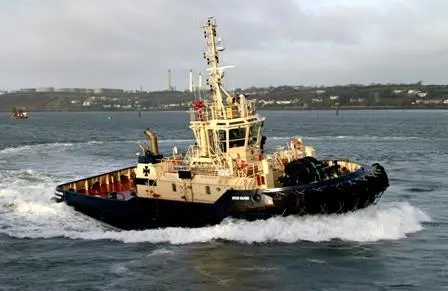
It is interesting therefore to report that one of the world’s largest providers of towage and marine services, Svitzer, has announced its intention to construct its first ECO tugs. With a global fleet of approximately 300 vessels, Svitzer, part of the A.P. Moller – Maersk Group, has ordered two new environmentally friendly tugs as part of its plan to reduce the company’s environmental footprint. The company has, as part of its environmental plan, set a CO2 reduction target of 1% each year through the years 2008-2012. To achieve that, Svitzer’s environmental plan focuses on three elements: a fuel efficiency program, the use of alternative fuels and this new tug design.
Svitzer has worked with its subcontractors for two years to develop the new ECO tug design. The two new tugs will be built in the Baltija Shipbuilding Yard in Lithuania and will be built to a design evolved from the current Svitzer ‘M’ class of 30m ASD shiphandling tug. Three individual diesel-electric generators will provide electrical power to the azimuthing propulsion system. The vessel will only use a single engine when cruising or lying idle in a port, but power can be increased by using two or all three engines when additional power is required during shiphandling operations. Additional features of the new design include improved insulation and towing electric winches. It all adds up to an expected 10% reduction in fuel use and emissions and a NOx (nitrogen oxides) reduction of 70 to 80% per vessel, thus meeting the IMO Tier III requirements.
Announcing the order for two ECO tugs, Svitzer CEO Jesper T Lok said, ‘The tugs cost around 50% more to build than regular tugs but Svitzer believes it will be a worthwhile investment. The technological solution is now acceptable but we intend to keep developing the technology and we will hopefully also reach a more cost friendly solution. Even though the ECO tug is more expensive we believe it will be a success and that ‘going green’ makes good business sense. We expect that especially terminal towage tenders increasingly will insist on environmentally friendly solutions and that it will emerge as a demand also from several port authorities. We ventured into unknown territory with this project. We have had to invent the technology ourselves, but our cooperation with tried and tested suppliers has been very fruitful. Siemens will deliver the electrics, Schottel the azimuth thrusters and Wartsilla is responsible for the main engines, the Selective Catylitic Reduction (SCR) equipment, and the particulate filter.’
More ECO tugs will be joining the Svitzer fleet as part of its fleet renewal, and Jesper T. Lok is confident that in 10 years the fleet will have more than 20 environmentally friendly vessels.