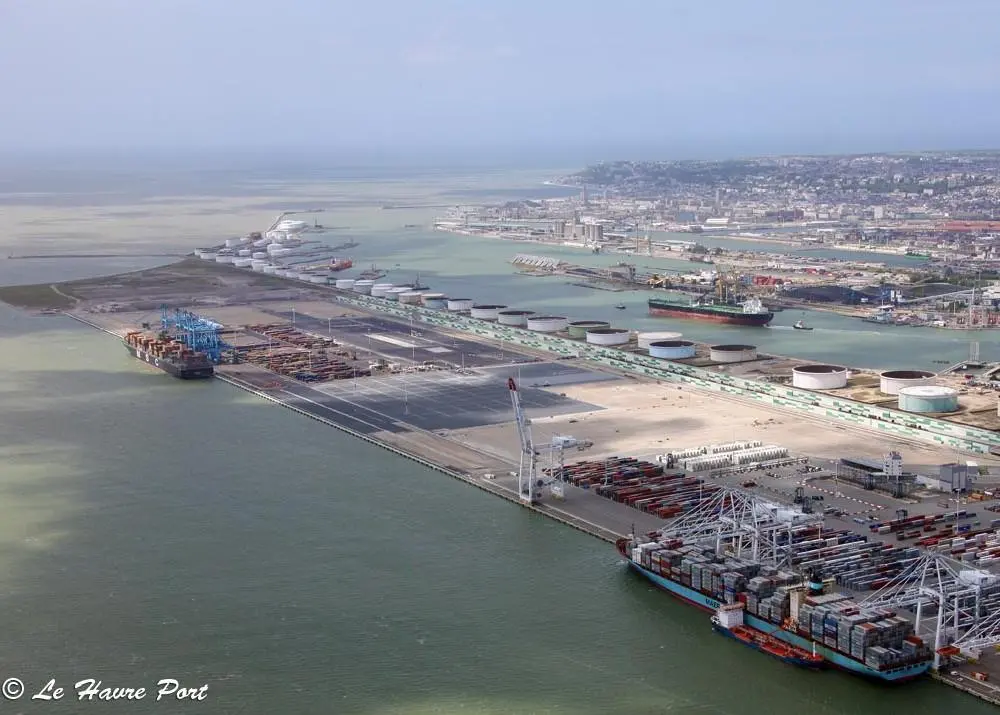
In Le Havre, air-quality issues relating to all the industrial and port business are subject to a particular follow-up through a plan called the Air Protection Plan (PPA in French) approved by the Regional Prefect.
In this context, the port authority is involved in:
– Monitoring of emissions due to cargo-handling operations
– Monitoring of ship emissions and their contribution to overall pollution
– Reduction of emissions of Volatile Organic Components during off- or on-loading of ships
“Air Normand“is a local network in charge of monitoring air quality and forming part of 39 associations approved by the French Ministry for the Environment. The Port of Le Havre Authority is a member of the board and financially contributes to the association which measures all the pollutants emitted into the atmosphere, and especially carbon dioxide (CO2), sulphur dioxide (SO2), nitrogen dioxide (NO2), and particulate matters (PM).
Regarding river and maritime transport, as shown below, it contributes to nearly 3% of the local GHG emissions:Graph 1 River and maritime traffic emissions (sulphur + NOx) account for the second pollution source in % but are very low in volume compared to the global air pollution.
Graph 2
Graph 3
For more than 20 years now, air quality has considerably improved in the city and port owing to joint investments made by industrialists and public authorities.
Graph 4
For nitrogen dioxide, taking the example of Le Havre city, located near the maritime port, there are constant emissions and a reduction in concentration which meets the requirements of the European values which are, every passing year, more ambitious than the previous years.
Graph 5
___ Average for Le Havre city sites ___ Le Havre traffic sites ___ European ceiling value
Actions set up and plans for the coming years by the port authority of Le Havre
The port of Le Havre is one of the 55 ports which commit themselves to improve air quality during the Word Port Climate Conference which took place in Rotterdam in July 2008. The main commitments of the ports were:
– Launching a Port Incentive policy to promote clean shipping in the framework of the Environmental Ship Index
– Transport Regulation Intermodality Plan (TRIP): implementation of sets of measures to limit congestion within the port area
– Construction of a Multimodal terminal (in 2014): Less 300.000 to 850.000 tonnes of CO2 emissions per year
– Study of the implementation of Onshore Power Supply for Ro-Ro vessels
– Fostering the launch of new maritime shuttle services between French ports (example Caen-Le Havre) to lighten road traffic on these routes
– Together with actions performed by Le Havre industries, the objective of the Grenelle II environmental Law of a reduction of 3 % per year of CO2 emission is on the way.Port Authority’s building renewed in 2010: 29.8 tonnes of CO2 saved per year.
Actions in favour of renewable energiesThe attractiveness of the port of Le Havre for industrial projects within the scope of the off-shore windmill parks to be created in the region is another asset. In late 2011, the big international energy grouping, AREVA/GDF SUEZ/VINCI, selected the port of Le Havre to set up assembly firms for the manufacturing of windmill equipment for the parks due to be set up in the region. Le Havre has indeed the convenient sites to set up an industrial platform of production, assembly, trial and maintenance of windmills.
In addition, the port provides the necessary infrastructures, a draught adapted to the loading of heavy loads, important storage areas in a single place, and the proximity to the future windmill parks which will be installed along the Normandy Coast (Le Havre region), without forgetting the river Seine, a major communication artery, which will play a major role in the transport of the out-of-gauge elements, the assembly and the maintenance of the future parks. In addition, the port of Le Havre fosters the development of eco-industrial firms in its port industrial zone such as, for example, the OSILUB firm, a subsidiary of VEOLIA and TOTAL, which now completes the construction of its firm in Le Havre zone and which will recycle waste oil from engines into basic oils for the local Normandy refinery or ECOMOTION. This company will build a firm in Le Havre for the production of methyl ester from animal fats and waste food oil that could be used as additives for biodiesel oil. Lastly, they are examples of initiatives of ecological industry which meets the objectives of the French Environmental Law and provides high-performance solutions for waste management.
Carbon footprint assessments
Since 2008, Le Havre port authority has made four carbon assessments of its own activity and of its buildings and equipment. During this period, emissions have been reduced by 14 %. The main fields of CO2 savings are refrigerating fluid (prevention of leaks and reduction of losses), electric consumption, and trips of staff outside the port (using more the train or the video conference). This reduction is also due to the French port review status which created new scopes of activities for the port authority (according to the new French law). In the future, expectations of CO2 savings are focusing on new coming projects.
Graph 6