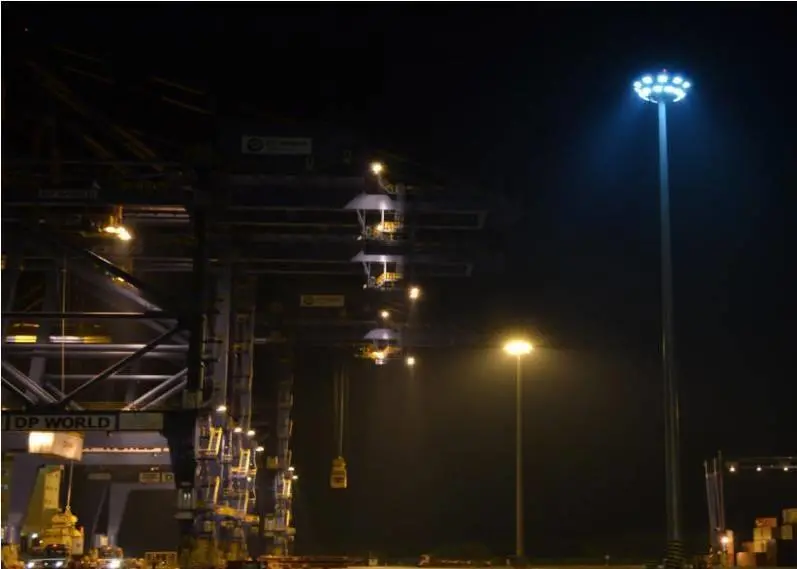
For this project, the lighting had to increase the safety and efficiency of operations during the night time cargo handling and also contribute to the image of the container terminal, which intends to be one of the most modern in the entire Asia region using “Sunlight” White LED Lighting.
The lighting installation had to reduce power usage by at least 70%, comply with strict requirements, especially in terms of horizontal light strength and uniformity, and protect itself from over voltage spikes to the towers. The lighting also had to be strong enough for the images from a high value closed circuit television to be assessed without excessive glare which could distract the truck drivers or other workers.
The choice had to be in favour of a product with a long lifecycle, with high light output and minimal light hindrance. Due to the proximity of the sea, the light fittings are watertight and resistant to corrosion, and since space is restricted in the container terminal, optimum lighting had to be achieved using the minimum number of masts.
The Port
The container port in Cochin India Cochin Port is a major port on the Arabian Sea – Indian Ocean sea-route and is one of the largest ports in India. The port lies on two islands in the Lake of Kochi: Willingdon Island and Vallarpadam, towards the Fort Kochi river mouth opening onto the Arabian Sea. The International Container Transhipment Terminal (ICTT), part of the Cochin Port, is the largest container transhipment facility in India.
The port is governed by the Cochin Port Trust (CPT), a government of India establishment. The modern port was established in 1926 and has completed 86 years of active service.
The Solution
Globaltechled chose to keep the existing light fittings which were in good working condition, and installed their patented LED inserts inside the existing fittings. Rated for over 100,000+ hours, including a 10 year warranty, this low cost strategy delivered great value to the project and provided a very quick return of less than 2 years.
A total of 126 Lumiled Chips manufactured by Philips were installed inside each light fitting using custom inserts designed especially for the existing fittings to install in 10 minutes. Twenty housings on each tower previously consumed 28kW of power. After the custom LED inserts were installed, LUX levels were maintained, white colour improved the safety and port image greatly and power was reduced to only 5.7kW, thereby delivering a staggering reduction of 22.3kW per tower, or approximately 80%.
Heat and Life
Because of the summer heat issues at the port, the existing fittings were upgraded to “Active Cooling Technology”, thereby increasing life to well over 100,00 hours, and provided the opportunity to operate the chips at high forward voltages (900Ma), thus delivering a tremendous quantity of lumens using little power without compromising longevity.
Effective Lumens
Lighting performance is important both for safety and productivity. Scientific studies over the past 15 years have concluded that general lighting with high scotopic to photopic ratios (S/P), characterised by high colour temperature lamps, provide better visual acuity. LED lighting provides for reduced visual fatigue, reduced glare, a reduction in task orientated errors, and improved human performance and safety.
With the introduction of new LED lighting technologies it is now possible to provide an ideal light source designed specifically for maximum retinal efficiency of the human eye. For the first time in the container terminal and port industry a recommendation is made to employ an optimum colour and light source that would be compatible with the physiology of the human eye.
By understanding the importance of colour for the effective functioning of visual signal lights – for example to ensure day and night identification of eyewash stations and other critical safety equipment – and the importance of CRI for optimum performance of industrial white lighting, perhaps we are opening the door to increased safety at ports.
For those ports operating in EU territory, cash incentives of up to 50% are now available to make the switch.