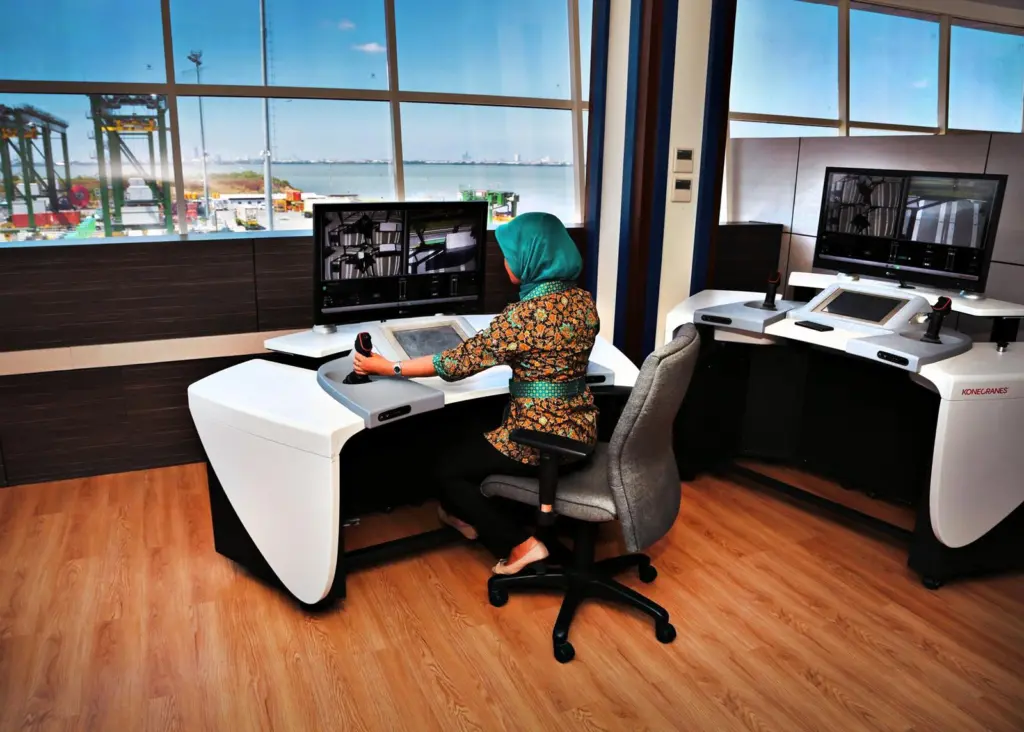
The container terminal is part of the country’s plan to improve the movement of goods through its waterways. Its automated container handling system has been provided by Konecranes and consists of 20 automated stacking cranes (ACSs), remote operating stations (ROSs) and associated container yard infrastructure.
“Lamong Bay Terminal is the next generation container terminal. Thanks to the reliability, productivity, predictability and safety provided by our Konecranes automated container handling system, we will provide our shipping line customers with uninterrupted, reliable container flow,” said Mr Prasetyadi, president director, Pelindo III. “This will be the key to build up business success in Indonesia and South-East Asia.”
In addition, the terminal is equipped with 10 Konecranes ship-to-shore (STS) cranes and five straddle carriers.
Pelindo III says Lamong Bay Terminal’s automated container handling system is “next generation” and will results in better productivity thanks to an improved ROS and graphic user interface (GUI).
Konecranes’ Active Load Control technology is also in use, with an advanced machine vision system which precisely identifies containers and container profiles. As the container approaches the target, the container profile becomes more accurate and the effects of dust and fog etcetera are said to be minimised. The system senses neighbouring container stacks from the point of view of the load, and performs canyon driving, which Konecranes says makes the automated container handling process more precise and predictable.
The Lamong Bay is said to be the first ‘green’ container terminal in the country, and will increase the port’s annual capacity from 1.5 million to 3.5 million teu. Once operational, the total capacity will be 5.5 million teu.