When ports refer to growth, they generally mean more tonnage. But the Belgian port of Ostend is taking a different approach.
“When we talk about growth, we are talking about growth in employment. That is why we want diversity. We want to invest more and ensure continuity,” says Port of Ostend chief executive Dirk Declerck.
Ostend was best-known for decades as a major ferry port, with its ro-ro links first to Dover and then to Ramsgate. The last service ended in 2013.
Today the port is better known for its role in supporting the construction and operation of offshore wind farms, through its REBO base. However, that is just one part of the overall picture, says Mr Declerck.
Ostend is in the process of reinventing itself, based on five key sectors, a new financial structure and a slimmed down board with less political influence. It has been transformed from a municipal company into a PLC and its board – previously 18 members, 11 of whom were politicians – is now reduced to 13, of which six are politicians, six are drawn from industry and science, and one is the chief executive.
“The main driver for the change is to have less political influence, more entrepreneurship and a more agile board able to make decisions quickly,” he says. “We really have a strong board ready to tackle the challenges of the future. Also, it is good to have strong people to challenge what the management decides. I am not afraid of that.”
Target five
The port has identified five market segments on which it will focus: the blue economy, bulk and project cargo, cruises and ferry, circular industry and the fishing industry.
The first of these dominates at present but all five have potential and will be cherished equally, says Mr Declerck.
“In the blue economy, Ostend wants to establish itself as the most important port in the North Sea for the offshore wind industry. We have a cluster already and companies active in the industry already established. But of course we want to grow that and make it more stable and less susceptible to economic fluctuations – making sure there are reasons for these companies to stay in the future.”
Among current initiatives the port has established, in partnership with the University of Ghent and the Province of West Flanders, the Ostend Science Park, which offers accommodation to maritime-related companies backed up by the offer of research assistance from the university.
Within this, a maritime research centre is being built, to include a towing tank for simulating and testing manoeuvring and other operations, and a 30×30 metre wave pool for researching the impact of waves, tides and wind on ships and objects at sea.
As well as strengthening marine scientific research in the region, the centre will support the development of the port: “It will reinforce what we have and anchor companies in the port by ensuring that they benefit from each other,” says Mr Declerck.
Among other initiatives, the Nemos maritime testing platform is being built 500 metres from the port; this will provide a base for testing conditions at sea, with the focus on wave, wind and tidal energy as well as topics such as corrosion research and cable manipulations.
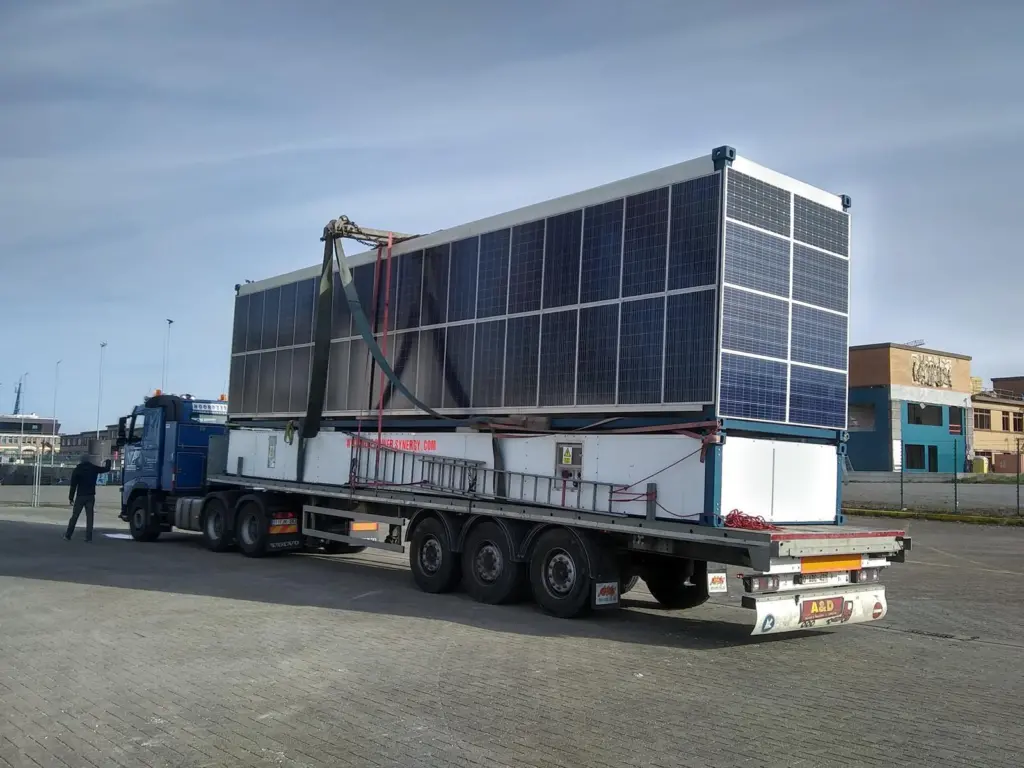
Meanwhile Blue Power Synergy (BPS) is testing a self-supporting energy pontoon in the port. Part of the European PECS project (Ports Energy and Carbon Savings), the pontoon is based around a container with solar panels and wind turbines to generate energy which can transform seawater into drinking water.
Ostend has one particular advantage – a landbank with 50 hectares of available space: “We want to develop this for companies involved in maritime activities,” says Mr Declerck.
The port’s bulk operations include major sea-dredged sand terminals, supplying the construction industry; in the circular economy sector, there are a number of companies active in recycling and the port wants to develop a more integrated cluster in which companies reinforce each other’s activities.
The loss of major ferry operations at Ostend in 1997 was a big hit for the port and local employment. “Lesson learned – you should never be a one-product shop, as a company or a port,” says Mr Declerck. “Hence our drive for diversity. Fortunately, we have this landbank, which is an opportunity to attract more activity and new companies.”