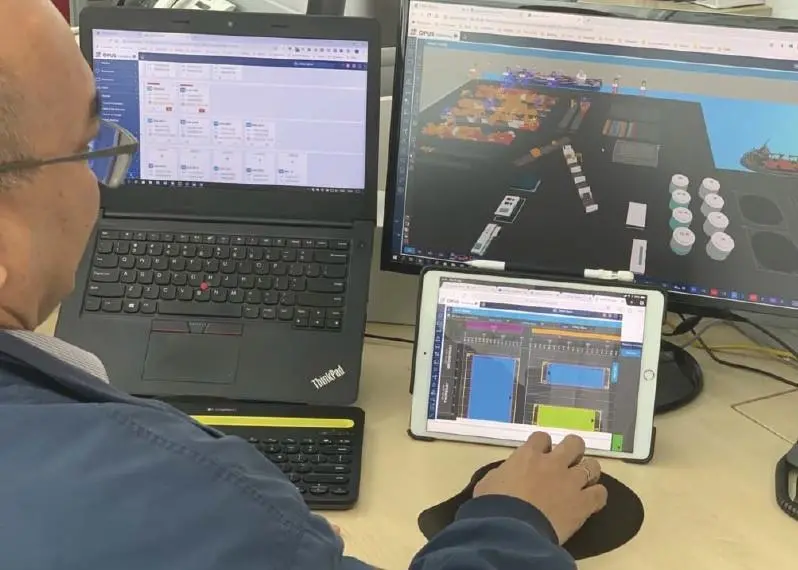
Innovation remains the word of choice for today’s Terminal Operating Systems. Wai Mung Low, head of business consulting, CyberLogitec Global, outlines the four main ones.
“Dashboards and business intelligence modules capitalising on big data; 3D visualisation; the capability to handle multiple types of cargo, and not just containers; and finally, the automation of terminal operations.”
Cloud technology and automation have had a massive impact upon the container terminal industry. “This has led to an increase in demand for TOS vendors to include these technologies into their TOS,” says Harry Nguyen, CEO of RBS.
“Automation has allowed terminals to improve their operational efficiencies and ability to manage larger vessels. This allows terminals to keep up with the rest of the world with minimum dependency on human resources. This has made such a big breakthrough in our industry because terminals can now enable CHEs such as ASC, ARMG, ARTG, AVG, and STS, to automatically adapt to dynamic situations which optimise performance and output.”
RBS has implemented a Cloud TOS to keep up with the changing demands of today’s terminals. “There is no surprise that the Cloud has weaved into the container handling industry and yielded quite a presence,” says Lilian Huynh, Marketing Assistant, RBS Marketing Team. “This is because the Cloud’s pervasive nature grows proportionately with the masses of the world continually shifting to the digital landscape due to consumerism and globalisation. As this innovation foresees a promising future the reinforcement and integration of the Cloud into a TOS is inescapable.”
Ms Huynh says that creating a TOS entirely in the Cloud allows terminals of any size the opportunity to leverage autonomous and real-time functionalities which achieve maximum return on investment.
RBS’ TOPX Expert has been developed in a unique architecture that can support any automated CHE without additional third-party interface software – a TOS that offers automation modules entirely in the Cloud.
While AI is a well-known word, it is still an unfamiliar concept for most. “In this bullet-proof industry, many fear the unknown and avoid change,” says Lilian Huynh. “However, the relentless rise in consumer demand resulting from globalisation incites the development of larger vessels with greater capacity. Therefore, it will soon become almost impossible for the human mind to manually plan and solve for all factors without omitting one or the other.
“Currently, the concept is still in the early stages. However, machine learning in tandem with real-time processing, automation, and the Cloud has rendered machine learning functionalities in TOPX Expert which assists in berth planning to achieve optimum decision-making and resource optimisation. AI will gain more remarkable traction in the future when it expands and advances its capabilities, and therefore, should not be overlooked.”
Dan Pershin, Head of Marketing, SOLVO, specifies several significant approaches towards TOS development and innovation that could change the market of IT solutions for ports and terminals and general trends in supply chain execution segment.
“First, we are talking about the future development of SOA, or good old service-oriented architecture. The approach provides resource and cost optimisation benefits through a ‘collection of loosely coupled services’ integrated with lightweight protocols.”
Mr Pershin explains that this technique is becoming popular among global TOS vendors, thanks to the growth of DevOps and Cloud-native applications. “Classic monolithic systems are getting more difficult to support for vendors and clients, especially when it comes to introducing new modules and supporting new types of cargo.”
The second growing trend is for standardisation of processes at multi-purpose terminals. As a result, a modern TOS can be introduced to those terminals handling break-bulk and bulk cargoes. “Certainly, software systems for general cargo handling had been there for quite a while already,” says Mr Pershin.
“However, now the functional requirements for the type of systems have changed. For example, in the past ports could easily rely on TOS systems being more of a general SORs (systems of record) with only a few basic functions dedicated to technological process management automation, but now general cargo terminals demand fully-fledged functionality repeating that of more advanced container TOS.”
These functions include automated and semi-automated stowage planning and forecasting, real-time management of yard operations with automated yard planning and put-away of cargoes.
Increasing demand is growing for access to more supply chain data, and making it available across the wider port community. Tony Davis of Jade Logistics explains that this can be achieved by using Cloud-based platforms to capture data from multiple sources and making that data available to all supply chain participants.
“Technologies such as Blockchain will also play a part, more so, ensuring the integrity of the data being captured and providing trust that the information is true and accurate. Jade Logistics’ TOS, Master Terminal, is already integrated with the CargoChain information sharing platform to achieve this.”
A wider array of TOS functions is now available on mobile devices like smartphones, tablets, handhelds and vehicle-mounted terminals. “By deploying these apps on mobile devices, real-time tracking and dynamic work instructions dissemination becomes more convenient and quicker to deploy,” says Wai Mung Low.
Mr Low adds that TOS solutions are moving to the SaaS model, reducing cost and time when implementing terminal systems. Port operators have the flexibility to deploy the software of their choosing on pay-per use basis. It is then left to the software vendor to manage and host the software, rather than the port.
“The SaaS model helps the port to save money. Moving to usage-based charging means that terminals have more flexible Opex options for financing their investment on systems as against hefty Capex investments.”
SaaS modelled terminal operating systems offer more flexible add-on modules to the “core” product, thus enabling operators to gradually grow the system in accordance to their business needs and complexity.
TOS pricing is becoming more competitive, ultimately affecting price points. Although as Tony Davis says, more flexibility around pricing models is equally prevalent. While the traditional licensing model is still relevant, the ability to offer OPEX models through subscription based pricing is becoming more common.
“Given the breadth of TOS functionality, and differing levels of complexity across terminals, most TOS can be purchased on a modular basis, ensuring operators only pay for what they need now, with the ability to upgrade to new functionality in the future as they scale and grow.”
“Cost-wise, TOS prices are not reducing or increasing, but rather pricing structures are changing, depending on the type of TOS (Enterprise or Cloud) that terminals prefer,” says Lilian Huynh.
“However, what we are seeing, especially in the European market, is that the cost and price pressure in the overall industry are also coming towards TOS suppliers,” adds Norbert Klettner, Director, RBS EMEA. “As such, that puts pressure on the market, but at the same time, this makes a good, efficient TOS necessary for terminals.”
Greater optimisation of terminal operations is a core driver for ports as they look to provide efficient service. “This means faster turnaround of ships, faster turnaround at the gate and increased visibility of the operation as a whole,” says Tony Davis, adding, “Once the core TOS solution is in place, terminals are able to identify areas where additional investment in technology can provide even more returns.”
Wai Mung Low explains that core functions like yard planning and real-time operations are key interests of ports when it comes to implementing TOS. “Supporting functions are very important. Our real-time module is very dynamic, and is able to support the main aims of the port.”
Dan Pershin says that the most wanted areas of application are ship stowage planning, yard planning/optimisation and real-time equipment control. “All these areas require high end technologies to be featured including genetic algorithms for sequencing cranes for example, BI, machine vision (MV), and Artificial neural networks (ANN).”
While real-time processing is becoming more common in the TOS field, it is still vital to analyse a system’s architecture to determine if its functions can truly support this. “To say a TOS without real-time capabilities can engender catastrophe is quite the understatement,” says Lilian Huynh.
“Without real-time capabilities, operations and equipment behave unpredictably. There is a common misconception between the exchange of real-time and transactional processing, so the true meaning behind real-time becomes misleading and convoluted. Transactional processing is not to be synonymous with real-time processing as it adopts a static and sequential operation when feeding and filtering data, which are pulled from multiple different servers and incur substantial wait times.”
As a result, CHEs on the field receiving work instructions to move a container from one location to its destination, execute tasks on redundant data and spawn bottlenecks as well as congestion.
RBS’ TOPX Expert challenges these impediments which inhibit container terminals, achieving efficiency and optimisation with its unique, centralised, single server infrastructure.
“A system architecture like TOPX Expert is constructed on a genuine real-time environment, ensuring data always remains in its most updated state,” says Ms Huynh. “Optimal decision-making for vessel planning, yard planning, and CHE work instructions are, therefore, always created based on data that automatically update even if it is changed in any stage of planning. Any alterations in data are automatically adjusted accordingly, so every step of the planning process gains independence and remains unaffected.”
All CyberLogitec system functions are conducted in real time. Wai Mung Low says that CyberLogitec’s Terminal Operating Systems are built with dynamic decision-making in mind: “Port operators are working out the most efficient ways of handling cargo: efficiency-based decisions such as optimal yard stacking and storage of containers that minimises shifting can boost productivity and reduce operating costs.
“Therefore, when the TOS solution record all transactions and activities in real time, terminals can maximise the dynamic method of allocating containers and assign operational jobs to terminal equipment and resources.”
Tony Davis explains that the use of web-based mobile applications by workers on the ground complements this by allowing real-time data to be sent directly to the core system, reducing time and human error. “While access to real time data is important at an operational level, historical data for analysis and business decision making is also a key output from the TOS.”
What are the main benefits of TOS? Dan Pershin lists some of the most important ones: “Substantially increased speed of processes, elimination of human errors, overall transparency, more efficient planning and increased quality and range of services that ports can offer to their clients, such as shipping lines and cargo owners.”
Wai Mung Low explains that the TOS is the central repository of all data and information. “It’s a source of Big Data and business intelligence, adding a great deal of value for port owners,” before adding, “A TOS that can effectively process inputs from various sources (shipping lines, shippers, port authorities, customs authorities) and transform these inputs to system-driven cargo handling jobs will help a terminal manage operations in an optimised and effective manner.”
A TOS with sufficient data validation points ensures accuracy of information that in port operations will be used to generate reports to the relevant parties. Following on from this, data from the TOS is the basis for generating invoices after vessel departure. “For example, in the vessel operations process, each aspect is accurately matched with tariff values, which can then be invoiced to the customer. All movements are recorded, highlighting the need for TOS data to be accurate and secure.”
“A TOS provides a port or terminal with increased visibility of their operations, access to decision making information, and the ability to capture and record opportunities to generate revenue,” concludes Tony Davis. “The TOS can be the differentiator when it comes to optimising the use of port resources and providing high levels of customer service to port customers such as shipping lines and carriers. A TOS allows a port to take control of their operations.”