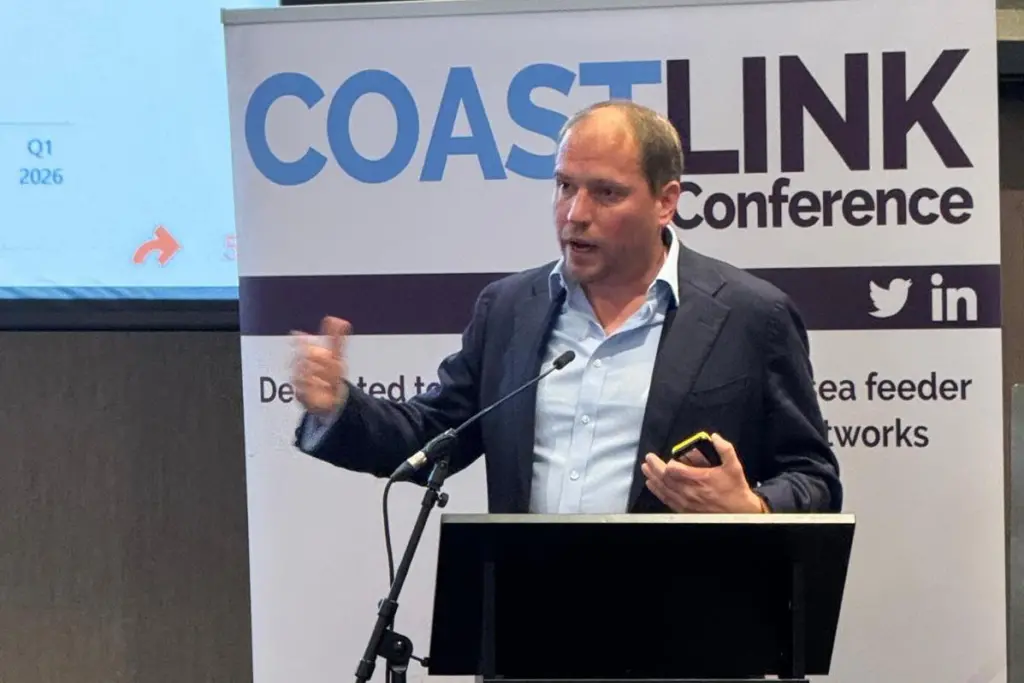
Speaking on day two of this year’s Coastlink conference, Johan-Paul Verschuure, maritime entrepreneur and director/partner, Rebel Ports and Logistics, warned delegates that an increasingly complex regulatory framework will fundamentally shape investment, fuel choices and infrastructure planning for the European maritime sector.
“Regulation is not something that people talk about too eagerly, they don’t like it too much, but in the last two years the regulation has shot up so much that I think it’s increasingly important,” Mr Verschuure told delegates.
“This regulatory space is becoming more complex but is driving the entire market in the next ten years.”
Major policy shift
Mr Verschuure said the recently published EU Port Strategy and EU Maritime Industrial Strategy signalled a major policy shift, placing greater emphasis on competitiveness, decarbonisation, safety, security and financing support for ports and maritime infrastructure.
He argued that port operations would increasingly be shaped by carbon taxation, fuel regulation and security requirements, while operators would also face mounting pressure to maintain operational resilience amid geopolitical uncertainty and infrastructure vulnerability.
A key concern raised during the presentation was the fragmented implementation of EU regulations between member states. Mr Verschuure highlighted how delays to the Renewable Energy Directive had already created distortions in bunker pricing between ports, prompting vessels to reroute fuel purchases to lower-cost locations.
He also warned that inconsistent adoption of road charging systems and carbon measures risked undermining the level playing field required to encourage modal shift from road to short sea shipping.
According to Mr Verschuure, heavy penalties under FuelEU Maritime and the EU Emissions Trading System could unintentionally reverse progress unless competing transport sectors were regulated consistently.
Fuel uncertainty
The session also examined the uncertainty surrounding future marine fuel markets, including methanol and hydrogen.
Mr Verschuure said predicting long-term fuel availability and pricing remained difficult, complicating investment decisions and subsidy planning for shipowners and terminal operators. Beyond decarbonisation, the presentation placed strong emphasis on security and strategic autonomy within European port economics.
Proposed measures include tighter scrutiny of port concessions, accelerated environmental permitting for strategic infrastructure and additional funding for smaller regional ports, hinterland connections and shore power systems.
Mr Verschuure said the EU was moving toward a more interventionist approach to maritime policy, with increased protectionism and substantially expanded funding mechanisms designed to support sustainable infrastructure and resilient supply chains.
He concluded that ports and shipping companies must begin integrating regulatory risk into long-term planning strategies now, particularly around fuel pricing, carbon taxation and infrastructure investment, as the sector moves toward 2030 and beyond.