When Sir Alan Sugar was building consumer electronics company Amstrad he overlooked the opportunities for market penetration offered by ownership of the software that made his green-screen computers come alive.
Instead, he remained focused on the price of circuitry, monitors and keyboards, and spurned the advice of uber-geek Bill Gates, who took the opposite view.
Sugar, although not short of money, freely admits he got it wrong, and Gates, through his ubiquitous Microsoft, became the richest man in the world.
It’s not, on the face of it, a mistake that makes much difference to the rest of us, but not making it has changed the way 21st-century life is lived, with realisation of the Gates dream of ‘a computer in every home and on every desk’.
Mr Gates’ ‘lesson from history’ appears to have been well learned by Helsinki-based Mirasys Ltd, developer of software to help manage information captured by digital video and CCTV surveillance cameras. Its chief executive Jukka Riivari advocates use of the Gates business model. “We offer software, and encourage end users to buy hardware locally,” he said. Not only is the approach apparently working, but the impact has the potential to change the way ports operate into the rest of the 21st century.
“We are witnessing the growing trend of large multinationals perceiving the benefits in choosing only one software solution for their enterprise-wide activity.”
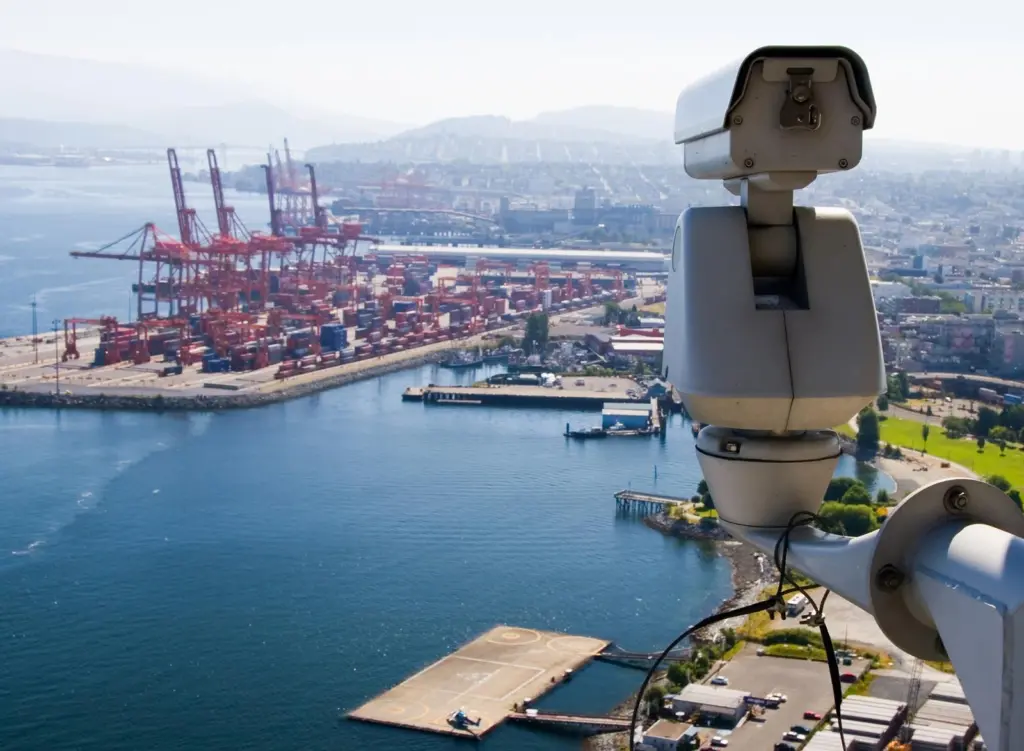
And it’s that focus on software that allows Mirasys, currently managing almost a quarter of a million cameras worldwide with software written in a plethora of languages, to predict and react to the future of ever-more extensive surveillance systems offering high-resolution pictures and the things that can be done with them.
The result is systems that underwrite automation, removing people from areas of potential danger, and yet still delivering a clear view of operations. And building on the ability to gather large amounts of high-quality video footage creates a resource with the potential to add more to the bottom line by husbanding that most precious of resources – time.
Powerful systems, capable of pulling together images covering activities on several kilometers of quaysides, land perimeters, and the port activities in between, present unique logistical challenges. Not least among those is managing the data captured by cameras whose numbers are growing exponentially – the largest Mirasys systems collate images from 1,000 cameras in a single hub.
“A key challenge is to seek advancements in storage technology and build software products better able to cope with searching, managing, viewing and archiving much larger amounts of data than ever before. We intend to make it possible to be able to store crucial data for very long periods, and search huge amounts of unstructured data quickly using intuitive and sophisticated tools.”
That’s probably well understood by Bill Gates, but may leave the rest of us behind. What will all that sophistication mean on a windy quayside on a freezing February morning?
For Mr Riivari the availability of huge amounts of data offers potential on a similar scale; another company asset that can be worked to deliver extra value.
He suggests object tracking and people-counting as other ways in which surveillance can point the way to unlocking greater business efficiencies, combining his systems with asset protection tools like ANPR (automatic number plate recognition) and RFID (radio frequency identification).
Synchronising such technologies will allow tracking of errant boxes as well. “If a box becomes lost within the dock perimeter camera footage can be replayed to spot its movement and identify the destination. If someone tries to take it fraudulently RFID tags can be used to locate it.”
And he also sees huge benefit for ship-to-shore satellite links that allow port operators ashore to identify individual boxes on vessels a couple of hours before the vessels are alongside.
“That means port operators can know if the boxes they’re getting are the ones that were expected, and where they are on the ship. That means the flow of intelligence and the flow of goods can be brought together to save time by making an accurate unloading plan before the ship arrives. Knowing how to handle the boxes before they arrive has lots of operational benefits,” he says.
But while all that sophistication is going on, the user interface has to remain intuitive and as simple as possible if the greatest business benefit is to be realised. Mr Riivari cites the example of a pan-European petrol retailer with 3,000 filling stations, where all of the operators need to be able to navigate quickly through screens to keep cars moving.
“Training is a genuine challenge. A complex screen doesn’t necessarily indicate a good product. It is a tool, and must be easy to use,” says Mr Riivari, a former Nokia executive. He illustrates the point with the experience of dealing with a clothing chain in Sweden, where recording of CCTV images has been legal for little more than five years. “We won a contract after several months of pilot projects, in which our solution was better at catching in-store thieves because the staff were able to use it more effectively,” he says.
And there’s that commonality of systems throughout companies again, becoming a benefit since there is no need for inter-site training should there be a need for employees to re-locate. “This means local staff are not intimidated by new systems, and employers can be certain their employees can be flexible.”
He also sees greater benefits to be gained by engaging any organisation as a whole in making a contribution to its security. How’s that achievable? By intelligent distribution of alarms to mobile devices and PDAs, backed up by a system that doesn’t cry wolf. “We are investing in intelligent video analysis to cut the number of false alarms, making sure that real incidents get the attention they deserve,” he says.