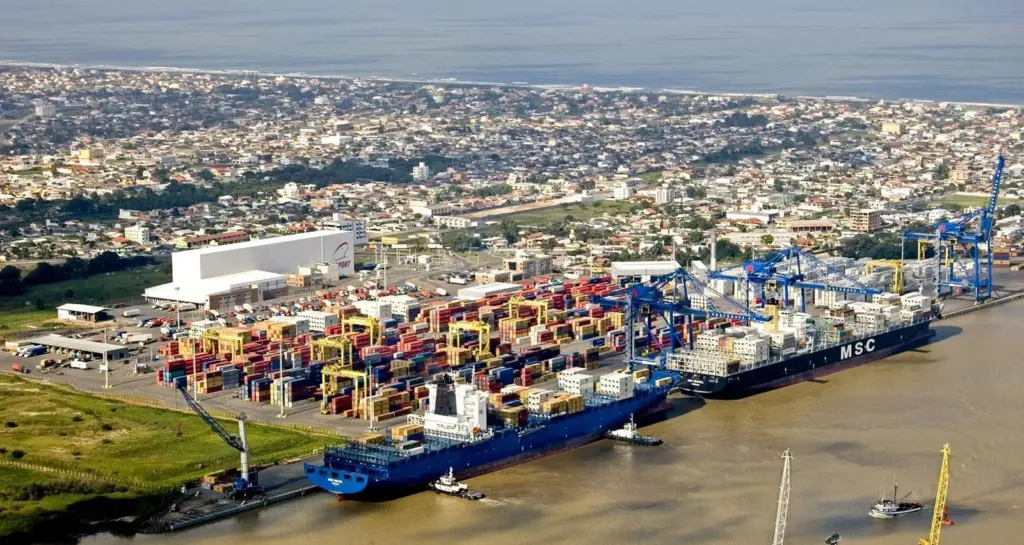
Navegantes in Santa Catarina State is one of the best examples of Brazil’s new port policy and practice – one it must be added with enviably eyewatering rates of growth.
“In January we handled 37,756 teu, 22,885 containers; an average of 467 containers per ship. That meant a 175% rise compared to January 2009,” says Osmari de Castilho Ribas, Portonave’s administrative director. “We moved 413,968 teu, which meant a 73% rise compared to the year before. Imports rose 151% and exports were up 48%.”
On top of this the expectation is for more of the same this year with Portonave planning on handling 650,000 teu, he tells Port Strategy – not bad for a facility that only opened in late 2007.
Mr Ribas offers a new twist on the hows and the whys of these enviable figures, stressing that this was a port set up – or in his words “idealised” – as offering its clients a complete infrastructure with high technology equipment and specialised personnel for moving cargo.
“We benefit from modern technologies, innovations, security, a highly-qualified team, security and investments in social projects and sustainability,” says Mr Ribas. In short, a purpose-built place privately-owned – it is a joint venture between Triunfo Particpacoes e Investimentos and Backmoon Investments – putting a premium on technology to move cargo thereby evading the problems found elsewhere.
The infrastructure is good but not, it should be noted, overwhelming. A pier of 400 metres, a retro area of 270,000 m2 and three berths and equipment including three post-panamax portainers, two mobile harbour cranes, eight transtainers, two reachstackers and six empty container handling cranes, says Mr Ribas.
Landside, the facilities are equivalent to 150 parking spaces for trucks and 10 access gates which connect the port to its economic hinterland and onwards to the rest of Brazil.
“Portonave is geographically close to very important roads, connecting the terminal not only with the main cities of the Santa Catarina state, but also in the country,” says Mr Ribas.
“Our proximity to the federal road BR-101, which connects the country South-North, and BR-470, which connects the coast to the country side of the state, puts Portonave in advantage when it comes to providing the trucks with a fast and easy access to the Port and back to the road,” he adds.
That hinterland, Santa Catarina – the home of Brazil’s biggest meat industry – explains why Navegantes as a port has become focused on containered reefer cargo.
“Between January and December last year, 46% of the cargo handled was frozen meat, while wood totaled 17%, tobacco 12% and furniture 6%. Machinery, paper, fruits and pottery were exported via Portonave, but in a smaller quantity,“ says Mr Ribas.
This goes to a variety of destinations mainly the US, Europe and Asia with Oceania being the only part of the world currently not served directly. On February 5, Portonave loaded the first ship that left the terminal going to ports in South Africa, Singapore, China, Japan and South Korea. “The new service should increase by 10% the activities of the terminal,” says Mr Ribas.
This is very much a symbol of the way Portonaves operates: incremental expansion driven by the market. That being said, Mr Ribas is reluctant to comment on further expansion plans saying only that they are being considered. It’s unlikely, however, that Portonave will sit on its laurels, certainly if development in the chilled or frozen business lines is anything to go by. Portonave, after all, has 1,200 reefer plugs at its disposal.
“We’re just starting apple season and we intend to increase in 20% the exports of this product in 2010,” says Mr Ribas. “Last year the amount of teu transported through the terminal totaled 2,034. All the fruit is stored in reefer containers at a temperature of 32 degrees Fahrenheit, or 0 (zero) Celsius.”
Imports are very different being much more diverse and mostly from three American ports: Houston, New Orleans and Savannah. Of these, plastic and it’s derivatives were 12% of the total imports last year followed by fibres and synthetic filaments, and machinery both at 6%. The remaining imports are widely spread over small volumes of things like paper, metals, rubber, pottery, electronics, fabric, chemicals, lead, steel, paint, toys, beverages, leather, and salt and rations for animals; a list which suggests the scope for expansion is not only there, but is also considerable.