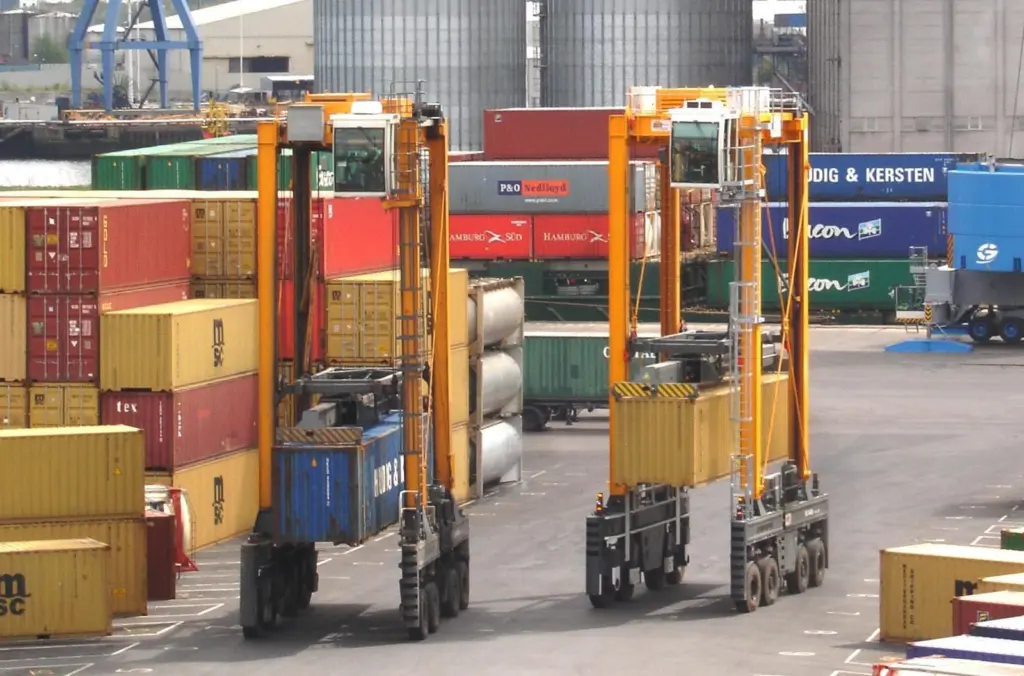
Liebherr has taken the unusual step of designing an entirely new straddle carrier based on its RTGs, while Mobicon has produced a mini-straddle carrier aimed at small ports. Straddle carrier operational efficiency can also now benefit from a new IT tool, marketed by the Institute of Shipping Economics and Logistics.
Liebherr’s new SC440S unit was developed by its Killarney production unit in Ireland using technology already inherent in its existing RTG design. The initial prototype machine underwent trials at Belfast Container Terminal, which is part of the Irish Continental Group.
Liam Lacey, managing director of ICG’s container and terminal division, says: “We found it to be a reliable and efficient machine, so after the trial period was completed, we bought it, as well as placing orders for two further production models. All three are now in operation, allowing us to retire existing Kalmar and Noell straddle carriers that had reached the end of their working life.”
During the initial year-long trial, the Liebherr prototype provided additional lift capacity to that already in place, so when it had to be temporarily taken out of service for upgrades to take place, there was no negative impact on the service to shipping lines, he explains.
“During those first 12 months of operation, when BCT handled 100,000 teu, the SC440S was effectively faultless, which impressed us greatly,” he says.
ICG already had a long-term relationship with Liebherr before agreeing to the trials. Liebherr RTGs are in operation at the group’s Dublin Container Terminal and Liebherr MHCs had previously been deployed at Belfast. As a result, ICG has long acted as a reference client for the manufacturer.
“Liebherr was clearly aware of our specific requirements in terms of straddle carriers, given our close association with them,” says Mr Lacey. “Furthermore, there was also a reduced supply chain involved, because any spare parts we needed could easily be obtained, given that the SC440S was built at Killarney in the west of Ireland.”
Nevertheless, he emphasises that ICG was under no commitment to buy either the prototype straddle carrier or subsequent production models. Any purchases would be made strictly on commercial criteria. Perceived maintenance and running costs would therefore be key in any calculation.
“We sought quotes and technical specifications from other suppliers to see what else was out there, so you can see we did our homework. In addition, of course, we had the advantage of having operated the Liebherr prototype for a year, which allowed us to build up accurate information on its running costs and overall reliability.”
Looking at the figures, it became clear that over its lifetime the SC440S would prove to be more competitive than new models offered by either Kalmar or Noell, says Mr Lacey. Quite how much cheaper it will eventually prove to be is difficult to say at the moment, he concedes, since the three units ICG has bought are new and operating under warranty. Nevertheless, Liebherr remains confident that over the long term the SC440S lifecycle costs will produce sufficient savings to more than offset its slightly higher purchase price.
“We won’t know whether there are any inherent problems with the SC440S for quite some time. Nevertheless, an awful lot of the component parts – the motors and drive systems – are pretty generic and used by all the manufacturers, so we are already familiar with them,” he says. “In addition, Liebherr has proved exceptionally good in terms of after-sales service, providing any further information or demonstrations that we have asked for, whilst also explaining all new technology thoroughly to our maintenance teams.”
He says that, despite the revamped hydraulic system incorporated into the new straddle carrier, in-house teams have not met any difficulties in maintaining it, while the overall design has proved to be very reliable.
About 100 Mobicon mini-straddle carriers are operational around the world, deployed mainly in on-dock and off-dock warehousing environments, primarily to stuff and de-stuff containers.
The Australian Customs Service has five units operational at ports, and another is working at a container fumigation site linked to the Port of Fremantle. The US Navy uses a Mobicon for ro-ro applications. Alotau Stevedores in Papua New Guinea is currently the sole port terminal operator using a Mobicon.
Tom Schults, managing director of Mobicon, identifies upwards of 500 smaller port operations – mainly in the Pacific, but also in Africa and Latin America – as potential customers. These are either not handling containers because they lack the equipment to do so, or are doing so, but using ineffective equipment.
Traditionally, containers are loaded directly on to road trailers in smaller ports, either because no alternative equipment exists or because low weight-bearing wharves cannot support heavier FLTs or reachstackers. A lighter weight Mobicon, which applies the lowest downward force of any container handling equipment, gives stevedores the option of rapidly removing boxes to a storage area or simply loading them on to trucks on the quay.
“At Alotau Port, vessel turnaround times have been reduced by many hours using the Mobicon,” says Mr Shults. “This means that ROI could be achieved in under 12 months using this type of operation, which separates transport functions from those in the warehouse or stacking yard.”
Many ports with wooden or low load-bearing quays are faced with a real dilemma, he notes: “In many cases, the wheel loadings of a conventional straddle carrier, reachstacker or heavy FLT cannot be supported on these types of quay – forcing the stevedores to use trailers, which are understandably limited in number, resulting in a highly inefficient operation.”
However, using a Mobicon, unloading the ship and removing containers from the quay become completely separate activities. Inversely, the quay can be charged with boxes in advance if a vessel is known to be arriving late. If a port relies on road trailers to supply the vessel, this simply cannot be done as efficiently if there are delays to schedules.
The catalogue price of a Mobicon is significantly cheaper than that for an FLT or reachstacker, and running and maintenance costs are about 25% of those for an FLT. Transporting the Mobicon to a remote area is also easier, since one will fit into a single 20 ft container and can be assembled by two people in 48 hours.
Operating costs, says Mr Schults, are significantly lower than for FLTs or reachstackers, since the Mobicon has a 60 hp engine, as opposed to a conventional 300 hp engine for heavier equipment. This means it uses less fuel and is cheaper to maintain. Transmission repair costs are also lower, and replacement hydraulic pumps are cheaper. Tyres last longer: up to 3,000 hours for those on the rear tower and 4,000 hours on the front tower.
Many Mobicon operators can be located up to 1,000 km from major population centres, so the company offers training to local technicians, many of whom will already be familiar with FLTs. Although the straddle carrier design is radically different to what they are used to, many of its components are to be found in forklifts all over the world. Readily available hydraulics are supplied by Bosch Rexroth and engines by either Deutz or Hatz. There are no onboard electronics and the electrical system is of a simple automotive design.
“For operators in very remote locations, we do advise spending the equivalent of 5% of the purchase price on acquiring emergency spare parts, just to be on the safe side,” says Mr Shults. “But otherwise, the Mobicon is so reliable that it can be years before we hear back from clients in these out-of-the-way locations, since they soon become totally self-sufficient.”