Workers at the southern Italian port of Gioia Tauro were dealt a hammer blow in May 2011 when Maersk announced, as of early July, the port would no longer will be used as a transhipment hub in its global network.
The company, whose Asia-Europe services accounted for almost a quarter of total traffic, shifted the bulk of its central Mediterranean transhipment business to the island of Malta, where it said it would “leverage” its vessel sharing agreement with CMA CGM. East Med boxes formerly rotated out of Gioia Tauro switched to the Suez Canal Container Terminal at Port Said, in Egypt, which was viewed as a “more convenient” location.
Terminal operator Medcenter, where Maersk subsidiary APM Terminals held a 33% equity stake, would retain just a single weekly feeder service to Genova.
Asked to explain the move, a Maersk spokesperson noted that the company is “constantly looking for more attractive products and cost reductions to adapt to market dynamics”.
Medcenter, which had long been synonymous with labour unrest, not only suffered from low productivity, but was also rumoured to have been infiltrated by organised crime, all of which undermined its one major asset: the prime location it enjoyed at the heart of the Mediterranean.
Gioia Tauro is also one of the Calabria’s few major employers and stevedores made redundant as a result of the loss of Maesk had nowhere else to go.
Changes therefore had to be made.
New tack
Anchorage rates regulated by the state have been slashed by up to 90%, while crane productivity has reportedly increased by more than 20%, with consistent averages now at 30 moves per hour.
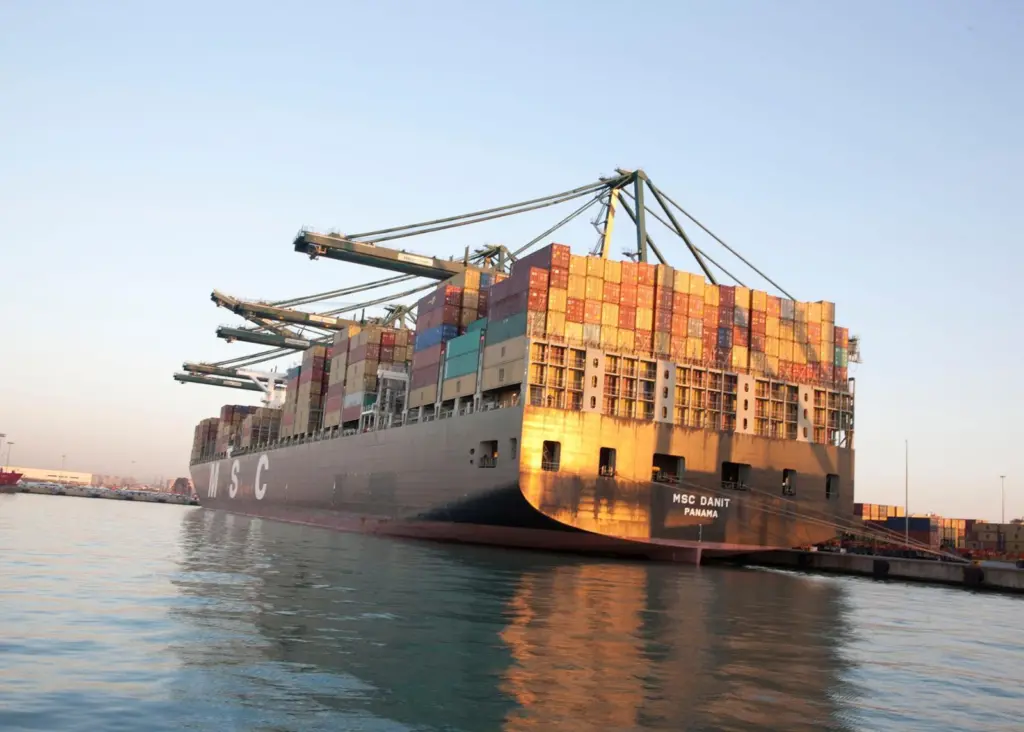
In January, TIL, which the industry regards as the effective terminal arm of shipping line MSC, also took a stake in Medcenter. MSC now seems poised to use Gioia Tauro as its transhipment hub for several of its regional requirements.
Contship Italia president, Mrs Eckelmann-Battistello, notes: “The entry of TIL – and the continuing partnership with APM Terminals – contributes to further reinforce the terminal commercially and organisationally to allow it to face the challenges of a difficult operating environment in the global container shipping market.”
But if MSC switches services to Gioia Tauro, it may well be at the expense of the Spanish port of Valencia.
Despite being Spain’s largest container port, Valencia has struggled to achieve levels of productivity commensurate with those at main rival Barcelona, and remains too expensive to survive in the cut throat transhipment market, despite having done well in this area in recent years.
MSC has long been demanding that costs fall there, but port unions have dragged their heels, reluctant to give up long held privileges. But MSC is adamant, publicly announcing that Valencia might well lose 70% of its existing transhipment volume within eight years unless a new cost cutting strategy is applied urgently.
The 2011 figure of 2.14m teu transhipment boxes could fall to as few as 1m teu in the short term, suggests MSC, and then drop to just 600,000 teu by 2019. In contrast, by getting handling costs down, overall throughput could rise to 6.2m teu by 2021, of which nearly 4m boxes could be in the form of transhipment.
Cost crisis
All those involved in the West Med transhipment market are aware that price remains an issue now that a more cost effective solution for lines has opened at Tanger-Med in Morocco.
The port of Malaga learnt this lesson the hard way. In 2009, the port, which essentially handles transhipment traffic, registered a 32% drop in throughput, as main customer Maersk switched vessels to its new North African enclave, while consolidating its existing business in Spain at Algeciras.
Following two years in the comparative wilderness, traffic returned en masse last year, following labour unrest at APM Terminals’ facility in Tanger-Med. In the meantime, the port authority and terminal operator had worked hard to get rates down to take advantage of just such an opportunity.
A similar fate was expected to overtake Algeciras. However, last year, throughput surged by 28% to 3.6m teu, of which 3m teu was handled by APM Terminals. Nevertheless, Anders Kjeldsen, head of APM Terminals West Med operations urges caution.
“You have to remember that our best ever year was 2008, when throughput amounted to 3.6m teu, which was followed by a drop to 2.67m teu the following year. So, although our percentage increase last year was good, it was against a backdrop of falling traffic over recent times.”
He notes that, in 2011, around 330,000 teu of extra traffic returned to the terminal, which, in part, he puts down to the Arab Spring, but was also due to impressive growth in West Africa. Although some traffic did come back to Algeciras because of strikes at Tanger-Med, Mr Kjeldsen says that APM Terminals in Algeciras wasn’t the main beneficiary, with the main volumes going to other terminals in the Straits.
Going spare
He notes that terminals in the area currently have around 25% surplus capacity, which means that competition is tough and will remain so.
“The shipping lines are under extreme pressure to lower their cost base and this also means that competition between the terminals is very tough,” he says.
Because the terminal handles 95% transhipment traffic, Mr Kjeldsen says that there is a wish to increase import-export volumes, although concedes that transhipment will remain the dominant traffic. Cost, he stresses, need not be the only factor in retaining traffic. It is also important to consider the overall network cost for the shipping lines and not just the actual terminal handling costs. This, he says, is where APM Terminals Algeciras’ overall size is an advantage, because by offering stability and flexibility in the terminal, it might be possible for the operator to actually create a saving for the shipping line in its network.
“In respect of actual unit cost – and with all other variables being equal – it is hard to compete with ports that have a lower cost base. For our terminal in Algeciras, cost will remain a serious threat in the medium and long term. Work systems therefore need to be more flexible, plus we need to adapt to changes and new technology much faster than what we do currently.”