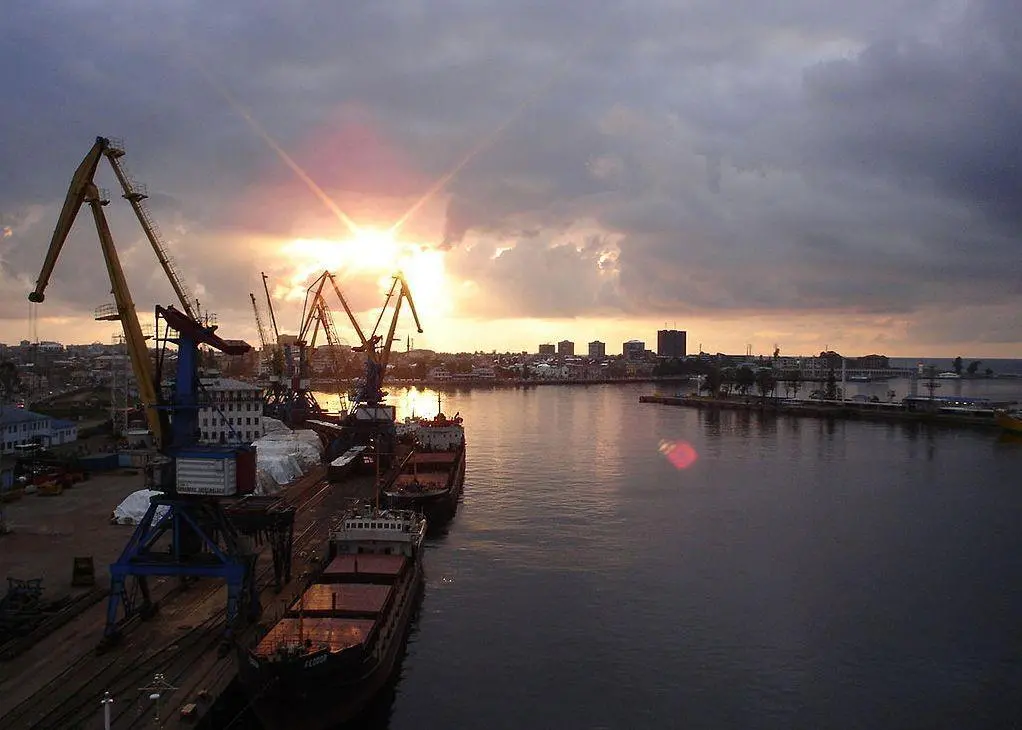
Whatever it is, international terminal operator ICTSI has taken the exceptional step of seeking an arbitration against the “adversarial” approach of its landlord at Batumi Sea Port, Georgia.
ICTSI states that since the beginnings of its operations in Batumi, in 2007, it has traditionally enjoyed a good relationship with the port management body but this relationship soured at the beginning of the year.
Batumi is slightly different from the norm in that the port management body is not a Georgian public entity. The port of Batumi was acquired in 2008 by a national company of Kazakhstan “KazMunajGaz”, and as such the effective relationship between ICTSI and this company is closer to a private sector relationship.
ICTSI operates in Batumi on a concession basis, which dictates powers and responsibilities on both sides, but even with this in place it is not beyond the bounds of possibility that Batumi Sea Port may have to respond to a strategic considerations, dictated by its parent, or simply identify a commercial opportunity which places it in effective conflict with its tenant. There is not the same ‘neutrality’ in place as is usually the case with a public port management – hence inherently there is more opportunity for conflict, a factor to consider when taking up this type of opportunity.
Often emerging national oil companies have close and interlocking relationships with their national governments, with geopolitical and strategic aims factored into foreign investments rather than purely commercial considerations. In this context, it is interesting to note that Kazak’s proven oil reserves are estimated between 9bn and 17.6bn barrels, making it a potential producer of considerable influence. Its challenge, however, is how to get its product to market – this has been a big focus in recent years and without doubt underpinned its acquisition of Batumi Sea Port.
Oil from Kazakhstan to Batumi moves along the so-called Caucasian Corridor, a route that does not cross Russian territory, and is unimpeded by volume allocations. Volume on this route has grown significantly and with KazMunaGaz recently emphasising its wish to expand strongly into Western European markets the thought raises its head that ICTSI, through no fault of its own, may well lie in the path of the aspirations of KazMunaGaz and the constraints of the geopolitical realities this organisation has to work within.