Port Sustainability
Sustainability is the simple principle of being aware of a person or entity’s impact through responsible use of resources. The American Association of Port Authorities (AAPA) recently implemented a task force to examine port sustainability issues, and it encourages ports to implement the concept of sustainability as part of standard business practices for both short and long-term planning.
Under regulatory and community pressure, the nation’s largest ports have adopted formal policies to enhance the environmental, social, and economic sustainability of their operations. These sustainability goals supplement basic regulatory and legal requirements imposed on port operations. Regional ports and transportation providers are starting to work together to adopt long-term sustainability objectives and strategies to achieve their common goals.
Seaports and Energy ConsumptionEnergy consumption and costs can account for up to 60 percent of a port’s operating expenses. Continuously rising energy costs are catching the eye of terminal and port operators. Although a challenge, this provides opportunities for a port to lower its carbon footprint and energy consumption while also increasing competitiveness by becoming greener and more efficient. One opportunity gaining momentum is the installation of Light Emitting Diode (LED) lighting fixtures on cranes. The specification of energy-efficient LED floodlights onto container and bulk handling equipment dramatically reduces energy consumption and moves terminal operators closer to global goals of long-term sustainability and profitability.
LEDs and Container Handling EquipmenAutomating terminals also presents new opportunities to reduce maintenance expenses and environmental impacts. Automated equipment lighting requirements are different than standard equipment; less lighting is needed overall, but it is still required to be available on-demand for remote control and maintenance operations. Furthermore, LED lighting is instant-on, as oppose to many traditional lighting options that require an extended warm-up time. This allows for lighting to be turned on only when necessary. There is a strong trend to outfit Automated Stacking Cranes (ASCs) with LED lighting which significantly reduces energy costs, minimises downtime, and puts that particular terminal on the path to sustainability. Lighting is often perceived to be a fixed expense; with LED technology, however, power consumption from lighting can be reduced by up to 75 percent.
New optic technology can distribute a very even light over a wider target than traditional lighting options. This means that fewer lighting units are required and exterior units can be mounted lower. Light pollution is also reduced as the light output is focused only where it is needed. The reduction of fixture quantity using LED technology offsets the additional costs and allows for a reasonable two year payback period.
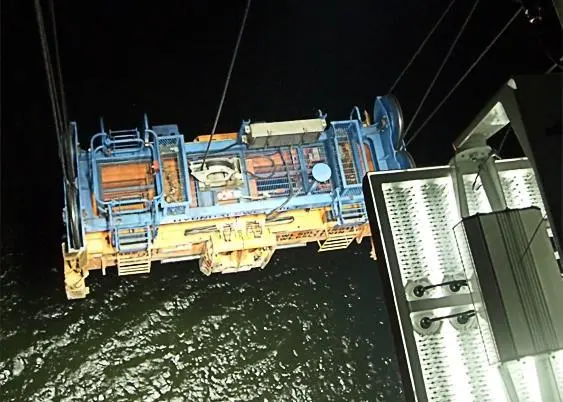
Container crane light fixtures are subject to extremely high vibration, and they have very frequent failures. The use of LED floodlights can eliminate constant maintenance in this abrasive environment and reduce the ground personnel entering the automated terminal. Just as crane manufacturers have engineered revolutionary advances, so too have LED fixture manufacturers, making these lights ideally suited for the harsh, corrosive environment in which container cranes operate.
RTG Electrification In their drive to achieve environmental targets, terminal operators continue to transition to electric Rubber Tired Gantry cranes (E-RTG’s). Most major crane manufacturers now promote E-RTG’s as cranes that operate more efficiently. Surprisingly, LED lighting has not yet been included as a standard feature of these electrified RTG’s. A traditional RTG with fourteen 400W fixtures consumes 6150W of power when all fixtures are illuminated and ballast losses are included. Conversion to LED floodlights reduces power draw to only 2100W – nearly one third of the energy. The design of LED floodlights onto a standard or E-RTG crane also opens the possibility of reducing illumination levels during idle time with the use of dimming technology. This lowers energy consumption further and therefore reduces the emissions of the equipment. As terminals convert to or purchase E-RTG’s, upgrades to LED lighting are being considered as a means to achieve even greater energy efficiency and cost savings.
LED Fixtures in Action
Green Port Gateway-Long Beach Container Termina
lLong Beach, CAFounded in 1911, the 3,200-acre port is a premier gateway for trade between the U.S. and Asia. It is the second busiest port by container volume in the U.S., and the 18th busiest in the world. The Port of Long Beach (POLB) adopted a “Green Port Policy” that incorporates the following five guiding principles to minimise or eliminate negative environmental impacts:
- Protect the community from harmful environmental impacts of port operations;
- Distinguish the port as a leader in environmental stewardship and compliance;
- Promote sustainability;
- Employ best available technology to avoid or reduce environmental impacts and
- Engage and educate the community.
The middle harbour expansion of the Port of Long Beach is currently underway through the development of the new Long Beach Container Terminal (LBCT). In pursuit of higher environmental standards, LBCT selected LED technology for its new Ship-To-Shore (STS) trolleys and ASCs. LBCT expects considerable energy reductions, cost savings, and elimination of lighting-related maintenance.
Port of Los Angeles
Los Angeles, CAThe Port of Los Angeles (POLA) is a major container terminal on the West Coast, which together with the Port of Long Beach, forms the sixth busiest container complex in the world. This prominence brings with it responsibilities and expectations for the highest possible standards of efficiency, security, and environmental leadership. Promoting a sustainable philosophy and ensuring that the port is a leader in promoting environmental stewardship is a strategic objective and the Port of LA has become known for its groundbreaking environmental initiatives.
In 2009, the POLA secured more funding than any other port in the country from the American Recovery & Reinvestment Act, including $1.75 million to invest in energy efficiency and conservation projects. In 2010, the port completed installation of the first E-RTG crane in North America. Multiple terminals within the POLA are evaluating LED lighting on STS cranes as well. One of their terminal operators chose to replace all 1000W STS Trolley fixtures with 300W LED floodlights for an energy savings of 74 percent. In addition to the energy savings, the industrial-grade LED floodlights have required no maintenance since their installation approximately six months ago.
South Carolina Ports Authority
Charleston, South CarolinaBased on the premise that growth and environmental improvement are mutually attainable goals, the South Carolina Ports Authority (SCPA) has an ongoing sustainability program that includes upgrading technology and equipment. To ensure that this southeast cargo hub keeps its place as a top ten U.S. port, the SCPA has laid out measures that will keep them on track to achieving its goals, including investing in newer, more efficient equipment.
Recently, LED fixtures were installed on a STS Crane with mounting height of 125ft with the goal of improved lighting into the vessel hold. After the upgrade, light levels increased by nearly 55 percent.
Advantages of LED Fixtures
Durability and VersatilityAnother important advantage to LED technology is its inherent durability. LEDs are solid-state light sources that contain no moving parts, filaments, or fragile glass. This dramatically reduces the risk of damage during transportation, installation, and operation, even in the toughest environments. The durability of LED fixtures allows terminals to reduce the hazardous waste from broken lamps. A standard STS Crane is lit with up to fifty 1000W HID floodlights and over 150 fluorescent walkway fixtures. Due to vibration and corrosion, broken floodlight lamps often require numerous replacements each year and are discarded to the environment. Conversion to LED fixtures will eliminate this hazardous waste stream to the environment while reducing both disposal and maintenance costs.
LED technology also offers a great deal of versatility to improve operational light while limiting wasted light to the surrounding environment. A modular design of LED fixtures allows for customisation for specific crane heights. The directional nature of LED light allows for improved light penetration at the bottom of the vessel hold and improved operator viewing conditions. Manufacturers on the forefront of this technology take into account the variety of lighting requirements for port equipment when designing optical packages. An LED fixture can incorporate an array of point sources that direct light precisely where it’s needed with very little scattering or loss of light to the surrounding environment. Effective fixture design can translate to lower optical losses and an even distribution of light across the target area.
LED Illumination – Ready for Prime TimeThe question has been raised as to whether LEDs have adequate lumen output. As U.S. terminals on all coasts and some of the largest European terminals have begun to embrace LED lighting solutions, however, concerns have been quelled. Crane operators especially appreciate the colour of light and improved visibility into the vessel hold while maintenance staff values the elimination of lamp & ballast replacements. Incorporation of LED technology is a decision that moves a terminal closer to being a “green port” and provides significant maintenance savings and operational improvements.
Ryan Hertel is the Director of Business Development at Phoenix Products Company and may be reached at +1-414-973-3349 or rhertel@phoenixproducts.com
Phoenix ProductsA privately held company founded in 1892, Phoenix Products Company serves mining, port, and marine industries that require unique solutions to equipment lighting. Over 120 years later, it continues to be a leading lighting manufacturer of high quality, durable products that are built to withstand even the harshest of conditions. For more information on Phoenix Products Company, please visit: www.phoenixproducts.com.