If one theme unites the ports industries of Australia and New Zealand, it is “competition”. But whereas in Australia there are concerns about control over pricing arising from privatisation, the focus in New Zealand is on taking the battle to an inland hub arena.
Usually, competition is seen as a fillip for keener pricing and improved services, but privatisation in Australia has had some unusual side effects including attempts to limit the growth of container traffic at the port of Newcastle in order to protect volumes going through other ports.
The New South Wales Government left something of a sour taste in the mouths of many when it was confirmed there were secret “cross payments” to compensate the owners of rival ports Botany and Kembla, if Newcastle’s container volumes pass an agreed limit.
In Victoria, the saga of Melbourne’s container expansion has also been fuelled by arguments between competing stevedores.
The lease of the Port of Melbourne was finalised in September 2016 for a record price of A$9.7bn paid by the Lonsdale Consortium. Two years earlier, Victoria International Container Terminal Limited (VICT) signed an agreement with the Port of Melbourne Corporation for the design, construction, commissioning, operation, maintenance and financing of a new international container terminal and empty container park at Webb Dock.
However, VICT’s chief executive Anders Dømmestrup strongly criticised decisions taken by the port corporation after the deal was done. “The settlement of the very public rent dispute between DP World and POMC has increased DP World’s competitiveness and entrenched it for a lengthy period of time. This has skewed the level playing field on which the three stevedores [ICTSI, DP World and Patrick Stevedores] were expected to compete.”
Carrier view
From the perspective of a major Australian-based carrier, ANL’s managing director John Lines is keen to see clarity on a way forward for both the port lease and the VICT operation. He tells Port Strategy that “looking at the hefty price tag I can only be concerned with the level of prices that will eventually flow through … stemming from this transaction.
“ANL is the biggest user of the Port of Melbourne so we are very keen to meet with the new operators and discuss their future plans for the port. In terms of a second port for Melbourne this is now in the hands of Infrastructure Victoria and we look forward to their findings on long term capacity for the port in view of increasing ship sizes.”
With VICT set to open in 2017, Mr Lines says he regards it as a very impressive facility. “Now, with a third stevedore in operation in Melbourne it means there is real choice and competition for stevedoring in the major East Coast Australian ports of Melbourne, Sydney and Brisbane.
“Competition is a good thing not only for prices but also as an impetus for change and innovation. The new fully-automated terminal at Webb Dock is an example of this. Larger vessels are certainly on their way to Australian ports and therefore facilities like VICT will be needed.
“The proposal by VICT to extend the berth by demolishing the unused 30-metre outcrop needs to be addressed by the port now rather than when the terminal gets busier,” he says.
Infrastructure Victoria is to provide advice on the timing or location of a second container port to complement Melbourne this year. “Making a decision on incomplete information risks getting the decision wrong, which would have significant negative consequences for Victoria’s economy, environment and society,” it says.
Regulatory controls
Competition watchdog the ACCC (Australian Competition and Consumer Commission) has raised the need for regulatory controls to offset the “monopoly characteristics” of privatisation.
Chairman Rod Sims argues that a “negotiate-arbitrate framework” is the best control to use. He is concerned at “governments seeking to boost one-off sale proceeds” through privatisation at the expense of creating a competitive market structure or putting in place appropriate regulation to curb monopoly pricing.
“This effectively provides one-off proceeds but places a ‘tax’ on future generations of Australians,” says Mr Sims. As an example, he quotes the Port of Melbourne seeking to increase rents by 75% at the time of privatisation.
“It was suggested by some that the high rent benchmark was set by the bidder for the third stevedore licence. But let’s be clear; if a bidder believes any bid will see the incumbents forced to match it, the bidding process is fundamentally flawed!
“While the Port of Melbourne sensibly backed down, rents for DP World will still increase significantly, and these costs will be passed on to port users.”
However, the ACCC is heartened with its engagement with governments to highlight the importance of promoting competition and efficiency and the preference for the negotiate-arbitrate regulatory framework.
Government blame
Ports Australia chief executive David Anderson points out that the ACCC has in the main directed its criticisms at government shareholders. “The allegation is that when placing their port assets on the market for long-term lease, they have made undertakings to purchasers that are anti-competitive in their impact, to maximise the sale value.
“The allegation that somehow privatisation leads to monopolistic practices on the part of new owners has no basis in fact or history. There is nothing new about port privatisation in Australia. It started with Flinders Ports in 2002.”
Although Ports Australia does not have a philosophical view on privatisation, Mr Anderson observes that “state Governments by and large have not proven to be particularly good shareholders, often subjecting their ports to capricious short-term political decision making and subjecting them to bureaucratic second guessing notwithstanding that they are supposed to operate arm’s length from government.”
While conceding there is a certain logic to selling mature assets to fund new wealth-creating infrastructure, Mr Anderson says that although government-owned ports are run by very competent managers and have performed well, privatised ports can act with greater commercial agility; have easier access to investment capital; and can grow and expand their supply chains without unnecessary intrusion.
“Generally speaking, privatisation is good for the business of operating and developing ports. The countervailing argument goes to the big policy-based question. That is the existence of community disquiet about selling off large nationally-important strategic economic assets that generate assured income streams for short term financial gain.”
New Zealand battle
Across the Tasman Sea, New Zealand’s major ports are fighting their competitive battle on land. The country’s largest import port, Ports of Auckland (PoAL), began constructing of a 33-hectare development at Horotiu (Waikato) in December which is due to be commissioned late in 2017 or early 2018.
The site has rail and road connections to the country’s two largest ports, the lower North Island and three of the country’s five largest cities, and will be connected by rail to PoAL’s existing inland hubs at Wiri (South Auckland), Mount Maunganui [Bay of Plenty] and Longburn (Manawatu).
“By creating a network of freight hubs across the North Island and by partnering with Napier Port, we will be able to keep freight costs down and offer access to a wider range of shipping services to North Island exporters and importers,” says PoAL.
Others are following the same pathway. Coda Group, of which Port of Tauranga is a shareholder, opened a 10,000 square metre freight hub in Otahuhu (Auckland) just before Christmas. The facility is to be further expanded with a 7,500 square metre warehouse and additional freight canopy planned for next year.
Providing a single consolidation point for export, import and domestic cargo flows, it will be one of the largest fully-intermodal freight hubs in New Zealand, says Coda chief executive Scott Brownlee.
“Each day we’ll see more than 300 teu container loads of goods flow through the site, with products despatched to supermarket shelves and retail stores or railed to port for export to markets around the world. The intermodal freight hub is a significant step in increasing the landside logistics capability required to consolidate cargo and service the larger ships now visiting New Zealand.”
Coda has also announced plans to build into the MetroPort Christchurch freight hub developed in Rolleston in the South Island by New Zealand’s largest export port, the Port of Tauranga. A 20,000 square metre, food-grade warehouse will provide export packing, import devanning, cross-docking and domestic product handling and distribution. Mr Brownlee says the Coda freight hub will unlock a number of efficiencies, including the potential for cargo to be transported by rail directly to and from Lyttelton Port.
Lyttelton recently opened its own 27-hectare freight hub at Rolleston. Chairperson Trevor Burt says MidlandPort is strategically positioned at the intersection of major transport routes, servicing the increasing productivity from the Canterbury plains.
“Irrigation is boosting exports such as dry and refrigerated dairy, frozen meat and vegetables. In central Canterbury 60,000 hectares of mostly dry-land farms will be transformed by the Central Plains Irrigation scheme. That will increase agricultural output by about $264m a year.”
LAND USE CONFLICTS CAUSE CONCERN
Ports Australia chief executive David Anderson says the major strategic issues facing Australia’s ports include protecting port land from land use conflicts and ensuring landside capacity matches port side capacity.
“Both our bulk and container ports have, in recent years, undergone substantial increases in portside capacity. If this is not matched by landside capacity then the benefits of this substantial portside investment will never be fully realised and the sustainability of our ports is at risk.
“This is not just a matter of the quantum of landside capacity and protecting it from intrusions but also a matter of how it is managed and priced.”
Another issue identified by Ports Australia is regulation. Ports now have to address a plethora of costly and prescriptive regulation that directly impacts on costs and in some cases is more driven by populist opinion rather than objective analysis, and often works directly against otherwise job-creating policies of government.
“While Ports Australia puts a lot of work into constructive engagement with regulatory agencies to secure improved risk-based regulatory regimes; reform, when it does occur, progresses at a glacial pace.”
Mr Anderson says there are many statutes that impede port business and development without necessarily producing net community benefits. Environmental and security regulation are two examples.
“Lack of integrated planning at state level is a very substantial issue in that insufficient resolve is evident at state level to protect port access corridors and freight precincts from land-use conflicts.
“Recognition by governments that our shipping channels are a key and integral part of our supply chain infrastructure is lacking and needs attention.”
NEW ZEALAND PORTS CONFRONT EARTHQUAKE REALITY
The Kaikoura earthquake has brought new focus to the seismic risks facing New Zealand ports, even as Lyttelton Port of Christchurch (LPC) continues its recovery from quakes in 2010 and 2011.
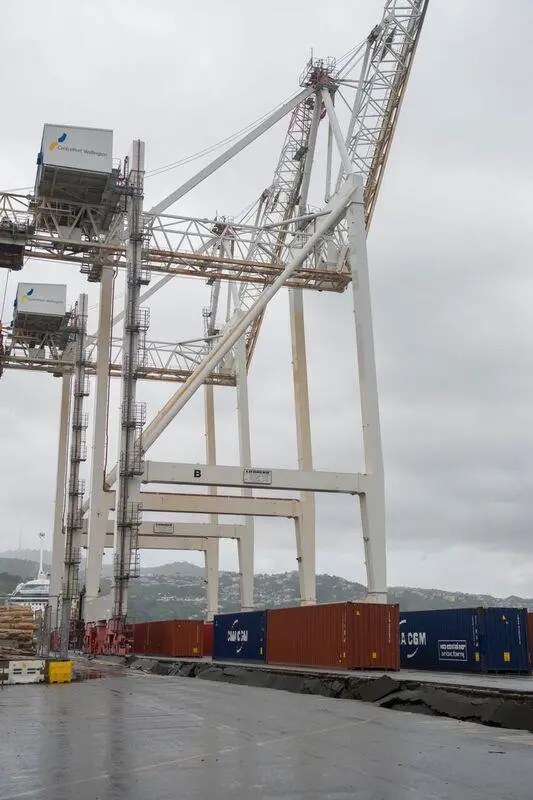
CentrePort Wellington’s future is uncertain following the 7.8-magnitude Kaikoura earthquake in November 2016 that significantly damaged wharves, commercial buildings and roadways. Its lucrative property business suffered a major blow, with options for repair or renewal being considered for affected buildings.
CentrePort’s container terminal – which reported a 23% lift in throughput to 132,000 teu in 2015-2016 – is understood to have subsided by over half a metre. Its container shipping capability had been affected in the short to medium-term, with its two gantry cranes and container berth out of action. The future prospects for the container terminal will depend on engineers’ reports.
Should the terminal need to be demolished and rebuilt, CentrePort’s container trade aspirations – which were about to be buoyed by a channel-deepening project – could be undermined. The estimated two years’ outage for a rebuild would see shipping services become entrenched at other ports.
However, Greater Wellington Regional Council – which owns about 77% of the port – has vowed that CentrePort will not be allowed to fail.
Meanwhile, Lyttelton has continued its recovery path following the devastation of the 2010-2011 Canterbury quakes. Capital investment since has now reached NZ$286.9m, principally funded by insurance proceeds received in 2014 of NZ$357.6m.
Lyttelton says it is committed to significant further capital outlay to “replace destroyed assets, increase resilience and maintain competitiveness” and recently unveiled a 30-year future-proofing plan
The overarching strategy is to move the port towards the east, expanding the container terminal onto 34 hectares of reclaimed land and deepening the harbour to accommodate 6,000-8,000 teu capacity vessels (expanding from the current capacity of 4,000-5,000 teu). A new, larger berth for oil vessels, new and/or upgraded log facilities and rebuilt inner harbour jetty are in various stages of completion, while plans to build a new cruise shipping terminal are being evaluated.