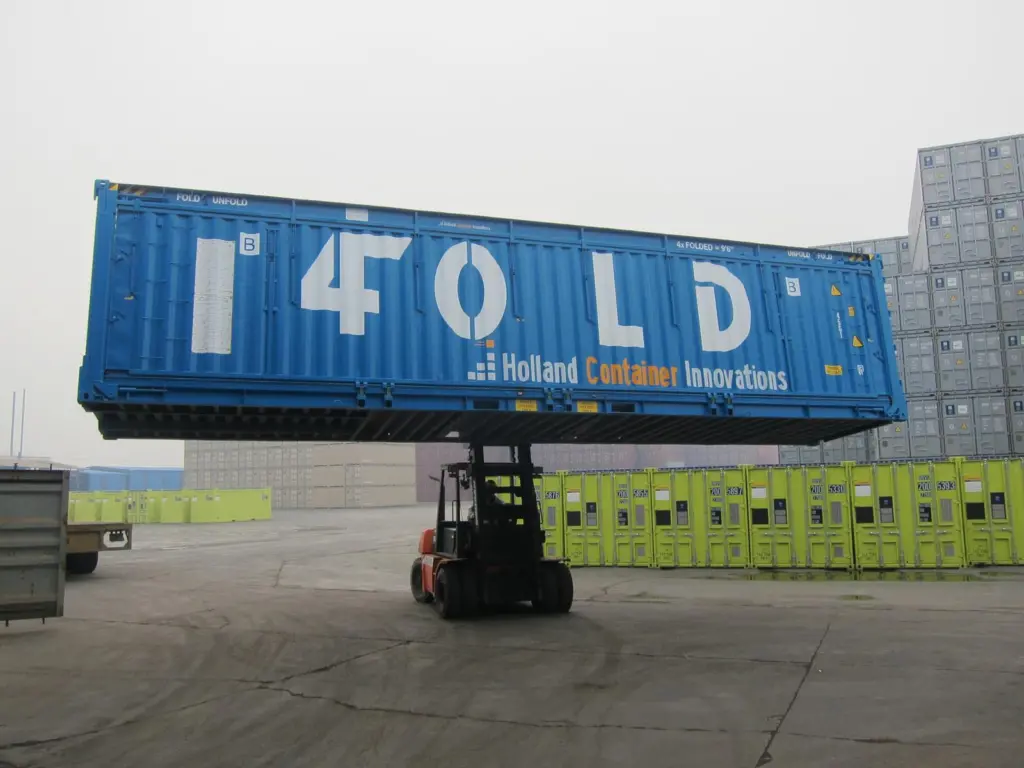
The 4Fold has the potential to significantly improve efficiency in container transport. When the container is folded it takes up only 25% of the volume of a standard container. The space saving can deliver a cost saving of up to 25% for shippers on land and sea.
Repositioning empty containers
As a result of the rapid development not only of China but also of the other BRICS (Brazil, Russia, India and South Africa), the number of container movements in the last decade has significantly increased. This is parallel to the huge increases in volumes of containerised exports from China to Europe and the USA. Considering that China has a positive trade balance, and new containers have been manufactured there, ocean carriers do continuously relocate their empty containers to their next point of cargo. The global imbalance of imports and exports means that ocean carriers may even have to move empty containers from Europe to, for example, Asia. Ocean carriers end up spending about €25 billion a year on repositioning empty containers to the point of their next cargo. On average, 20% of the containers transported at sea, and 40% transported on land are empty. This economic inefficiency cuts into shipping lines profitability and increases unfavourable greenhouse gas and fine particle emissions. In order to keep the system in balance, there must be a same number of containers moving in both directions. This imbalance continues to expand. The costs caused by the transportation of empty containers, due to the trade imbalance can be significantly lowered when shipping lines use the 4Fold. Throughout the complete logistic chain serious savings will be achieved. Given current environmental policy developments there is a high probability that shipping lines will be able to monetise their CO2 emission reductions. Since less transport movements will result in fewer emissions.
ISO certification
The 4Fold is the first 40ft foldable container in the world to receive the official ISO certification, granted on 27 March 2013. This ISO certificate guarantees that the 4Fold meets all industry requirements and can be used in the existing logistic system. The 4Fold is a standard maritime 40ft High Cube container designed to comply with ISO-standards and CSC-approvals. In unfolded state, the 4Fold can be used as a normal container. HCI has developed and patented eight technologies and is the first company in the world to successfully pass the tests of the ISO certification with a 40ft HC Foldable Container. This proves that the steel foldable container meets the same requirements as a standard container. The test are tough, for example, the container stacking test is done with a mass over 360 metric tons, the weight of 2 Boeing 747 airplanes. The container passed the test effortlessly.
When empty, the container can be folded to a quarter of the height. Four folded containers can be bundled and one bundle of four folded container has exactly the same dimensions as a standard container and also complies with ISO and CSC. A bundle of folded containers can thus be handled in the same manner as a ‘normal’ container. The folding and unfolding of the container is done with standard lifting equipment and two dock workers. The operation of the container is completely done from outside. The (un)folding time for trained personnel is expected to be around 4 minutes (based on tests with prototypes).This results in fast, easy and save folding and unfolding of the container. All parts of the container stay connected, in this way no parts of the container can get lost. Furthermore, the container is completely made from steel, and many standard parts are used. In this way it is possible to use parts from standard containers to repair the foldable container around the world.
Early 2009, HCI completed, together with a major shipping line and the Delft University of Technology, the first prototype, which served as a proof of concept. The first prototype of the 4Fold worked as expected. Areas for improvement were identified and have resulted in a redesign in which the weight has been reduced considerably and the functional operability has been improved. From the start of this phase, HCI has cooperated with a Belgian manufacturer. This manufacturer has built a container according to the design and assisted HCI to obtain the CSC certification. This milestone was reached in June 2011 and recently in 2013, HCI received the ISO certification. Currently HCI is setting up the production for the first series of foldable containers, which will be followed by a number of pilot projects with various shipping lines, who will use the 4Fold on a daily basis.
Economic and environmental benefits shipping lines
Savings for a shipping line made with a foldable container depend on the chosen route and the trade imbalance. A foldable container will result in lower transport costs for repositioning, storage and ship handling. Extra costs are mainly folding and unfolding, maintenance and initial investment. Calculations have shown a possible increase of the shipping lines’ profit margin of 600%, corresponding to savings up to 25% on the operational costs and 2,7% on the total CO2 emissions of the container transport at sea.
The most realistic and profitable way for operating the foldable container is achieved by folding at the inland depot. The highest savings on using foldable containers will be realised in transport between inland depot and seaport. If the returning distance increases the total costs with standard containers rapidly increase. Shippers and/or shipping lines will benefit the most of transport costs reduction in trades where multiple empty containers movements in the supply chain are required.
The unique selling proposition of a 4Fold is its ability to reduce expensive transportation cost of empty containers. Folding and stacking are the two distinctive and important features of foldable containers which make saving on transportation cost and time possible. For deep-sea transport, handling is more than 11% of the total cost of the container transport and for short sea this is even more (>13%). This cost is made in less than 1% of the time a container is in the logistic chain.
There is a critical shortage of storage space in many ports in the world. Empty containers are stored in order to wait for a modality to take them to a certain place. The storage space required for empty containers will strongly depend on the dwell time of each container. Besides the economic, environmental and financial benefits, the foldable container also influences social aspects like noise pollution, aesthetics, (city) development and employment.
If you are interested or if you would like to receive more information about HCI, the foldable container, the official ISO approval and/or possibilities for cooperation, please contact HCI: info@hcinnovations.nl.