It was a message the host port Amsterdam was keen to enforce in its welcome address.
“If we work together we can influence fairer and more efficient supply chains,” said Koen Overtoom, CEO Port of Amsterdam.
“But we must also get better at compromise with other stakeholders in order to get the job done.”
Innovation
A keynote address by Jan Peter Balkenende, chair of the Dutch Sustainable Growth Coalition, introduced the concept of innovation to address global sustainability issues.
“The traditional way of working sometimes prevents us from making positive changes and seeking innovation,” he said.
“But if we don’t share knowledge and work together we run the risk of failing.”
Lamia Kerdjoudj-Belkaid, secretary general FEPORT said that the fourth industrial revolution is well on its way including major changes such as digitalisation, remote management and high technology.
All of which can be utilised to harness better sustainability.
“Innovation isn’t something we should fear but embrace, the first movers will prosper in the new economy,” echoed Conor Feighan from FEPORT.
Collaborate
It’s all very well to innovate, but the real game changer in driving sustainability will be collaboration and knowedge sharing across the industry, especially when it comes to urban and port planning.
“But to do this we need to solve the lack of coherence and the poor knowledge exchange between interest groups” said Malte Siegert, head of environmental policy at NABU.
The NGO’s relationship with the Port of Hamburg could be looked at as an example for others. It’s strong collaboration between all interest groups has led to the port’s new clean air action plan.
The Port of Dover in the UK is applying the same principle to traffic management. Vicki Jago, head of safety and environment at the port, said that if it didn’t collaborate with a number of parties, the result would be a queue of traffic from Dover to Antwerp.
The port tackles the issue in a number of ways including using a traffic modelling tool called Blip Track. The tool shares data with a number of stakeholders including the Highways Agency to predict and manage queuing. This has resulted in queue reduction of 50%.
Sustainability Development Goals (SDGs)
The second session focused on the UN SDGs and their relevance to the port industry.
Claire Bryant from Future Proof Solutions said that SDGs should be used as a tool to provide data, benchmarking and reporting frameworks to improve sustainability.
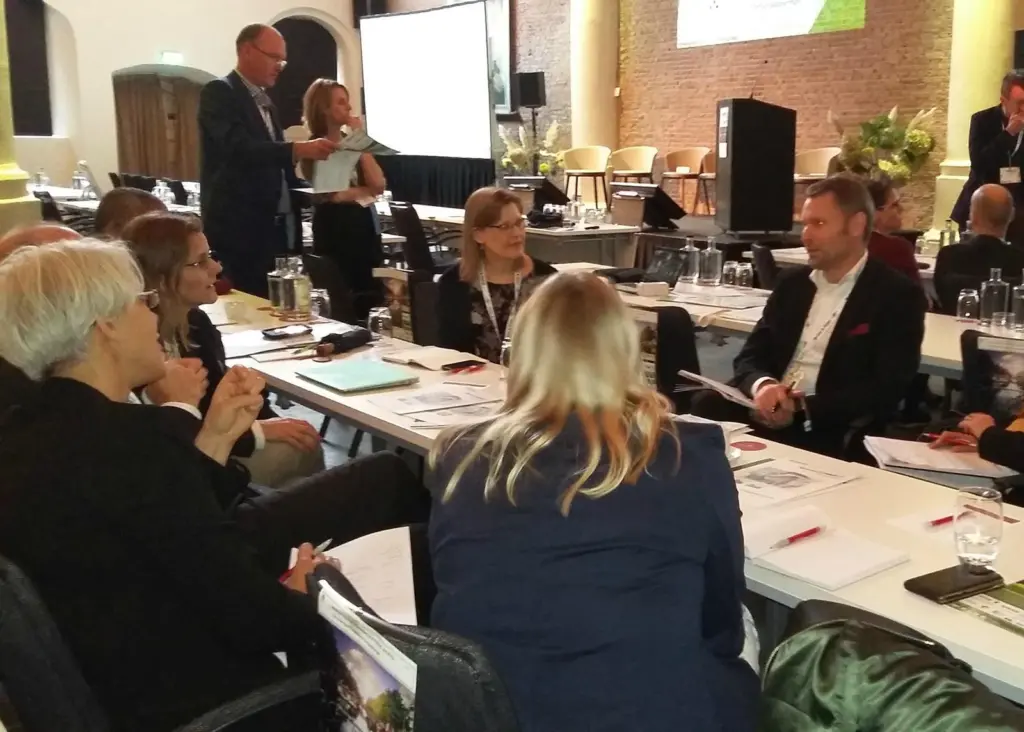
In one of the breakout groups, delegates were encouraged to talk to each other and come up with the challenges and opportunities that can affect sustainability reporting.
Challenges noted by delegates included finances, a reactive attitude and a lack of clear leadership..
Delegates were then encouraged to think outside the box and come up with opportunities to get better with sustainability reporting.
They concluded that these challenges could largely be tackled by sharing information, sector collaboration and innovation.
Jason Sprott, Sprott Planning and Environment, advised delegates to address the SDGs to best suit their individual businesses.
They are best used as part of the reporting process as a strong starting point for dialogue to involve all port stakeholders in tackling sustainability targets.