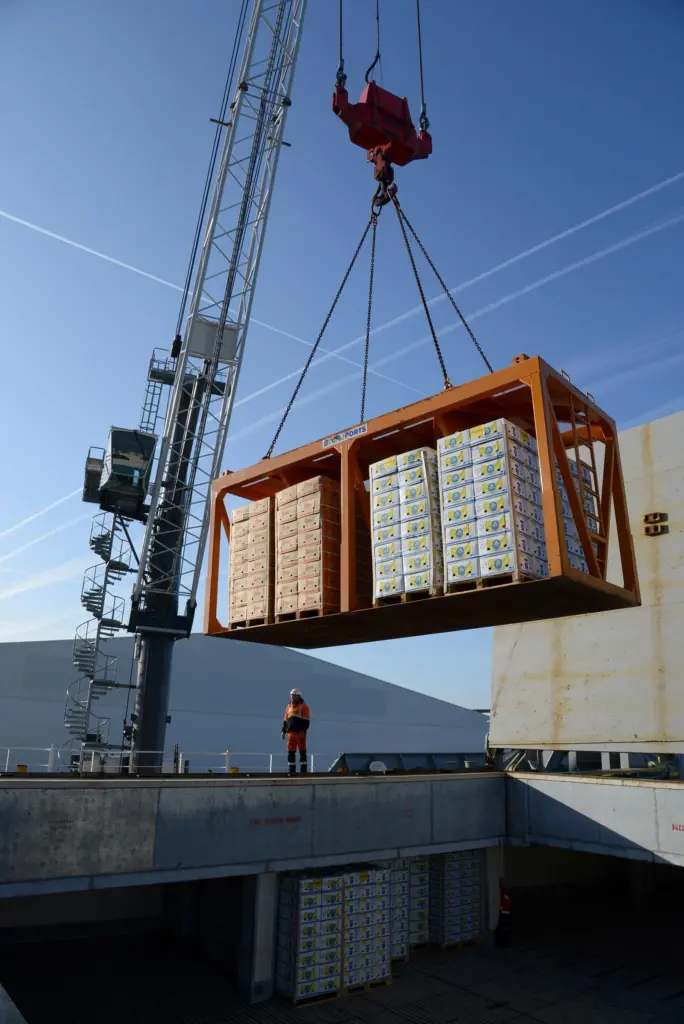
The movement of ever-larger numbers of refrigerated containers through the cold chain is posing new challenges to the industry, not least in plug demand and storage capacity.
Antwerp is a strong supporter of the reefer industry, offering specialist services for sensitive goods, such as pharmaceuticals. The port authority’s business development manager, Maartje Driessens points to an increase in the number of reefer plugs at deep sea terminals as a sign of the burgeoning market. “Warehousing capacity has increased significantly, with new players in the port offering cold and frozen storage,” she says, citing Antwerp Cold Stores.
Reefer containers can be a lucrative product, she adds, which is likely why many carriers have invested in extra reefer containers over the past few years.
It is a similar scenario at Terminal Pacifico Sur (TPS), in the Port of Valparaíso, Chile’s leading reefer box export facility. According to chief executive Oliver Weinreich, reefer volumes have increased strongly over the past few years. “On the back of this, TPS has made significant investment in both fixed and mobile reefer stations,” he says. “Today, we can offer 3,000 reefer plugs, which are distributed throughout the terminal.”
Mr Weinreich notes that investing in sufficient reefer capacity is costly, both in terms of infrastructure and energy and is one of the challenges that terminals have to face. Minimising reefer boxes’ costly electricity use, is, to an extent, impacting on how they are being handled.
In Chile, while exporters do seek to minimise dwell times of reefers in the port, they are not necessarily driven by energy costs per se; rather they wait until the last possible moment to send cargo to the terminal, which is then dispatched in the largest possible consignment size.
“In recent years, we have seen changes in the ways that reefer containers are handled, both in terms of existing refrigeration technology and in the way that information about them is registered and tracked. We now have manual scanners that allow the exporter to have information about the state of the reefer in real time,” says Mr Weinreich.
Tracking cargo
Meanwhile, TPS continues to look for ways to improve information reporting, and also to reduce the time that the containers are disconnected before being loaded on to vessels. Investment has been made in RTE technology to retain as much control as possible and also to track the cargo for every minute that it remains under TPS’ control. This has included acquiring mobile reefer stations to ensure that these containers can be moved around in the optimum way and completely within the terminal’s control.
“How terminals handle reefers depends on the volumes that they attract and how important reefer traffic is for them,” says Mr Weinreich. “In our case, given that we are in one of the world’s most important fruit exporting countries, the key is being able to give a quality service to our customers, and having an evenly distributed capacity for connections throughout the entire terminal, which we can easily look after,” he says.
In Antwerp, some shippers are now opting for a “port centric” model when managing their stocks. As an example, Ms Driessens cites a famous French fries producer that keeps a strategic stock in the port of Antwerp, so that the cargo can be stuffed into reefer containers immediately after a new order is placed and, therefore, be shipped very quickly.
“This model also helps carriers to keep idle time for reefers to an absolute minimum in respect of hinterland transport,” says Ms Driessens.
She suggests that reefer boxes are becoming more and more economical in their energy use too, thanks to the incorporation of the latest technologies.
“Carriers are already making the utmost effort to prevent them idling in stacking yards, where they are not active, or not making any profit, anyway,” she says. “Furthermore, as a means of ensuring that reefers are where the market needs them to be, on those trade routes where there is an imbalance, such as between Latin America and Europe, sometimes reefer containers will be sent back with other cargo – finished vehicles, for example – in a non-operating mode.”
Hinterland support
Ms Driessens stresses that the port authority does not try to intervene in strategies adopted by the carriers, but it does try to increase the fluidity of hinterland transport by supporting the intermodal transport of containers.
“New initiatives transporting reefers via barge (instead of road) will, for example, be financially supported by the port authority during the first three years. Such systems speed up the transport of reefers both to the port and to the vessel itself,” she says.
She also sees a change in the way that containers are being handled nowadays, with the containers themselves becoming ever smarter. In particular, she points to remote data management technology as having dramatically increased the transparency and control elements of the cool chain, with new information on temperature, humidity and location having optimised reefer box management.
In this respect, Mr Weinreich claims that TPS handles reefers better than some other terminals having, for example, hired specialist staff whose remit is to be entirely focused on reefer traffic, both physically within the terminal and also tracking it on line.
“In Chile, we have unique infrastructure, which is very much in the vanguard, and this allows us to be versatile and competitive in operations, not to mention that we now have years of experience as South America’s leading exporters of reefers,” he says.
Tried and tested
Antwerp, too, has a long history in the reefer handling market and has built up specialist know-how over that time, says Ms Driessens.
“A yearly perishable volume of almost 10m tonnes speaks for itself. Moreover, the Fruit & Perishables expertise group, including all the reefer specialists in the port, try to optimise their services via common research and through the sharing of best practices.”
The Belgian port also has reefer repair shops available on site, which allows repairs to be undertaken within the port, obviating the need to move them outside to specialists.
The deep sea terminals continuously invest in their reefer infrastructure, too, while their close location to the Food Safety Inspection allows fast and efficient procedures to be maintained.
Terminals at Antwerp also realise that qualitative reefer management is an indispensable requirement if they want to keep attracting the deep sea carriers, says Ms Driessens, adding that all container terminals at the port have invested in reefer infrastructure during the past few years.
Mr Weinreich adds that, in order to have high volumes of reefers as well as high productivity, it is essential to have refrigeration equipment present on site that is prepared for the arrival of vessels, since many times units fail and vessels lose time and incur extra cost all because of one specific unit.
“Efficient and rapid problem solving therefore ensures efficient operation at all levels,” he says.
SMOOTH HANDOVERS AND FLEXIBILITY
Antwerp’s Maartje Driessens highlights the biggest challenge faced by the cool chain as the continued ability to guarantee a smooth transfer from the terminal to the hinterland – and that means no waiting around, even in times of rapid volume growth at the terminals.
“We try to enhance this via initiatives such as extended gateways, night opening of the terminals, lower toll rates in our toll tunnel during the night, and so forth,” she says.
Terminal Pacifico Sur’s (TPS) Oliver Weinreich notes that the industry as a whole has improved and that cargo today is looked after better than ever before.
“Nowadays, it is rare that cargo is negatively impacted because of handling inefficiencies,” he says. “In the case of TPS, our operational protocols are extremely rigorous and seek out ways of ensuring that cargo is never negatively affected.”
Ms Driessens notes that a future challenge will be ensuring the continued ability to adjust to trends in the market.
“Fruit terminals in the port of Antwerp have luckily been able to become ‘hybrid’ installations, being able to handle both breakbulk and container vessels. This has required investment in new cranes, the creation of extra space for empty containers and training of the staff, among others. A good example is the Belgian New Fruit Wharf terminal, which handles both conventional vessels and the container vessels of producers such as DOLE.”
Whether terminals invest in the reefer market or not depends on national and regional realities, and on a terminal’s particular focus. “However, it would be somewhat odd to think of a container terminal that isn’t equipped to handle reefers,” Mr Weinreich. “We believe that would be a luxury that a terminal couldn’t really have nowadays.”