“There are a lot of good ideas out there, but you need practical experience,” says Bård Haug of SpillTech, a company that’s turning from oil incident mitigation to trash clean up. If a system is going to be sitting out there for extended periods, there are the various stressors of current, wind and waves “and you also want to know what happens to your technology when it’s exposed to UV and saltwater” he points out.
A couple of companies have hit on practical ‘bin’ solutions. The Portbin has been designed for those nasty patches that keep turning up in sheltered corners. It sits neatly with just an upper hoop showing on the waterline and moves with the tide, an impeller drawing the flotsam into the collecting basket below. It also presents fairly a low entry bar for investment: you’ll probably get change from US$10,000 on the standard model.
In a similar fashion, the Seabin relies on a water pump to suck the floating trash into a mesh bag. Founder Pete Ceglinski says that cigarette butts, packaging and – tellingly – microplastic particles are the most common items caught but larger items, including a banana tree and an office chair, have been found trapped by the inflow. Interestingly, Seabin is involved in a reverse crossover, it is to start mopping up small patches of oil using an inexpensive absorbing pad.
Although these are fairly economical, low-power units, they will likely require a straightforward electrical connection. Solar panels might seem an obvious pairing but Haug explains that the PortBin’s 900W draw would probably demand a sizeable photovoltaic installation.
Therefore, SpillTech is also looking at a passive device for off-grid deployment. Again, this takes advantage of local conditions – instead of reaching across the whole breadth of the fairway, a boom is positioned so that the current shunts the greater part of the flotsam along to the basket.
However, while the smaller ‘bin’ designs can be emptied by hand, the XL sizes will likely need a crane or winch. This is an often underappreciated detail: although the volume of material may not account for much, “if bottles or containers are partly filled with water, or there are a lot of autumn leaves, the weight in a 1,000-litre basket can reach half a tonne”, explains Haug.
The TRASH system, developed by New Naval Ltd (another oil spill crossover), goes some way to answering the issue. This combines channelling booms with subsurface skirts, directing the garbage to a multi-tiered, removable steel mesh collection cage sitting on a floating base.
Efficient, low-power onboard pumps switch layers as they fill “but it also gives the top storage levels a chance to evaporate or drain off some of the water before collection”, explains designer Alexandros Panagopoulos, adding that the prototype cage can be lifted off and tilted which further lightens the load “assisting the recycling company with the final processing”.
Testing in Piraeus
The full scale model, tested in Piraeus last year, features a 6m long, 3m wide and 4.7m high three-level cage capable of holding nearly 900kg of rubbish before emptying by truck or barge-mounted crane.
However, it’s both scalable and configurable for the location: for example, adding an impeller could increase flow into the cage. Further, the Piraeus prototype ran from batteries paired with solar panels “but you could also use wind or wave power for other off-grid installations” says Panagopoulos. Interestingly, remote online video monitoring, information and activation can take place by PC or even smartphone app.
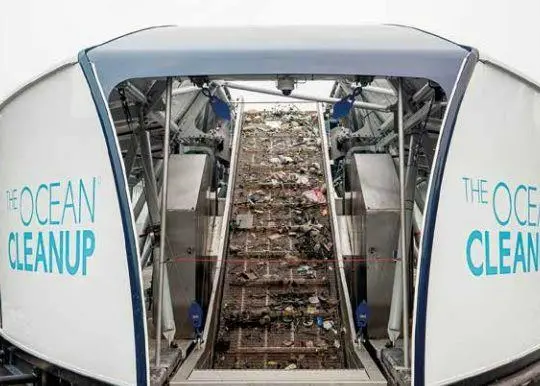
There is another, even larger solution for plastic-heavy waterways. The Interceptor, developed by the Ocean Cleanup team, still relies on a current to shift the trash along a collection boom to the collection vessel. But at this point the process becomes very high tech: a permeable conveyor belt lifts the flotsam upwards onto an automated shuttle which distributes the waste into bins sitting on a barge between the hulls. Oversized debris is taken care of by a passive deflection function, conveyor jams trigger an automatic shut down.
Once a filled barge is taken to a local waste management facility, the shuttle will act as a buffer, continuing the trash collection. Though designed for 24/7 autonomous operation, the power demands can be covered by the 5.6kW photovoltaic cells paired with a 20kWh lithium-ion battery. An internet-connected onboard computer monitors the system’s performance, energy usage and component health.
It is effective, capable of dealing with 50,000kg of trash a day – even 100,000kg under ideal conditions, claims the team. Obviously, this would require intensive discharge operations but the automatic bin filling means there is no tricky, manual loading.
Again, it’s a step up in price. The first pilots in Jakarta, Klang, the Mekong Delta and Santa Domingo cost around US$750,000, but once it is in series production, expect the price to drop, say the Ocean Cleanup team.
Other trash collectors are swimming over the horizon: SpillTech, for example, has been developing a battery-driven robo-cleaner. The stable, double hull and twin thruster design has no rudder to foul – and it has enough onboard power for a normal, eight-hour shift.
“It has a shark’s wide mouth, and behind that is a big mesh bag ‘stomach’ that can be swapped out when it’s full,” describes Haug, adding that the idea is to make that automatic. With a beam of just 240cm it’s small enough to be transported on a jet-ski trailer: “It could be taken from place to place, hoover up the rubbish, and then be packed off for the next location,” he explains, which means that it could be useful for share agreements or rental.
While Haug says the prototype “is already out there, doing small jobs… and looking very efficient”, SpillTech is looking to enlarge the 200Ah battery capacity and get it to move little faster than its present 2 to 3 knots: “We’re also experimenting with a docking station design, which would automatically empty and recharge the robot cleaner at the same time,” he adds.
The approach in Canada
Some regions suffer far more than others: “There are places around ports where you cannot see the water for plastic,” says Radé Svorcan, of Canadian developer, Technika Engineering. It is a real issue – not just for the wildlife which gets strangled or choked by it, but even for critical infrastructure such as pumping stations.”
The problem is, if there’s no current to bring the trash to you, a powered device is necessary – and ideally one able to carry on working without crew. At the same time the sheer volume of rubbish militates against the simple evolution of existing, manned sweeper designs into remote or autonomous operation. Firstly, “these have a high power demand as the vessel is working hard against drag and the volume of water trapped between the booms”, explains Svorcan. Secondly, and arguably the biggest problem, “is the tendency to clog”.
Therefore, the DeltaSea device takes a completely different approach. A pair of helicoidal ‘arms’ don’t fight the water or garbage, but instead continue turning their way through the floating trash: their screw action yields a steady, 1m per second pace and delivers the debris to the collection basket at the rear. Onboard is the appropriate signalling, communication and monitoring tech to operate it remotely (in busy locations) or even autonomously out in the open sea; those utilised in high traffic areas will have additional cameras – and ideally be integrated with the port’s VTS.
It may be novel, but recent trials in Vancouver have demonstrated the DeltaSea’s effectiveness: “It can cover up to 0.5km2 of water surface area during a 24-hour period,” says Svorcan.
While the first units will run on batteries recharged at the quay, the idea is that later devices will be able to pick up solar and wave energy, yielding a longer range. Most importantly, there is also the option of adapting the craft’s rear to connect with a conveyor and barge to accept larger quantities of debris prior to transfer to shore. Further, the DeltaSea isn’t limited to plastics: it can also clean up oil and chemical spills in a pollution incident.
The initial design (with a price nominally starting around US$150,000) has 6.5m booms with an 8.5m spread which, usefully, can be altered or closed up entirely for stowage and transport. However, Svorcan adds that as it can scale up easily, other, higher-throughput sizes “are available”.