



Germany fast tracks hydrogen
The Ukraine crisis is spurring Europe on to move away from crude and embrace renewable fuels faster
German energy firm Tree Energy Solutions (TES) is accelerating its plans to develop the German port of Wilhelmshaven into a global green hydrogen import hub.
The fast-tracking will provide for alternative energy security in the longer term for Germany and Europe whilst accommodating LNG as an intermediate source of energy supply given the current energy-crisis.
”The TES-Wilhelmshaven project is unique in its ability to achieve Germany’s and Europe’s plans to decarbonise in a sustainable way at an industrial scale whilst carefully and prudently navigating the current energy-crisis,” said Paul van Poecke, founder and managing director at TES.
Hydrogen focus
Mr van Poecke said that the Wilhelmshaven green gas terminal will be sustainable, carbon-neutral and transitional, meeting the German’s government short term and long term energy requirements.
ON a wider scale, the Wilhelmshaven project, initiated in 2019, will account for 10% of the total annual primary energy demand of Germany by 2045.
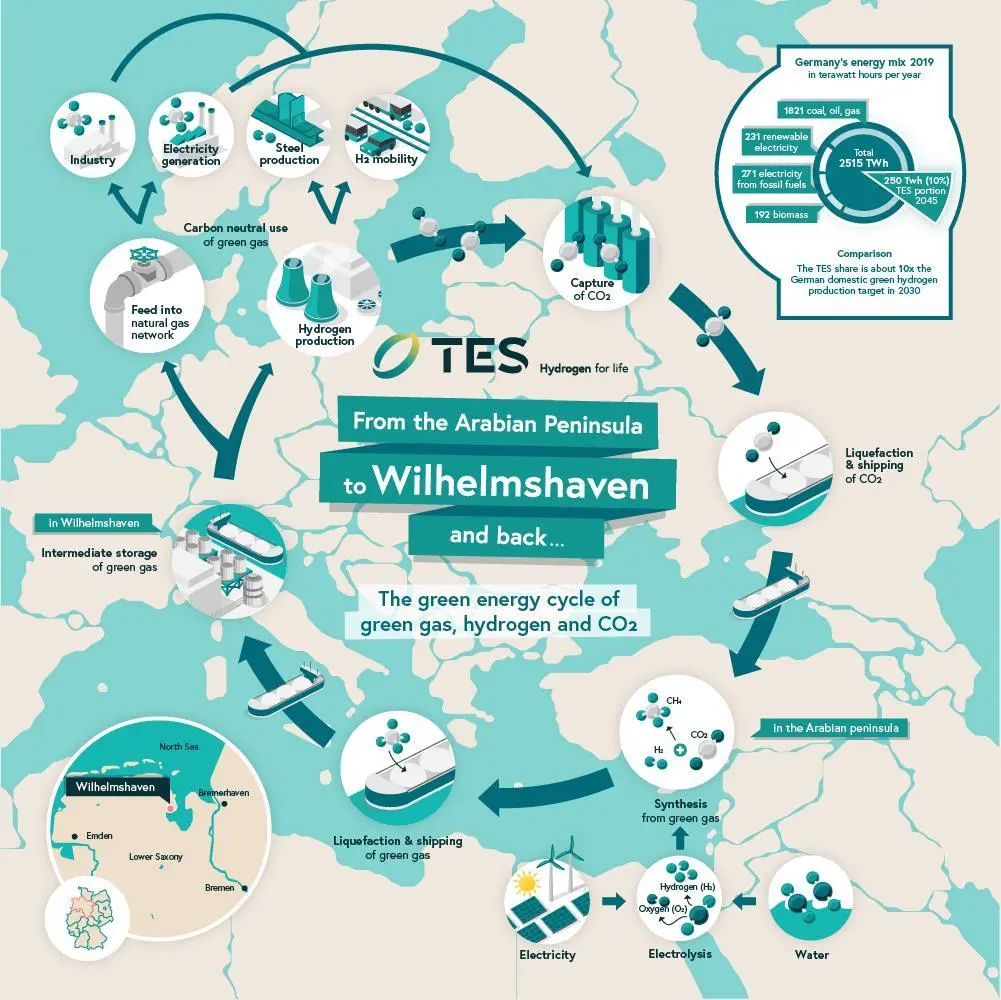
TES Green hydrogen will be primarily produced using solar, wind and hydro power in countries with abundant renewable energy sources, after which CO2 will be added to make green CH4 which will be used as the ‘energy carrier’.
This will then be transported to Wilhelmshaven utilising a specially constructed fleet of ships. At Wilhelmshaven, the green CH4 will be converted back into green hydrogen, with the resulting CO2 being captured and returned to the producing countries by ship in a continuous closed-loop system, this way the CO2 never leaves the cycle avoiding GHG emissions.
In the initial phase of 25 TWh per year of green gas import, more than half a million tonnes of hydrogen will be produced and imported in Wilhelmshaven. This will rise to 250 TWh per year and more than five million tonnes of hydrogen in a final stage. This corresponds to one tenth of the total annual primary energy demand of Germany.
Related Articles
 ALTERNATIVE FUELS GREENPORT
 ALTERNATIVE FUELS GREENPORT
 ENERGY & TECHNOLOGY GREENPORT