![GreenPort[PortStrategy]](https://www.portstrategy.com/greenport/wp-content/uploads/sites/4/2026/09/GreenPortPortStrategy.svg)

LNG ferry first
LNG powered ferries are bringing more bunkering opportunities to Spanish ports
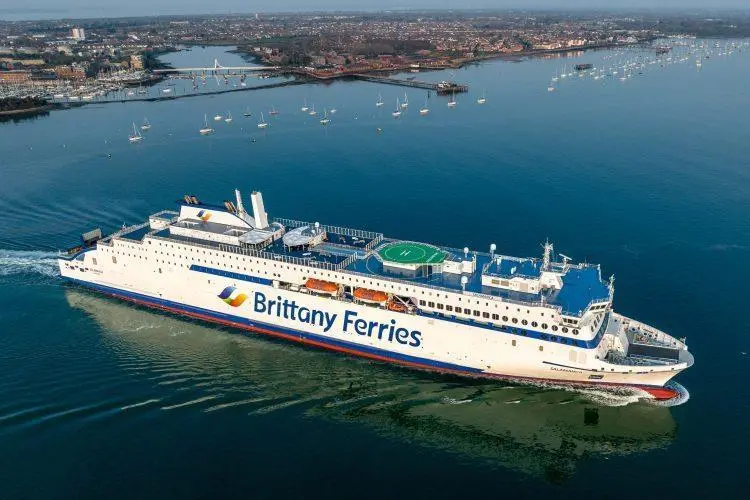
The UK’s first LNG-powered ferry has completed its inaugeral voyage from Portsmouth loaded with more than 600 passengers and freight vehicles bound for Bilbao.
Salamanca is the first LNG powered vessel to join the Brittany Ferries fleet, but it won’t be the last. By 2025 four LNG ferries will be based at Portsmouth, including two hybrids.
“LNG-powered ships like Salamanca are a clear statement of our commitment to the future and to fleet renewal,” said Christophe Mathieu Brittany Ferries CEO.
“They are cleaner vessels, significantly cutting air quality emissions like soot and sulphur. That’s good news for port partners today, but they could be even greener in the years to come.”
Future proofing
Salamanca will make two round trips to Bilbao each week. It will also make a weekly return-voyage to Cherbourg in France. Bilbao has been equipped with a bunkering terminal to power the ship, supplied by fuel partner Repsol.
In addition, Salamanca is capable of running on future fuels like e-methane or bio-methane if these become available in volume.
Brittany Ferries will strengthen its partnership with Portsmouth even further next year when Salamanca’s sister-ship Santoña joins the fleet. LNG-powered Santoña will connect Portsmouth with Santander. Both Bilbao and Santander Ports will host bunkering (refuelling) terminals to power the ships, supplied by fuel partner Repsol.
Two LNG-electric hybrid vessels will also arrive in 2025 connecting Portsmouth with St Malo and Caen. They will operate in a way that is analogous to a hybrid car, powered by LNG, by battery power or by a combination of the two.
The hybrids will be shore-side-power ready. This means they could be plugged-in, when port-side infrastructure allows. Portsmouth International Port has just applied to the area’s distribution network operator (DNO) to begin the process of upgrading the electricity supply.
Related Articles
 ALTERNATIVE FUELS GREENPORT
 ALTERNATIVE FUELS GREENPORT
 ALTERNATIVE FUELS GREENPORT