



Birth of the super-port
Hong Kong and Shanghai have barely stopped for breath over the last 50 years, as Wing Kah-goh explains
The advent of the container just over half a century ago, undoubtedly changed the face of shipping allowing two budding port beasts to renew their battle for business with vigour.
But while both are now at the top of their game, it’s been a rocky road for Hong Kong and Shanghai, and their respective futures are less than clear.
Their distance apart is the equivalent of Hamburg to Genoa and their hinterlands stem from two great rivers. Yet few places on Earth match Shanghai and Hong Kong for preeminence as port cities. Both are heavily interlinked; Hong Kong’s current shipowners hailing from the Shanghai region and these same tycoons helping spur Shanghai to ever greater maritime feats.
Originally a fishing and textiles town, Shanghai – which literally translates as ‘on the sea’ – grew to importance in the 19th century due to its favorable port location and as one of the cities opened to foreign trade by the 1842 Treaty of Nanking. The city flourished as a centre of commerce between east and west, and became a multinational hub of finance and business by the 1930s.
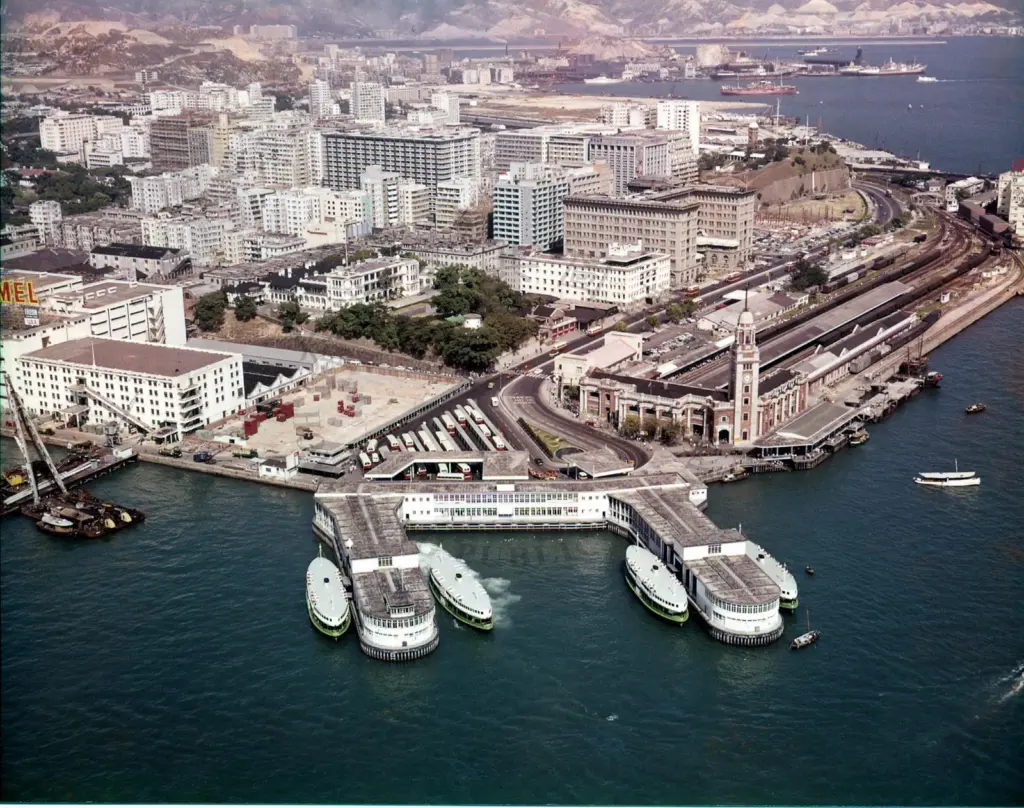
Hong Kong, meanwhile, was nothing but an inhospitable, sweaty rocky outcrop back in 1842 when the British took it over. It was undoubtedly a strategic natural harbour, but with very little else at the time – “an upland terrain which the sea has invaded” as a 19th century government official eloquently described it. Pioneering businessmen and sheer perseverance would eventually change Hong Kong into one of the key trading hubs of the world.
By 1906, Hong Kong cargo throughput exceeded that of contemporary London and New York – 22.m tonnes as opposed to roughly 20m tonnes for the two major capitals, according to Dr Stephen Davies, director of the Hong Kong Maritime Museum.
It was 60 years ago that the Communists overran Shanghai, forcing a tide of swift migration to the south, to Hong Kong, the then British colony. Post World War II Hong Kong could not have been more different than today. A desperately poor place, it was bolstered by the raw ambition of the influx of Chinese flooding into the territory to avoid Mao’s soldiers – up to 100,000 people a month at its peak.
Many of Hong Kong’s most famous names in shipping – the Tungs, Paos, Tsaos and Chaos – were among the first wave of this huge exodus. They would not properly return to their motherland for another 40 years. The few ships they bought with them were added to with second hand tonnage from Europe, most of which was sold onto Indonesians by the end of the 1950s for a tidy profit.
Frank Tsao, the 83-year-old founder of shipping conglomerate IMC Group, recalled his family’s flight from Shanghai, two months before the city fell to Mao’s troops.
Unlike the majority of citizens “the move was very lucky and smooth, we travelled by air so it was a deluxe way of running away”, he says.
Living conditions were decidedly cramped in Hong Kong to begin with. Mr Tsao’s family, the servants and their families all lived in one room. “The toilet was like a toilet on an aeroplane – you had to queue up and wait.”
Shanghai, once labeled the Paris of the East, for its exciting, fast paced attitude to life descended into darkness during the 1950s as austerity, laced with dictatorship, kicked in to knock the high life out of the city.
During the 1950s and 1960s, Shanghai became an industrial centre and centre for revolutionary leftism. For most of the history of the People’s Republic of China (PRC), Shanghai has been the largest contributor of tax revenue to the central government compared with other Chinese provinces and municipalities. This came at the cost of severely crippling Shanghai’s infrastructure and capital development, including the port.
As the 1950s progressed, the Cold War warmed up, the Korean War crackled and Chang Kai-Shek’s Nationalist navy blockaded the mainland’s ports, all of which Mr Tsao acknowledged made it a “time of difficulty” but also “a period of opportunity”.
To carry one tonne of cargo from Hong Kong to Shanghai in those days, just three days sailing, would net HK$300, a sizeable sum, equivalent to an entire year’s salary for one of Mr Tsao’s servants.
“There were shortages of every material and prices went up several times,” Mr Tsao says, adding, “We made huge percentages of profit and were able to consolidate ourselves financially.”
For the maritime historian, the break bulk trades handled in Hong Kong were a fascinating but painfully inefficient way of transport. In 1956, the average ship took 57 days to transport a cargo from Columbo to discharge in Hong Kong, of which 11 days were at sea. Today, the same journey takes 19 days of which 11 days were by sea. “That’s the box; it has transformed the world,” says Dr Davies.
Hong Kong would see an enormous economic resurgence in the 1960s, becoming a so-called Asian Tiger. The territory’s shipowners formed close ties with the Japanese shipyards to massively expand their fleets and become some of the largest shipowners in the world. The textile industry proved the backbone for the colony’s booming economy. ‘Made in Hong Kong’ adorned products worldwide. Shanghai meanwhile grappled with the disastrous Cultural Revolution, further distancing the mainland from global trade.
Malcom Mclean invented the concept of container shipping on the US’ east coast in 1956. Sixteen years later, Hong Kong’s first container terminal came into being, run by Modern Terminals. Hong Kong would go on to become the world’s largest container port, a position it only relinquished to Singapore in 2005. Last year Shanghai also surpassed it.
Political power in Shanghai has traditionally been seen as a stepping stone to higher positions within the PRC central government. In the 1990s, what was often described as the politically right-of-center “Shanghai clique,” included the president of the PRC, Jiang Zemin, and the premier of the PRC, Zhu Rongji. Starting in 1992, the central government under Jiang Zemin, a former Mayor of Shanghai, began reducing the tax burden on Shanghai and encouraging both foreign and domestic investment in order to promote it as the economic hub of East Asia and to encourage its role as gateway of investment to the Chinese interior. Since then it has experienced continuous economic growth of between 9%-15%. As well as HPH, the AP Moller Maersk Group was an early party to the Shanghai ports scene.
As cash piled in central government embarked on what many saw as a vanity project – Yangshan Deepwater Port. A pair of islands to the southeast of the financial metropolis were coated with concrete and quay cranes, opening in November 2005 and will eventually spawn 52 berths. Shanghai, already the largest port in the world, with 560m tonnes of cargo last year, could surpass Singapore in 2009 to become the largest box port across the globe.
Meanwhile, down south in Hong Kong (which literally means Fragrant Harbour), the port is struggling to stay in touch, posting single digit growth for a number of years, based on more transhipment cargoes. Hong Kong suffers from high prices and being comparatively far away from the cargo base. While analysts and civic leaders have started to clamour to let the port fizzle out and redevelop it in, say, ten years as property developments, the local government confounded critics earlier this year by announcing plans to develop a tenth container terminal at Tsing Ti island. Hong Kong is not yet ready to relinquish its physical trading past.