![GreenPort[PortStrategy]](https://www.portstrategy.com/greenport/wp-content/uploads/sites/4/2026/09/GreenPortPortStrategy.svg)


Automation justification
Automated guided vehicles make sense on a productivity and a labour cost front if the expense can be justified. Alex Hughes report
Better productivity and lower labour costs make automated guided vehicle technology an attractive proposition for any terminal. But high capital costs mean that AGVs remain the preserve of the new rather than existing terminals.
And those new facilities opting for AGVs are taking the technology one step on, moving even further away from technology at existing termainals.
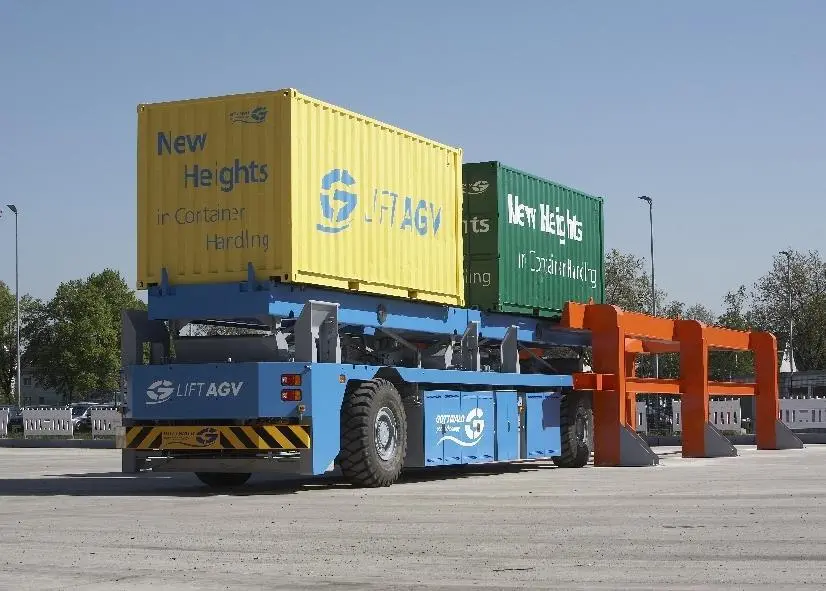
The two new container handling facilities being built in Rotterdam’s Maasvlakte II development zone will be unique in that the automated guided vehicles deployed there will also incorporate a brand new lift capability.
Essentially, the AGVs will pick up boxes on the crane side, transport them to the yard and then place them on a platform. They will then be retrieved by automated yard cranes immediately before stacking.
Frank Tazelaar, managing director of APM Terminals Maasvlakte II facility, notes that from his perspective that while the decision to adopt Lift AGVs is breaking new ground, it is not a particularly high risk move. “The industry will never progress if we don’t adopt new technologies,” he says.
Volumising
Nevertheless, there were sound operational reasons for adopting new technology at Maasvlakte. “The overall driver for deciding on this approach was a perceived need to boost productivity, since, in Rotterdam, we are in a highly competitive market, which means berth productivity will have to be high to attract customers, as will overall terminal productivity.”
Considering that the concession to operate the terminal was for 50 years, the technological fix required had to be suitable for the next three or four decades, too. That meant adopting some degree of non-proven technology if APM Terminals was to reach the necessary productivity. The Lift AGV technology eventually opted for is 90% proven in hardware terms.
“The addition of the lift device is an important step in the direction of higher productivity, but in terms of technology risk we believe that it is relatively limited,” says Mr Tazelaar. In addition to boosting productivity, there were other reasons for going along the AGV route, too.
“In engineering terms, we wanted to automate the terminal as much as we could. We didn’t just want AGVs, but also automated RMGs in the stack and also some degree of automation in the ship to shore cranes. This was driven by our conviction that sufficient levels of highly qualified workers would not be readily available at Maasvlakte II, which is quite some way out of Rotterdam.
“Not only are these people hard to find, but they are also more expensive to employ and that situation was not expected to get any better in the years to come. So, in terms of a business case, adoption of more automation was an easy decision.”
No unknowns
The cost and availability of labour were also elements considered by DP World when deciding how to equip its Rotterdam Gateway Terminal, notes Bruno de Jonghe, director of Projects and Technical Services for DP World Europe & Russia. He says that the new facility lends itself very well for development as an automated AGV terminal, given that there is sufficient space to implement it. In addition, with ECT already using AGVs at the port, the technology is not unknown there.
Software glitches can be a threat to AGV fleet control, but successful operations at similar terminals in both Rotterdam and Hamburg mean that the software should be mature enough for the RGT operation. He also sees few technical differences between Lift AGVs and conventional AGVs.
“Adding the lift capabilities is not considered to be a major equipment change. All the functionalities, such as steering and guidance, remain the same, while lifting devices are common in many logistic applications and are not very complicated,” he says, noting that Gottwald’s prototype has been running for several years with satisfactory results.
As a result, Mr de Jonghe says, “We feel that extensive testing upfront will guarantee a smooth operation once the terminal is up and running.” However, he concedes that it is always wise to consider worst case scenarios and that these will have been included into the test programme to mitigate the risks. Even though much of the technology used builds on existing, well proven solutions, DP World will not be complacent.
The combination of the AGVs, automated stacking cranes and terminal operation systems is always a complex one and will require months of testing to ensure it works perfectly.
Simple recipe
“An automated system is similar to baking a cake. You put in the ingredients, take all the necessary steps and the end result is invariably fine. It is very hard to change the taste of the cake once it comes out of the oven. The same applies to an automated terminal.
“Although it might sound a bit risky from somebody looking in from the outside, fortunately, there are a lot of good cooks in the world!”
The one element that is totally new to both terminals is the decision to go with a battery driven, rather than a diesel-electric driven vehicle. According to APMT’s Mr Tazelaar, this decision was made not only as a means of cutting exhaust emissions and noise, but also because it brings lower operational costs. Batteries, therefore, make a better longer term solution.
“It’s our objective to make a new environmental leap forward in Rotterdam, which means lowering our carbon footprint. There is a lot of commitment on our side to making the terminal greener, despite the fact there is no obligation to do so,” he says.
However, by eliminating diesel fuel, the terminal will also be better placed when negotiating prices with an electricity supplier, since gantry cranes, yard cranes and AGVs will all work with external power.
Testing time
But what could go wrong the Lift AGV technology? While Mr Tazelaar says there is nothing obvious, he concedes that the only potential problem would be with the hydraulic system powering the lifting table.
“We will have to see how reliably it will function in a continuous mode over a long period of time in a challenging marine environment. That will only become apparent over time. Nevertheless, even if there are occasional glitches, the AGVs will still function.”
Asked about return on investment, Mr Tazelaar says he’s unable to disclose details regarding the exact business case for adopting automated vehicles. However he adds that while an automated terminal does require a little more capital expenditure compared with a conventional operation, the productivity APM Terminals is aiming for makes a strong business case for going down this road.
“Land around Rotterdam is expensive, so it made sense to look for a solution involving density of operation and high levels of productivity. A non-automated solution would have required much more land. So, by automating, the initial cost is higher, but the business case is competitive.”
In terms of the attractiveness of going over to all-electric AGVs, Mr de Jonghe says that, from a productivity point of view, there is very little real difference between full-electric AGVs and diesel AGVs. “The main difference is in the cost of maintenance, since all-electric systems tend to be easier to maintain and are more reliable.”
Related Articles
 CONTAINER & CARGO HANDLING
 CONTAINER & CARGO HANDLING