![GreenPort[PortStrategy]](https://www.portstrategy.com/greenport/wp-content/uploads/sites/4/2026/09/GreenPortPortStrategy.svg)


Dakar
Dubai World hopes to turn Senegals port of Dakar into West Africas leading gateway. Mike King investigates
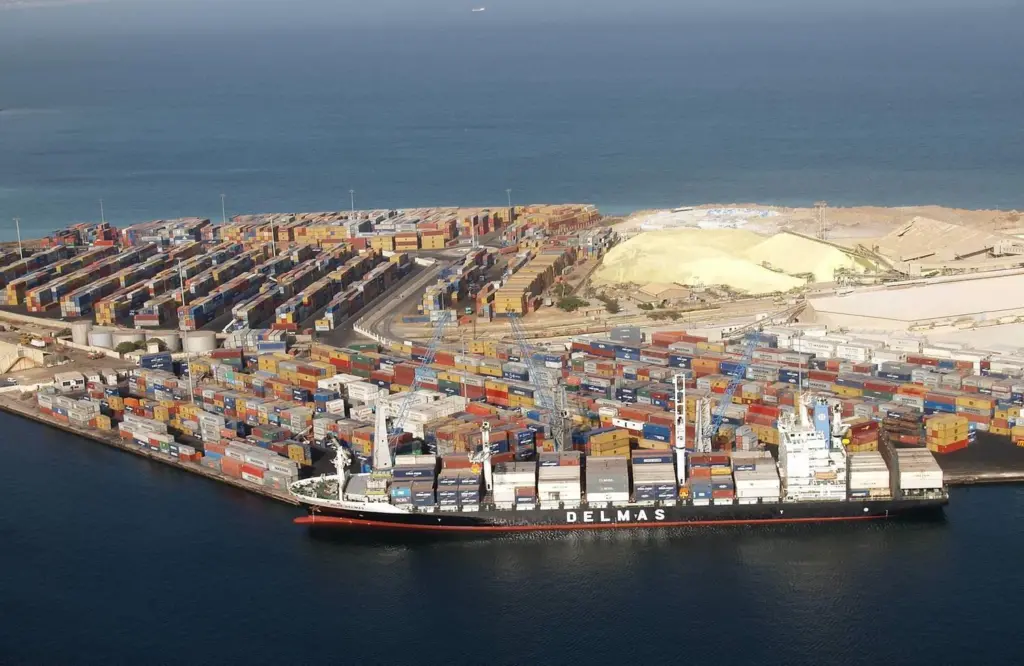
Senegal is rightly lauded as one of Africa’s success stories. With a firmly established democratic political system, economic progress was boosted in the mid-1990s by a series of liberalising reforms. The private sector now generates over 80% of the West African’s country’s GDP. Central to Senegal’s success has been the port of Dakar through which the bulk of its international trade passes, most notably exports of agricultural commodities, fertiliser, fish and chemicals and imports of finished goods.
As part of its economic reforms, in 2006-2007 the government of Abdoulaye Wade turned to the Dubai World group of companies (amid much controversy over the port concession) to revitalise the ports and logistics sector.
Dubai Customs World (DC World) was signed up to rejuvenate Senegal Customs’ management and stock control systems, statistical data management and to train staff. DP World was awarded a concession to take over container operations at Dakar port, while Jafza International signed an agreement to develop Dakar Integrated Special Economic Zone (DISEZ).
The $800m DISEZ agreement will see the development of a 6.5m sq m free trade zone south of Dakar which Jafza claims will turn the Senegalese capital into the “most important strategic location for doing business in West Africa”. The 6,000 hectare site, which is due to open next year, will feature offices, warehouses and Light Industrial Units and will dove-tail operationally with a planned ¢350m ($314m) new airport.
The DP World deal saw the company granted a 25-year concession starting in 2008 under which the ports giant pledged to spend over ¢500m ($448m) to develop and operate Dakar’s container business.
DP World ambitiously plans to turn Dakar into a “strategic gateway for West Africa” by working closely with Jafza, as it has with considerable success at Djibouti and its flagship port of Jebel Ali in Dubai.
“Terminal operations cannot be taken in isolation,” says Anil Singh, DP World’s senior vice president and managing director, Africa. “For maximum efficiency, the whole supply chain needs to be considered. If we can take containers on and off ships efficiently, but they cannot move quickly on to or off the terminal, then the supply chain becomes congested, which of course adds costs for shipping lines and traders.
“Clearly there will be efficiencies for all if the two [the port and DISEZ] are developed in tandem, and that will be our goal.”
The two-stage container terminal development plan will see the existing Terminal à Conteneur facilities overhauled at a cost ¢120m ($108m) with work due to be completed in 2010.
An extra 300m of quay wall and seven hectares of yard will be added, taking total combined berth length to 730 m with 22 hectares of yard area. Modern quay equipment in the shape of four ship-to-shore cranes, 2 mobile harbour cranes and 10 rubber-tyred gantry cranes plus a new terminal management system – NAVIS N4 v1.6.12 – have also been installed in a bid to more than double capacity from 250,000 teu to around 550,000 teu.
“The infrastructure and equipment that existed at Dakar were not able to handle the new generation vessels,” says Mr Singh. “We have now improved efficiency at the terminal and also invested in the training and development of our staff. Waiting time at anchorage dropped to 2.33 hrs in December.
“Our record today stands at 58 gantry moves per hour with mobile harbour cranes only.
“Truck turn-around times for delivery of import containers are well below the benchmark of 30 minutes and on an average it takes 17 minutes for the receiver to take out his container.
“Before we arrived it was well above 1.5 hours.”
DP World will also design, finance, construct and manage a new ¢300m ($269m) container terminal at Dakar called Port du Futur, which will have the potential to be expanded to handle 1.5m teu per annum. The first phase is due to be operation in 2010-2011.
A total of nine gantry cranes will be installed on the present container terminal and at Port du Futur.
But does a port which currently handles little more than 250,000 per annum really needs a new 1.5m teu facility? Yes, according to Mr Singh, who calls the new hub “not just feasible but vital for coastal West Africa, both for the development of the region itself and of the vast hinterland the port will serve”.
He adds: “We invest for the long term, and this is a long term project that will be developed in phases according to market demand. Planning for the new port is well underway, and we hope to begin phase 1 in the not too far distant future.”
Related Articles
 CONTAINER & CARGO HANDLING
 CONTAINER & CARGO HANDLING