![GreenPort[PortStrategy]](https://www.portstrategy.com/greenport/wp-content/uploads/sites/4/2026/09/GreenPortPortStrategy.svg)


High costs and heavy weather
The opening of Shanghais new Yangshan port may well solve some draught and congestion problems, but it raises some important cost and operational issues as well. James Macpherson reports.
On 1 December 1 the first phase of Shanghai’s new container port at Yangshan will be handling 16 service strings operating on the Asia/Europe trade. The port is welcomed by ocean carriers since it will at least partially solve some of their pressing problems.
With a draught of 16 metres and capacity of 2.2m TEUs, Yangshan phase one will handle the super post Panamax (8,000TEU+) ships currently being deployed on the trade and help resolve congestion at the existing Waigaoqiao berths. However, operational capabilities of the port, particularly during poor weather, and costs, are of major concern to ocean carriers and ultimately shippers.
CC Cheung, managing director of OOCL China, comments: ‘There are impacts for the move because the shipper has to bring the cargo to Yangshan and this means extra cost. Shanghai International Port Group (SIPG) will not subsidise the moves and we have to carry the empties back to Waigaoqiao which will be additional cost. The customers do not want to pay for it, but is there another choice?’
There are two principal means of transferring cargo from Waigaoqiao to Yangshan, a distance of about 53km. Trucking will cost US$60/20ft and US$94/40ft, whereas barging will cost US$44/20ft and US$74/40ft. Shippers will have to pay this additional amount. But at least THC at Yangshan is 10% cheaper than at Waigaoqiao – US$52/20ft, compared with US$58/20ft.
Given that freight rates on the Asia/Europe trade are in decline, ocean carriers are not too happy that they will have to absorb empty repositioning costs. They will have to spend US$44/20ft and US$65/40ft repositioning empty containers from Yangshan to Pudong for export shipments, although eventually these costs will probably be passed on to shippers.
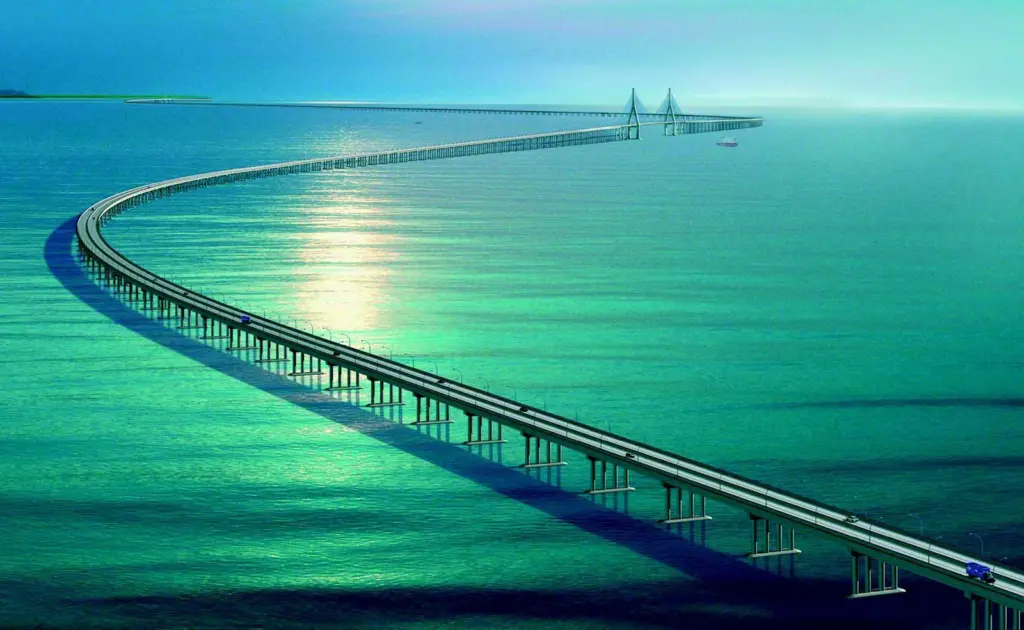
TYPHOON CONCERNS In addition, ocean carriers are concerned about the impact of bad weather on the operations at Yangshan. Much discussion has taken place on this subject and many analysts are of the opinion that it could prove to be a major problem. Phase one is connected to the mainland by the 32km Donghai bridge, but during high winds or typhoons which are not unusual in this region, the bridge will most probably not be operational.
The operators of the port, SIPG, will also have a monopoly on barge services. Three barges of 300TEU capacity will operate in each direction per day, but some have questioned if this is enough. Others have queried why there is no alternative rail link to the new port.
An SIPG spokesperson replies: “According to statistics, workable days for the Yangshan area are 339. We can arrange drop-off of cargo at Waigaoqiao and Luchao harbour when the bridge is closed and will arrange transfer to Yangshan terminal to catch up with the schedule.”
Despite this favourable report, some ocean carriers remain concerned about the untested port. CMA CGM’s Asia vice president, Dominique Lovichi, says: “Fog will delay operations and there will be more stoppages than at Waigaiqao as there is no shelter. This year there have been eight typhoons and this will cause a jam, so we are asking what the contingency plans are. Having said this, we can now sail the ship regardless of tide which we could not do at Waigaoqiao so we do not have to wait for [up to] 12 hours.”
So it seems ocean carriers do not have answers to a number of pressing questions and the first few months of operations at Yangshan will be critical. At least every ocean carrier will be facing the same issues since all 16 Asia/Europe strings are moving across. But this raises two other issues. Will there be enough room to cope with a trade lane growing at 15% per annum? And a number of ocean carriers also carry Mediterranean cargo on these strings, traffic that SIPG insists must be re-routed. CMA CGM for example, will have some realignment to take care of on its premier FAL service.
Related Articles
 CONTAINER & CARGO HANDLING
 CONTAINER & CARGO HANDLING