![GreenPort[PortStrategy]](https://www.portstrategy.com/greenport/wp-content/uploads/sites/4/2026/09/GreenPortPortStrategy.svg)
Entrepreneurial spirit
Technology hubs are a new venture for ports to add to their operations, says Martin Rushmere
A different type of cascading is taking place as ports face an uncertain financial future. The menace of plunging oil price, sub-economic container rates, and slumps in base metal prices is moving from shipping lines to port economics, terminal operators and port owners.
Drewry says in a gloomy assessment of the industry that in 2015, container port growth was only 1% and likely to be no more than 2.5% in 2016, the lowest growth rates in the industry yet. Drewry asks what will happen if there is a new “new normal” of 2.5%.
The research agency recommends four possible choices for terminals/ports – co-operation, price hikes, accept a new era of lower margins and returns or just not invest in new capacity. “This is an extreme option that will in effect leave shipping lines with nowhere to berth their large ships.”
However, a fifth choice might be opening.
While grappling with unprecedented economic headwinds, ports have also had to contend with the longstanding drive to become more efficient, at the same time making sure that they strive towards greener and cleaner operations. A model for the future and a possible, though partial, solution for all these considerations has been found at Los Angeles and Rotterdam in the form of technological business hubs.
Both have the same underlying theme, but their methods differ. They support commercial operations, mostly start-ups, devoted to improving the environment (or at least making conditions more tolerable), improving efficiency and helping port operations. The big difference can be boiled down into four years versus three months.
LA calling
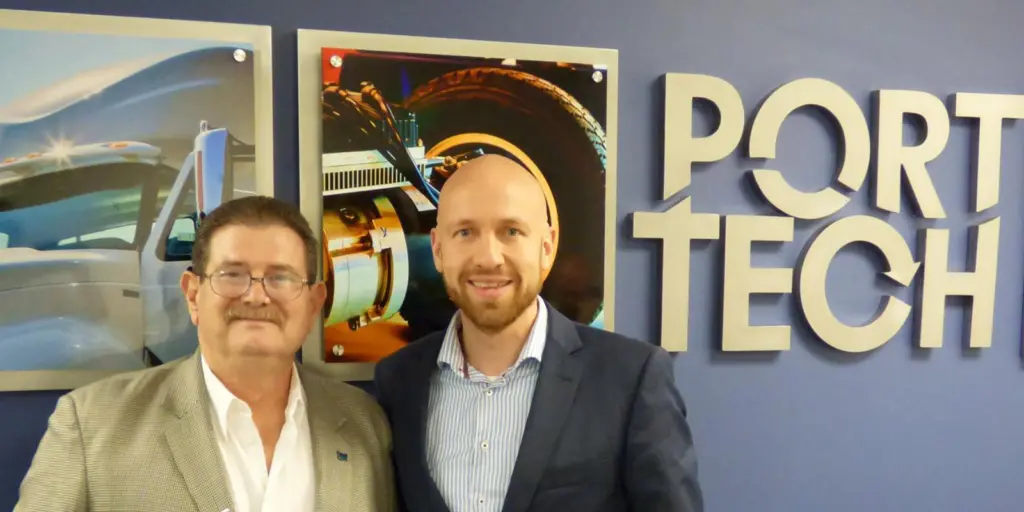
PortTechLA, set up in 2009 and the only such organisation in the world, nurtures start-ups for two to four years. “We are an incubator,” says executive director Stan Tomsic, “and our mantra is anything that supports the ports to help make them cleaner, greener and more efficient, is fair game for us.”
The benefit for companies is free expert guidance from more than 50 advisors and mentors, who range from experienced entrepreneurs to accountants, engineers, lawyers and executives who have been through all manner of tempestuous times in charge of companies.
Very small companies of up to 10 employees make up the stable of the 30 clients. “For between two to four years we are helping them build their organisation and become a sustainable business,” says Mr Tomsic. Some set up their facilities at Los Angeles port but others are in other states. One in Tijuana, Mexico is seeking to move to the tech hub.
All companies have to find their own funding and PortTech does not offer any direct financing. However much of its assistance is providing access to funders such as angel groups and venture capital organisations. Mr Tomsic is a member of the Pasadena Angels and John Dmohowski, PortTech’s director of client services is on the Board of Directors of the Los Angeles Venture Association. Says Mr Tomsic: “We spend a lot of time working with our clients funding needs, working with their pitches, positioning them for a funding opportunity, and bringing many funders around PortTech as advisors and to our events so our clients can network and connect as much as possible. Additionally, much of our programs and services are focused on helping entrepreneurs connect to customers, and being a port-focused clean tech incubator, we are a unique hub for new port technologies and innovations in the environment, energy, transportation and logistics and security/safety markets.”
More than 80 companies have been nurtured since the project began six years ago, and 545 jobs have been created, most of them in the San Pedro Bay port crucible. The area has the second highest unemployment rate in the Los Angeles region, which qualifies PortTech for state and city incentives to encourage job creation.
The legal status in the federal tax code is a 501 (c) 3 enterprise, classing it as a not-for-profit, managed by a staff of 10 and reporting to a board of directors. Mr Tomsic says 75% of its income is from grants and sponsorships, provided by a raft of higher education colleges, state and city institutions. Twenty five percent comes from fees from clients.
Search area
The search for suitable clients is a mix of advertising, attendance at tech fairs, meetings with likely businesses and the annual pitch program, narrowing down 100 applicants to three winners – which earn a bundle of free extra services from the organisation and its sponsors. “We work on the principle that everyone participating is a winner,” says Mr Tomsic. “The importance lies in taking part, meeting with other entrepreneurs, potential customers and investors.”
Ties with client companies can be informal. One such is Urb-E, manufacturer of an extremely lightweight and fold-up electric scooter described as solving the “last mile” for commuters getting from public transport to their work. “Our big advantage of being associated with PortTech is getting to meet other entrepreneurs and potential clients,” says chief executive Peter Lee.
Mr Tomsic describes one of the most important elements of becoming a client as “helping companies through the critical stage, where they have tapped all their potential funds and need to get outside investment and expertise”.
Allied to this is guidance to budding technology entrepreneurs at technical institutions. “The curriculum there does not teach them how to be an entrepreneur and they have no clue as to what to do next to turn their bright idea into a viable business entity.”
The long-term plan is to extend the operation throughout the US and internationally. “We have met with a considerable degree of success,” says Mr Tomsic, “and have achieved more than organisations two to four times our size.”
Rotterdam start-ups
By contrast, PortXL (short for accelerator) at the Port of Rotterdam, now in its first year, has a timespan of 90 days for clients. “We are a pressure cooker,” says managing director Mare Straetmans. “We offer companies the whole spectrum of advice and introductions.”
Because of the very short guidance period, companies need to have a clear business plan and avenues for raising capital. The only financial help is E15,000 to cover food and accommodation.
“The most crucial part of a start-up is finding the customers,” says Mr Straetmans. “We introduce companies to 30-40 executives and sit them down in front of advisors and mentors. They are continually meeting people and each other to discuss the difficulties, challenges and opportunities.”
As with Los Angeles, the criteria is clean/green products and services that are port-related, principally with Rotterdam. “Even indirectly related businesses are of interest. We have come across a company that makes tough and durable gloves for sword fighting and fencing. These could be used by port workers,” says Mr Straetmans. He says there is a chance that a client could branch into an unrelated venture. “One has gone into golf course development. We wish them well and know that at least we helped them get started.”
Four sectors are considered: refineries/chemicals, energy, maritime and logistics. Offices are at two locations, the former dry dock of the Rotterdam Drydock Company (RDM) and the Erasmus Centre for Partnership.
Not-for-profit
A non-profit foundation with an advisory board headed by former Netherlands prime minister Jan Peter Balkenende oversees a limited liability company that gets 8% of the equity of each client company.
“We are not aiming to get rich,” says Mr Straetmans.
For the first pitch programme 1,000 companies were contacted worldwide, which have been whittled down to 10. ”Three or four will become a success and three or four will probably change their products,” says Mr Straetmans.
A three-year plan has been drawn up, increasing the pitch programme from once to twice a year. The final this year will be on June 30. “There will be a thousand people in the room facing the companies.”
A big step for PortXL has been the addition of a 3D metal printer at RDM, specifically to make parts for maritime innovation.
The notion of developing tech hubs elsewhere is gaining international acceptance. Denis Davoult, strategic advisor for Urban Affairs at AIVP, says: “Nowadays most of the ports worldwide are looking for green projects and developing green business parks too. That’s part of their licence to operate, and provides an economics angle in the short and mid-term.” At the association’s forthcoming conference in Rotterdam, green projects and the principle of a circular economy will be among the topics of discussion.”
Related Articles
 EQUIPMENT
 EQUIPMENT