![GreenPort[PortStrategy]](https://www.portstrategy.com/greenport/wp-content/uploads/sites/4/2026/09/GreenPortPortStrategy.svg)

EXCLUSIVE: Building a resilient Europe: No pay, no cure?
The pile of crisis files on the EU Commission’s President von der Leyen’s desk is every year getting higher: Climate, covid, energy, the war in Ukraine, the (re)taking office of the Trump administration with all the geo-economic and geopolitical turmoil and surprises it is creating.
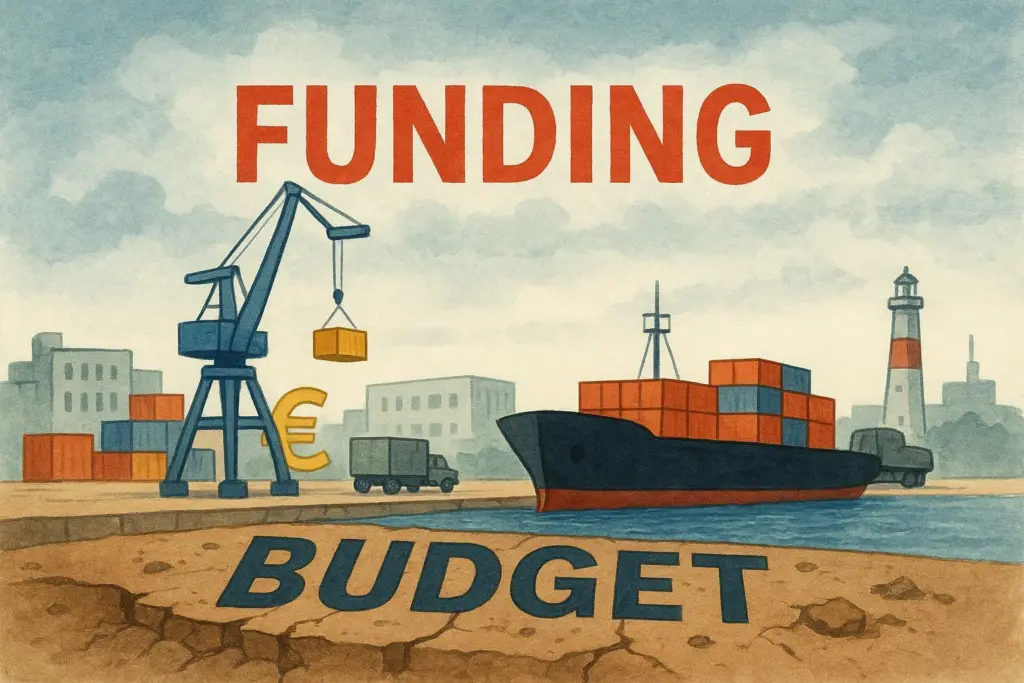
Each time another unprecedented problem comes up. And even if Europe is finding ways to avoid the worst, we cannot say that one crisis replaces another one, that for instance the climate crisis has been solved, no, each new crisis comes on top of the other ones.
These unprecedented times have obliged Europe’s policy makers and national governments to formulate unseen solutions and publish ambitious plans to give Europe, its citizens, businesses, its investors and the world as such, the confidence that Europe has everything under control.
Europe has a plan: Green Deal, Next Generation EU, Fit for 55, RePower EU, Net Zero Industry Act, Clean Industrial Deal, EU Preparedness Strategy…. These plans have, it must be said, often been rolled out at a never seen before speed, which explains their complexity in implementation and sometimes the unintended consequences or impacts they have generated.
But, above all, as we all know, solutions do not come for free. They come at a cost. And where are we now. What are the investments needed? What are the costs? And who will pay?
Budget plan
Mid-July, the Commission has published its plans for a new Multi Annual Financial Framework, the seven year budget for the period 2028-2034.
Even if the details of the new budget plan did remain until the last moments only on the desk of Ms von der Leyen and a few of her confidants, we all knew that a big reform was being prepared.
We understood that many EU managed programmes would probably be stopped (including our so-loved Connecting Europe Facility, the main budget instrument for transport), their needs would from now on be covered by national portfolios given to each Member State based on a national plan.
The proposals that were published mid-July have in that sense come as a positive surprise. Transport investments will not be part of the national plans but can still be funded under a new proposed Connecting Europe Facility that comes with a serious – reasonable – budget, a bit more than $51 billion.
Yet, in essence, only cross border and/or military mobility projects will be eligible for funding: One third of the transport budget will be dedicated to infrastructure to move troops and material.
Decarbonisation, innovation and digitalisation projects will be financed through a newly created big and all-embracing EU Competitiveness Fund, which looks at combining funding with private financing tools, so-called blending. The Competitiveness Fund will also fund some defence related investments as well as some investments in the protection of critical infrastructure.
Generating funds
While we are deep-diving in all relevant proposals, trying to find answers to our questions – will ports be considered “cross-border” entities under the CEF? We have also been checking the funding sources, where will the money come from? Even if you are not a budget wonder, one sees that the “expenses” column is getting bigger, but this can only be realised if the income side is being fed accordingly.
The new “own resources” proposal gives us an answer. The Commission is proposing new ways to finance the needs. One of the most remarkable new sources is a new tax on European Companies exceeding an annual net turnover of $100 million.
Different Member States have already signalled not being supportive of this new proposal. The Commission is also looking at the incomes of the Emission Trading Scheme and of the Carbon Border Adjustment Mechanism but is also trying to have a bigger reflow of the custom incomes the member states are receiving.
It goes without saying that the discussion on these own resources’ proposal will condition the whole budget discussion. Are the member states willing to give more money to Europe to face the challenges Europe and all its member states face? If Europe fails to agree on a stronger budget we can forget about the different funds and their promising envelopes published on 17 July.
Call to action
Let me conclude here with a call to “who it may concern” for a strong European budget and a strong portfolio for ports.
Europe is facing unprecedented challenges, which require an unseen level of governmental engagement in view of building the level of resilience which is required, both geopolitical economically and from a climate perspective.
This will cost money. If Europe is not planning these investments, it will be the member states. If Europe does it, synergies can be created, savings can be made and above all the internal market can be maintained, which has been the guarantee for economic growth and welfare over many decades.
Transport and in particular ports, are enablers in building the resilience we need. The investments to be made are not just giving the investing ports the needed return on investment but are coming with lots of added value for Europe’s economy and society.
If Europe is not investing in the supply chains and supply chain infrastructure that is needed to transport new fuels, to transport critical raw material, to transport military troops and secure the emergency supply chain, we can forget about the ambitions put forward for the next decade.
Related Articles
 ENERGY & TECHNOLOGY GREENPORT
 ALTERNATIVE FUELS GREENPORT
 ALTERNATIVE FUELS GREENPORT