![GreenPort[PortStrategy]](https://www.portstrategy.com/greenport/wp-content/uploads/sites/4/2026/09/GreenPortPortStrategy.svg)
EXCLUSIVE: Can Europe better combine ambition with pragmatism?
European Commission President-elect Ursula von der Leyen has presented the Commission’s broad political agenda for the next five years, writes Isabelle Ryckbost, secretart general, ESPO
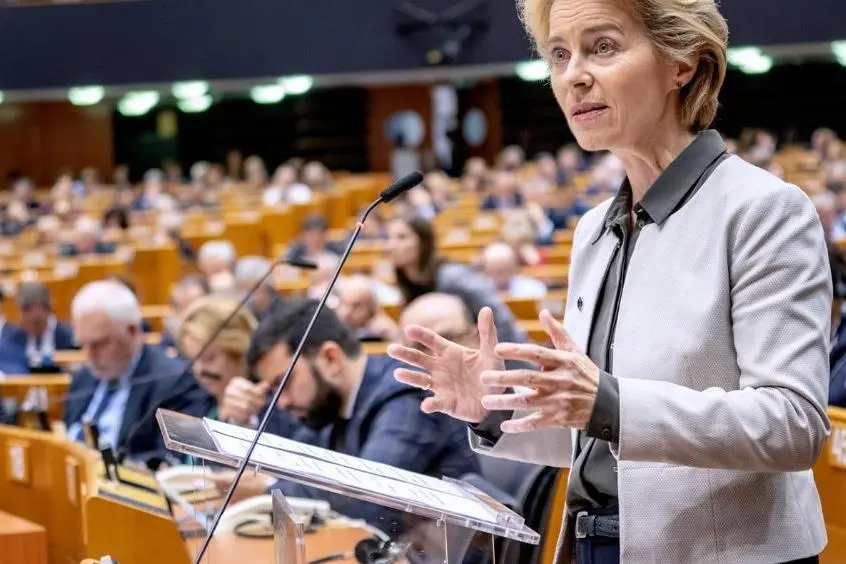
As part of her campaign too be re-elected by the European Parliament, Mrs von Der Leyen delivered a speech complemented by a 30-page document outlining her political guidelines.
So even if we do not know how these priorities will be further developed by the different Commissioners, this document outlines largely which course will be taken during the next five years when it comes to sustainability.
Pragmatic approach
Over the last five years, the Commission under the leadership of President von der Leyen has tput forward ambitious and big legislative packages, starting with the Fit for 55 and NextGenerationEU and proceeding with REPowerEU and the Net-Zero Industry Plan.
While all these packages have their merit and are based on a strong rationale, they have led to a lot of new legislative initiatives and new measures, which will now need to be implemented.
But the President-elect seems to understand that “pragmatism, technology-neutrality and innovation” are needed when implementing different sets of rules.
Von der Leyen understands that Europe’s competitiveness is under pressure and needs to receive a boost. So, the focus will now be on burden reduction – less reporting, less bureaucracy, better enforcement and faster permitting.
Looking at some of the measures that are of direct importance to ports, such as the Alternative Fuel Infrastructure Regulation, this new approach might help. But also, legislation such as the Corporate Sustainable Reporting Directive which sets out a very burdensome new reporting system might have to be newly scrutinised.
To deliver on the 2030 and 2050 Green Deal goals, the Commission’s new guidelines focus on implementation and investment and announce in that respect a Clean Industrial Deal, to be published in the first 100 days of the mandate.
This new Deal has to channel investments in infrastructure and industry in order to ensure decarbonisation and industrialisation go hand in hand. This will include investment in clean energy infrastructure and technologies, simplification measures for business and an Industrial Decarbonisation Accelerator Act to support energy-intensive sectors in the green transition.
“This will be an investment Commission”, the vision document strongly states. Mobilising more private financing will happen through the creation of a European Savings and Investments Union. In that way, start-ups do not have to go to the US or Asia to finance their expansion.
The Commission also announces some risk-absorbing measures in order to make it easier for commercial banks, investors and venture capital to finance fast-growing companies.
This is to be applauded, if these risk-absorbing measures can also be used for investments in ports, such as those related to enhancing the energy transition, which do not always come with an rapid return on investment for the investing port authority.
The Commission also speaks about a reinforced budget, focused on policies instead of programmes, with a new European Competitiveness Fund. It remains to be seen how this will be implemented and if ports will be eligible at some point.
Ambition vs realism
Overall, based on a first reading of the Commission’s political guidelines, it seems they are indeed based on a good understanding of the challenges Europe’s economy and society are facing and are trying to combine ambition and realism.
It now remains to be seen how these initiatives will be further implemented and what the role of the Parliament and the Member States will be in all this. Will there be money to make this a genuine investment Commission? Will the new legislation indeed bring us closer to the Green Deal and Net-Zero ambitions and to a more resilient and competitive Europe?
In spring 2024, ESPO published its priorities in the run up to the European elections and the new legislative cycle. Ports in Europe want to contribute to Europe’s ambitions to become a net-zero, smart, resilient and competitive continent.
But they need support for the implementation of what has been agreed over the last five years and clarification where needed, giving them the space to take up their role as facilitators of renewable energy and prioritise investments to reduce emissions.
They also need to receive the funding support they need to finance their investments.
In July, the Commission published the results of the last CEF call – 1 in 5 funded transport projects are port projects. Budget-wise however, we only count for 5% of the distributed funds. Almost half of the successful port projects were related to onshore power supply but there is a large funding gap to comply with the new EU legislation on OPS.
It is too early to assess how these new intentions will indeed keep all players on track towards net-zero while at the same time demonstrating more pragmatism and allowing ports to prepare for a more resilient and competitive Europe.
Related Articles
 ENERGY & TECHNOLOGY GREENPORT
 ALTERNATIVE FUELS GREENPORT
 ALTERNATIVE FUELS GREENPORT