![GreenPort[PortStrategy]](https://www.portstrategy.com/greenport/wp-content/uploads/sites/4/2026/09/GreenPortPortStrategy.svg)
Carbon-neutral ambitions in focus
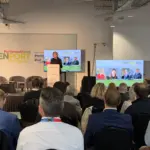
Delegates attending the final afternoon of GreenPort Congress 2017 gained insights into a number of different strategies for improving supply chain transparency and sustainability.
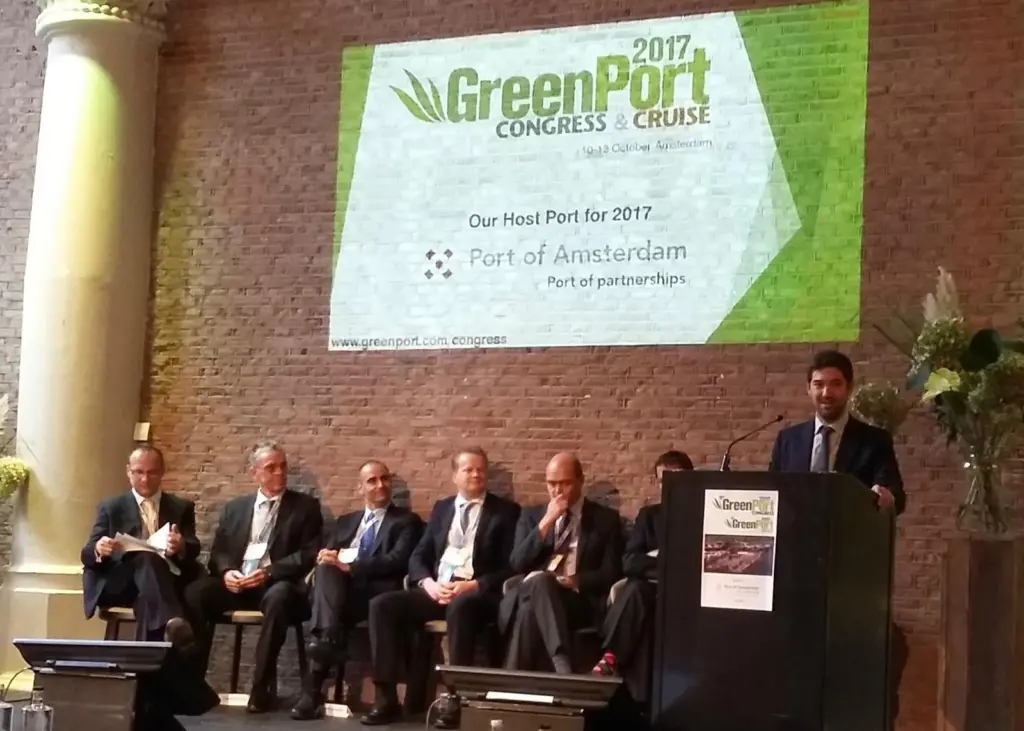
Speaking on the need for terminal operators and port authorities to align their methods and responsibilities on carbon footprinting, Alan Lewis, GLEC director, Smart Freight Centre, said: “We’re seeing emissions targets resulting from decisions by investment banks looking at how they invest funds and this is informing broader policy making.”
Conor Feighan, policy Advisor, FEPORT, said that he believed there was a strong commitment from terminals to reduce emissions in line with the Paris Agreement on climate change.
He cited the 2012 formation of EEEG (comprising seven companies that together account for 75% of all container lifts in the European Union) as a joint initiative that had resulted in a common framework on carbon emissions. “It can give operators a complete picture of their emissions across the logistics chain,” he said.
Operator’s perspective
Stefano Mordeglia, QSE & risk management supervisor, PSA Voltri-Pra, offered a terminal operator’s perspective.
“We have clients like Maersk and Hapag-Lloyd that have commitments to reduce emissions and they are asking us to be supportive in this process. But they are coming to the terminal with vessels that are bigger and bigger, which requires terminal investment.”
In order to tackle this, ports should look at the overall lifecycle emissions of energy consumed, said Kerstin Dobers, project leader, Green Logistic, Fraunhofer IML.
“It’s clever to look at specific emissions per service (for example, handling of a container). We allocate emissions to different sectors, destinations and activities to identify where they arise so we can decide which measures are relevant.”
Wind propulsion
Madadh MacLaine, CEO, Fair Winds Trading Company and a consultant with ITM Power, presented a report on the role that wind propulsion can play in enabling smaller ports to create ecologically sustainable supply chains.
She said that work is underway in partnership with the EU-funded DUAL Ports network “to create a sail cargo network using only renewable energy, with ethical cargos and minimal ecosystem impacts.”
Sail cargo hubs are planned for the North Sea region, starting with the port of Oostende in Belgium. Goods transported include chocolate, rum and oils for cosmetics.
Plans for the future include bunkering for hydrogen-powered cargo vessels, said Ms MacLaine. ITM Power has established facilities on the Scottish island of Orkney to this end.
The take home message from these sessions was clear, whatever the size of the operation, there is always a way to improve supply chain transparency and sustainability and ports should be striving to find it.
Related Articles
 GREENPORT CONGRESS GREENPORT
 ENERGY & TECHNOLOGY GREENPORT
 GREENPORT CONGRESS GREENPORT