![GreenPort[PortStrategy]](https://www.portstrategy.com/greenport/wp-content/uploads/sites/4/2026/09/GreenPortPortStrategy.svg)
Breaking free
Money’s getting tighter for oil dependant Middle East ports finds Stevie Knight
No matter which way you look at it, Middle Eastern ports have a challenge on their hands.
On the one hand, the economics are no longer on their side; the sluggish global market and the slump in petrocarbon prices have plunged many of the Middle East’s economies “into turmoil”, according to Shailesh Garg of Drewry. “Oil prices below $50 per barrel have put pressure on a number of oil-reliant economies… the money is no longer easily available and there are a lot of question marks hanging over infrastructure plans.”
Alastair Mackie of HFW adds: “People believed for a long time we’d see a short term correction in the oil price – but that’s just not happened and now everyone is having to adjust to a different reality.”
Even proud Saudi Arabia’s projects have been subject to a painful scaling down: the collapse of construction contracts has left thousands of – mostly – South Asian workers stranded, many without food or drinking water, prompting the launch of a ‘rescue mission’ from the Indian government.
However, a cursory glance would seem to suggest that not all are responding to these issues in the same way.
Pearl in the crown
The queen of them all, Jebel Ali Port, is in Dubai: although this is less directly exposed to the oil price than other Gulf Co-operation Council countries, it too is suffering from the region’s overall faltering confidence. While DP World said the UAE as a whole saw a small 2.3% rise in volumes during last year, this falls a long way short of the11.8% trajectory of the year before. Admittedly, 2014 was a hard act to follow, but more disturbingly the softer volumes of the latter end of 2015 have continued into the first half of 2016, resulting in a 6% drop.
While a DP World spokesperson underlined the flagship port is still running at about 90% utilisation and “plans are underway to increase Jebel Ali to 19.5m teu by 2017”, it’s a long way short of the T4’s $1.6bn expansion that was to boost it by 4m teu. In fact, DP World admits “the outlook for trade growth remains uncertain” and goes on to say, “macro conditions have been challenging and we have seen the impact of this across our portfolio including Jebel Ali”.
While the operator remains diffident about its plans for T4 saying only “we retain the flexibility to bring on extra capacity in line with demand”, Mr Garg predicts that it might still move quite quickly, even if it’s more phased than the original approach. Although Jebel Ali’s current capacity is 18m teu he says “no port likes to be running at much more than 80% full, it’s just too close to the top”, adding the port will probably revisit its plans “when the 17m teu line is crossed”.
He points out: “DP World will want to be ready – Jebel Ali has already seen what congestion can do to its operations, they had that before Terminal 3 opened and I don’t think they’ll want to repeat it.”
There are other issues: it’s an open secret that Dubai was handling goods destined for Iran, and with the latter now opening up to the West, it could be about to lose a slice of its cargo to Bandar Abbas.
Further, despite Dubai’s ‘open to all’ maxim, the area is still riven by cultural divides and political instability that impacts cargo – and Dubai is still one of Saudi’s allies. It’s a complicated back story, but according to one shipper “it may be coincidence, but Iranian containers have been taking significantly longer to get through the gate”.
Jump or fall
Given all the uncertainty, why are many regions still ramping up? The short answer is that the other contenders may simply have more to lose by standing still.
For them it’s not just about expansion, it’s diversification, and counter-intuitively, it’s the countries that are more dependent on oil that need to make the leap most – there’s simply more hanging on it than direct investment costs.
Will it work? Abu Dhabi’s Khalifa and Kizad industrial zone have been conceived as a ‘total offering’: a big manufacturing area with a big port to match, all supporting the country’s effort to free itself from oil dependency. Frustratingly for Abu Dhabi, a significant proportion of its potential market is still ensconced in Jebel Ali, a bare 60 kilometres along the coast, says Mr Garg.
Further, while Kizad has huge plans, “it’s been slow to start,” he says. “They need to gain leverage in order to lure people away from Jebel Ali.” The issue is the whole thing is something of a circle: “If they get more industrial players they can showcase the port; likewise they need to use the port to get more people into Kizad.”
Still, it could all just be about to change: China’s Cosco Shipping Co has plunged in with a $738m deal that will more than double Khalifa’s capacity to 6m teu, from its current capacity of 2.5m. Khalifa port will therefore be Cosco’s hub within the region.
Indian moves
Oman, on the other hand, is hitching its wagon to India to drive it along the diversification path; the latter’s economy is one of the few now growing at over 7%.
So despite a slow start, the South Asian focus has finally got Sohar’s 6,500ha Port and Freezone (a 50:50 joint venture between Rotterdam Port and the Sultanate) off the chocks and as a result Indian majors like Jindal Group and L&T, along with smaller companies such as Cabrol, have been drawn in.
Further, as oil and gas are cheap right now, Oman is trying to maximise their value. In a bid to grow the port and industrial area into a value-added regional hub, the Oman Oil Company – the government’s energy investment arm – is building an $800m petrochemical plant to convert these raw materials into the elements used for plastic bottles and food packaging.
Sohar also has tastier offerings on the table. The Sohar Food Cluster Company (SFCC) has leased a 10ha plot snug between the sugar refinery and the flour mill, alongside an agribulk terminal able to handle 700,000 tonne of grain and 1.5m tonnes of raw sugar.
However, it’s the combination of these elements that’s fascinating, and once again, Indian business has been first to spot the advantages of a single place for foodstuffs, packaging, logistics and cheap energy – underpinned by tax breaks and easy cargo clearance. Usher Agro is developing a $40m rice and pulses processing and packaging facility which will serve the broader MENA region. But SFCC’s offering could prove even more tempting for sweet and bakery businesses which could potentially get a deal on the molasses and other sugar by-products.
It’s not just India; Oman is also looking at strengthening agreements with other potentially rising economies: a route was recently opened between Sohar and Shahid Rajaee port in Iran – increasing trade could help boost both. However, HFW’s Mr Mackie points out Iran’s rehabilitation has been slow off the mark since its fanfare re-entry into the market a couple of years ago and many US bank sanctions are still in place – though he adds that “things have recently begun to pick up”.
Saudi’s goals
By far the largest of the Gulf economies, Saudi Arabia is seeing its port competition heating up. The deepwater Red Sea Gateway Terminal (RSGT) in Jeddah Islamic Port, which opened in 2009 as the country’s first privately funded Build Operate and Transfer (BOT) agreement, is now involved in increasing its capacity from 1.6m to 2.3m teu. Frankly, Jeddah needs it: the port has been congested for a while, although those on the ground say the issues are less about space and more about inefficiency.
And RSGT may have some competition says Mr Garg, because it’s got King Abdullah Port (KAP) strengthening its pull just 100 km away. KAP has already won the 2M Alliance, unseating Maersk from Jeddah and MSC from Salalah largely because TIL, MSC’s subsidiary has interests in KAP which he says “led to a realignment”.
Touted as a Jeddah alternative, KAP is steaming ahead. It’s doubling its box capacity to around 6m teu, prompted by 2015’s soaring 73% growth which brought volumes up to 1.3m teu. Alongside this, its southern basin is to see ro-ro rising to 600,000 vehicles and bulk capability growing to 3m tonnes. It’s also building a smart gate system and has a sensible plan for a logistics hub.
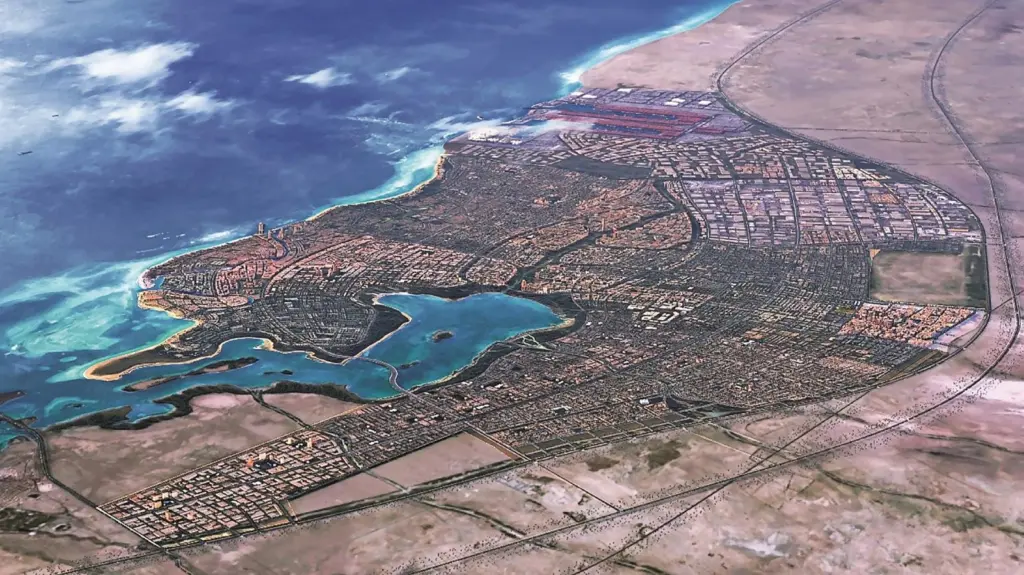
Like the others, KAP has also got a landside ‘twin’, but this one is rather different, explains Mr Mackie. More than an economic free zone, King Abdullah Economic City promises to be a full-blown metropolis with the usual laws ‘loosened’ to accommodate foreign business and Saudi’s western-educated youth – it may even be that women are allowed to drive inside its boundaries. Despite the fanfare, it’s been slow to take off, only attracting 5,000 people and 120 industrial tenants by the end of 2015.
However, Saudi Arabia’s top sovereign wealth fund is now negotiating a stake in the Economic City which would inject much-needed cash and it seems people are slowly moving over as they realise that “their future growth is only going to be with the KAEC”, explains one industry source. There are issues: “Although publicly people have unreserved regard for the vision, in private it’s a different matter: many feel they had a good thing in Jeddah and now it looks like that good thing is going,” he adds. “Some are losing a competitive advantage – so there’s a bit of resentment, especially as it’s costing them money to move.”
Despite this, Mr Garg is careful about his predictions for KAP as Jeddah appears to have cargo sticking to it like flies to toffee. Therefore, he has his eyes fixed not on the total throughput but on domestic traffic as the litmus for success; he believes “the critical level” is between 700,000 to 800,000 gateway, rather than transhipment boxes, indicating it has achieved the mass it needs to pull the traffic its way.
SORTING THE WINNERS FROM THE LOSERS
There’s little argument that the Middle East is seeing a huge change, one which may define who eventually survives and thrives the economic storm.
Alastair Mackie of HFW explains people are realising they can’t look to their reserves to fund the big infrastructure projects, but some elements can’t simply be put on the back burner as many of the Middle East’s historical ports are “old, crowded city facilities”. Therefore those with an eye to their country’s future have realised that they have little choice but to develop a modern port framework or risk choking.
As a result, a significant shift is underway.
“Quite a few are looking at public private partnership (PPP) models to attract finance,” he says. It’s not an easy pill to swallow: “Very often they have to build up a legal framework and change the mindset,” he explains. “After all, these countries have gone through generations where it’s all been funded by the state – culturally it can be hard.”
Kuwait has been one of the first to adapt to the new reality, driven by its stated position that development projects will move ahead regardless of the trajectory of oil prices and Mubarak Al Kabeer container port on Boubyan Island has been opened up to private participation. It seems Qatar is now actively exploring PPP potential for its own infrastructure projects and other countries are not that far behind.
However, Mr Mackie says that it may demand a certain scaling back of ambition. “Modernisation with PPP is a balance – a country inevitably wants to make its port future proof with a horizon of something like 50 years, it doesn’t want to look at it in a decade and say ‘we built it too small’. But private investment is looking for a return inside just a few years, end of story. Otherwise they just won’t come in.”
And although the favoured have access to some very roomy Islamic bank loans – RSGT’s ambitions are being supported by an Islamic financial agreement worth SR260m ($69.3m) while competitor KAP landed an SR2.7bn ($720m), ‘murabaha’ bank loan – Mr Mackie still believes the PPP model will play a crucial part in development. In his view the two elements could work together, as “any deal is looking for security” and the fact that these bank loans tend to be backed up by the state might just give private investors the reassurance they want.
Still, Mr Mackie sounds a note of caution about the future: “The continuing conflicts in Yemen and Syria and the presence of Isis is making people feel uncertain about a lot of the region… unfortunately, there’s the sense it could all spill over.”