![GreenPort[PortStrategy]](https://www.portstrategy.com/greenport/wp-content/uploads/sites/4/2026/09/GreenPortPortStrategy.svg)


EXCLUSIVE: AI redefines the container crane market
The global container crane market is entering a decisive phase where automation, electrification and artificial intelligence are becoming operational necessities rather than future ambitions, says Aqwa Chen, deputy general manager at ZPMC Port Machinery Group and board member of the Port Equipment Manufacturing Association (PEMA).
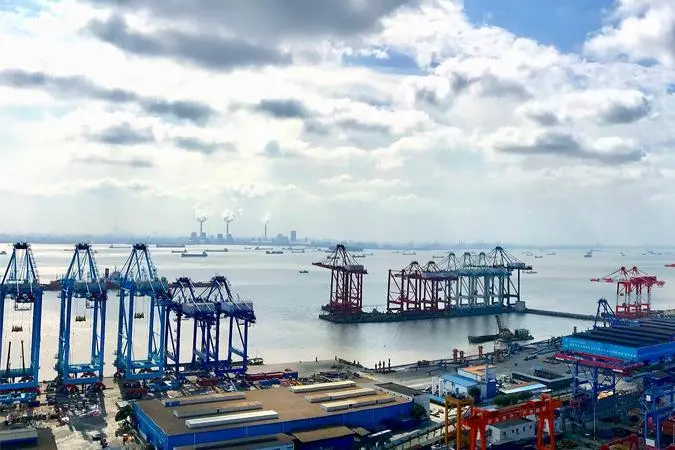
This strategic transformation is driven by sustainability targets, terminal efficiency demands and the continued expansion of mega-ships.
While overall market growth remains moderate, the direction of travel is clear. The global container crane market was valued at approximately $4.4bn to $4.5bn in 2025 and is forecast to rise to between $5.3bn and $5.6bn by the early 2030s.
The strongest growth opportunities are emerging around automation, decarbonisation and infrastructure upgrades needed to handle larger vessels.
Artificial intelligence is now central to this transition. AI is reshaping how cranes are operated, maintained and integrated into wider terminal systems. Historically, crane operations relied heavily on reactive maintenance and manual intervention.
That model is rapidly being replaced by predictive, data-driven systems that improve reliability and reduce downtime.
One of the most significant developments is predictive maintenance. Modern cranes are equipped with sensors that monitor vibration, temperature and hydraulics, while AI analyses the data to create digital twins – virtual replicas of the equipment. This allows operators to forecast failures before they occur and optimise maintenance schedules accordingly.
Automation is also advancing rapidly. AI provides the “eyes” and “brains” for autonomous crane operations through visual recognition, precision handling and intelligent path planning. More importantly, AI is now coordinating entire terminal ecosystems, integrating quay cranes, yard cranes and automated guided vehicles in real time to reduce conflicts and maximise throughput.
Despite these advances, terminal operators are not investing in automation for innovation alone. Procurement strategies are increasingly focused on solving specific operational bottlenecks.
Remote operation
For terminals facing long vessel berth times caused by mega-ship calls, the priority is high-performance ship-to-shore cranes with remote operation capabilities. Where truck congestion is the primary issue, operators are focusing on gate OCR and appointment systems.
In storage-constrained facilities, automated stacking cranes and rail-mounted gantries are preferred because they improve yard density and handling efficiency.
Return on investment now underpins every automation decision. Operators are evaluating not only purchase costs but also total cost of ownership, including maintenance, training, energy use and integration with legacy systems.
This is particularly important in brownfield terminals where automation upgrades must coexist with ongoing operations. Most facilities cannot afford prolonged shutdowns to install fully automated systems, so suppliers must provide technologies that can be introduced incrementally alongside existing manual workflows.
Alongside automation, sustainability and energy efficiency have become central procurement criteria. In many regulated markets, particularly in Europe, environmental performance is now considered as important as price and productivity.
Looking ahead
The EU Ports Strategy has accelerated this shift by positioning ports as key components of Europe’s clean energy and industrial systems. As a result, demand is increasing for fully electric crane systems and energy optimisation technologies.
Regenerative drive systems are becoming standard, allowing energy generated during lowering or braking operations to be fed back into terminal grids. At the same time, the industry is moving steadily away from diesel-electric hybrid solutions toward fully electric RTGs and shuttle carriers.
Looking ahead, the sector’s biggest challenge is market volatility driven by geopolitical tensions, trade policies and tariff uncertainty, all of which are influencing investment decisions and supply chains.
At the same time, the greatest opportunity lies in the accelerating transition toward electrification and smart equipment. Ports are evolving into integrated energy and logistics hubs and the machinery operating within them must evolve accordingly to support global net-zero ambitions.
Related Articles
 ENERGY & TECHNOLOGY GREENPORT
 ENERGY & TECHNOLOGY GREENPORT
 PRODUCTS & SERVICES GREENPORT