![GreenPort[PortStrategy]](https://www.portstrategy.com/greenport/wp-content/uploads/sites/4/2026/09/GreenPortPortStrategy.svg)



EXCLUSIVE: Beyond compliance: The real benefits of electric port equipment
The global push towards decarbonisation is reshaping the port and terminal industry and few understand this transformation better than Herman Klaus, director of application solutions at Hyster.
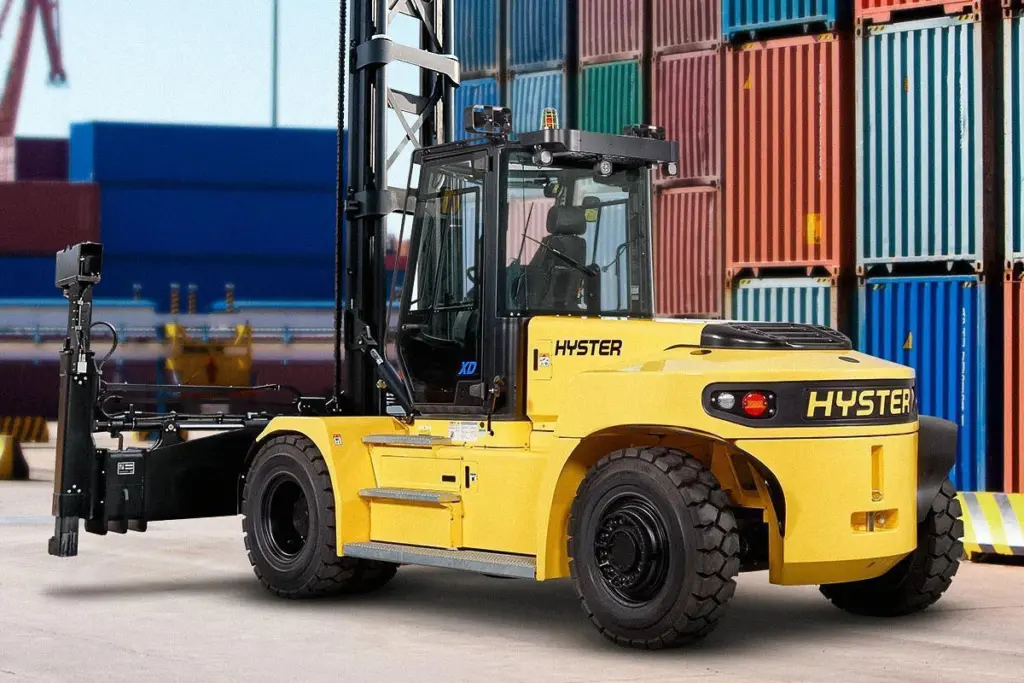
Speaking on the Portside Perspective podcast, Mr Klaus offers a manufacturer’s view on where the sector stands in its journey toward port electrification, the benefits operators can expect and the lessons emerging from real-world pilot projects.
“The electrification of container equipment at ports and terminals is still fairly new,” he acknowledges.
“But it’s changing very rapidly. There’s quite a lot of product development going on right now and some notable pilot projects are already in progress to see how the technology performs in real-world operations.”
Regulatory momentum
Mr Klaus sees two primary forces driving adoption: Government action and corporate sustainability initiatives. Regulations are accelerating change on both sides of the Atlantic.
“In the United States, the California Air Resources Board has set near-term zero-emissions timelines for ports, with regulations requiring transitions to zero-emissions cargo handling equipment over the next 10 to 15 years,” he says.
“In Europe, the EU’s goal is net zero emissions by 2050, with an interim target of 50% emissions reduction by 2030.”
With a typical container handler lasting about a decade, equipment purchased today will be expected to contribute to those targets.
On top of regulations, financial incentives are emerging, such as the US Environmental Protection Agency’s Clean Ports Program, which is allocating US$3 billion for zero-emissions port equipment and infrastructure, as well as air quality and climate planning.
Mr Klaus stresses that while there is still some uncertainty over how quickly these regulations and grant programmes will take hold, history shows that similar measures in the past have helped drive significant industry change. And even without binding deadlines, the timelines for infrastructure development mean operators need to be thinking ahead.
“A smooth shift to electrified port equipment really requires a lot of preparation,” he says. “Implementation can take quite a long time.”
Corporate initiatives are proving just as influential.
“Many companies have made sustainability commitments,” Mr Klaus explains. “Most of the international shipping companies and port terminal operators operate globally and have signed up for significant reductions in overall emissions. That’s really motivating interest in port electrification across the world.”
Benefits beyond compliance
While regulations might force the issue, Mr Klaus stresses that the advantages of electric port equipment extend far beyond compliance.
“Lithium batteries and hydrogen fuel cells produce zero harmful emissions at the tailpipe. Hydrogen-powered equipment only emits water and heat,” he says.
The environmental gains are significant: “A typical electric top-pick container handler can save about 120 tonnes of CO₂ and nearly half a tonne of criteria pollutants per year compared to a diesel equivalent.”
Operators and their communities also reap health and quality-of-life benefits from cleaner air and lower noise.
“The trucks run quieter, which is a benefit for operators and everyone on the terminal,” he notes.
“Operators like the smoothness of operation and reduced vibration.”
The impact goes beyond the terminal gates.
“People living in the community appreciate the reduction in noise and pollution overall,” Mr Klaus adds. “There truly are benefits all round.”
Performance, once a perceived weakness of electric models, has also caught up.
“Early versions required compromises, but current lithium-ion equipment can achieve the same level of performance and productivity without overheating or losing power as the battery runs down,” Mr Klaus explains.
“And with fewer moving parts than diesel machines, electric drivetrains can reduce downtime and maintenance needs.”
In the past, most electric models used lead-acid batteries, which lacked the capacity for larger equipment and brought productivity limitations.
The move to lithium-ion has, in Mr Klaus’s view, removed many of the barriers that once held operators back.
Obstacles on the road
Despite the clear benefits, Mr Klaus is realistic about the remaining challenges.
“One of the most important obstacles is infrastructure. Can the local grid handle the energy draw of the port equipment? That’s a local answer, depending on grid stability and capacity,” he says.
Planning upgrades to grid capacity can take years, requiring collaboration with utility providers and factoring in the needs of other operators in the same port. “You have to look at future growth.”
“What other equipment are you going to be converting to electric? What are your future needs going to be?”
Alternative strategies, such as staggered charging or overnight charging when grid demand is lower, can help in the interim.
In regions with limited grid capacity, hydrogen may be a viable option, but it comes with its own hurdles.
“Hydrogen availability is still regionally dependent, and transporting it is difficult,” Mr Klaus says.
“There’s a chicken-and-egg problem: Producers don’t see demand, so they don’t invest; potential users don’t see supply, so they don’t invest.”
For hydrogen adoption, green hydrogen is also a factor (produced from renewable energy rather than fossil fuels) and currently makes up less than 10% of supply worldwide. Many funding programmes require its use, making it a critical but limited resource for now.
There are also domestic sourcing requirements for US federal funding, such as the Build America, Buy America Act.
“This mandates that taxpayer funding be used for US-produced equipment,” Mr Klaus says.
“We have plans to expand our US manufacturing to include high-capacity models, including electric options, to meet those needs.”
Proving the technology
To validate new technologies, Hyster has committed to real-world pilot programmes across multiple markets and power sources.
At the Port of Hamburg, a hydrogen fuel cell-powered terminal tractor is undergoing trials alongside a dedicated hydrogen refuelling station.
In Spain, a hydrogen fuel cell-powered reach stacker was delivered to the MSC Terminal at the Port of Valencia in September 2023. It’s Europe’s first reach stacker application using hydrogen fuel cells in real-world operations.
“These units have zero-emission fuel cells that convert hydrogen into electricity,” Mr Klaus says.
“Hydrogen is stored in high-pressure tanks and can be refilled in 10 to 15 minutes, powering the electric motors or recharging the batteries as needed, all while reducing greenhouse gas emissions and noise pollution.”
In the United States, a hydrogen fuel cell-powered top-pick container handler has been operating in Los Angeles for several years, giving operators valuable insights into its performance and refuelling patterns.
Hyster is also advancing battery-electric solutions.
A two-year pilot at Malta Freeport Terminals will see a 650-volt lithium-ion battery-powered empty container handler capable of stacking six containers high.
This initiative is funded in part by CMA CGM’s corporate “Pulse” Energy Fund, aimed at achieving net-zero carbon by 2050.
“These pilots show there isn’t a one-size-fits-all solution,” Mr Klaus stresses.
“Some ports don’t have the grid capability for a fleet of battery-electric trucks and need alternatives. Hydrogen offers fast refuelling for high-duty cycles, while battery-electric can be ideal where grid power is abundant and affordable.”
Key considerations
Choosing between electric and hydrogen, or a combination, requires detailed operational analysis though.
Mr Klaus advises operators to start with an “overall operational profile” that captures duty cycles, daily operating hours and infrastructure constraints.
“Do you have space for chargers or hydrogen stations? Can they be located where they’re most useful? Is opportunity charging possible during breaks? What’s the reliability and cost of your local electricity supply?” he asks.
Costs must be weighed over the total cost of ownership. While the purchase price of electric equipment is higher, savings in fuel and maintenance can offset the gap over time.
In many regions, electricity is significantly cheaper than diesel, though hydrogen remains more expensive. Mr Klaus expects costs to fall as production scales up.
Prepare now
For Mr Klaus, the message to port and terminal operators is clear: Start planning early.
“The momentum is growing, but the deadlines aren’t immediate. Use this time to look at your options, run your own pilot programmes and electrify a couple of pieces of equipment to see what adjustments are needed,” he advises.
“Get ahead of the learning curve instead of waiting until the last moment.”
Mr Klaus is optimistic about electrification’s future trajectory.
“We’ve had diesel for a hundred years and electric for just a few. Battery technology is improving and grid shortages will be addressed. Embrace it, it’s coming and it’s going to be a good thing. The transition will be difficult, but preparation will make it much smoother.”
From regulatory compliance to operational gains, the benefits of port electrification according to Mr Klaus are clear.
With real-world pilots proving both battery-electric and hydrogen fuel cell technologies, Hyster’s work demonstrates that sustainable, high-performance port operations are within reach.
The question is no longer if ports will electrify, but how and when.
Related Articles
 ENERGY & TECHNOLOGY GREENPORT
 ENERGY & TECHNOLOGY GREENPORT
 PRODUCTS & SERVICES GREENPORT