![GreenPort[PortStrategy]](https://www.portstrategy.com/greenport/wp-content/uploads/sites/4/2026/09/GreenPortPortStrategy.svg)
Environment: priority for supply chain
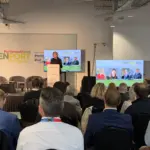
The recent Council of Supply Chain Management Professionals’ Annual Conference in Chicago discussed how the environmental impact of the global supply chain can be managed in the future.

While manufacturers, retailers and their logistics service suppliers continue to struggle with the challenges presented by the recessionary effects on volumes and costs in their supply chains, it is clear that they have not lost sight of their responsibilities to care for the environment. Government policy and regulation, carbon footprint measuring, consumer demand trends and means of emission control, as well as other aspects of sustainability were addressed at the conference. Sharon Bringelson, Divisional VP International at Sears pointed out that many green initiatives save costs rather than increase it, and that these policies, when enacted, can bring positive results more quickly than sometimes expected. She emphasised that ‘green’ was not just a short-term fad nor policies concocted simply as PR exercises.
James Barr, VP of Government Affairs at Ryder Systems, commented that while the development of green policy has been slower than expected due to the recession, recent data indicates that 75% of supply chain end-users still see environmental matters as either ‘important’ or ‘very important.’
Mr. Barr emphasised that his company like many other service providers have developed a whole array of green measures in response to customer demands, including carbon footprint metrics, ISO 1400 accreditations and fuel management schemes. However, while market awareness of the issues continues to grow, there is an urgent need for governments, both at the domestic and international level, to dispel regulatory uncertainty to assist providers in complying with uniform standards. David Miller, VP of Global Policy and Economic Sustainability at Con-way, further stressed the need for regulatory clarity. Within the US, variable state laws cause problems for transport operators. In addition, many emissions and other performance targets are way too low to be reasonably achievable. Mr. Miller called for more consultation with industry before hard and fast laws are put in place that will put an undue cost burden on operators and their customers.
Related Articles
 ALTERNATIVE FUELS GREENPORT
 ENERGY & TECHNOLOGY GREENPORT
 PROJECTS & INITIATIVES GREENPORT