![GreenPort[PortStrategy]](https://www.portstrategy.com/greenport/wp-content/uploads/sites/4/2026/09/GreenPortPortStrategy.svg)


EXCLUSIVE: Aberdeen navigates the offshore energy gap
Ports and terminals that have traditionally serviced the oil and gas sector are entering one of the most complex periods in their modern history.
As hydrocarbon activity declines faster than expected, the markets intended to support the energy transition are not yet arriving at scale, creating commercial and strategic risk for ports heavily exposed to offshore energy.
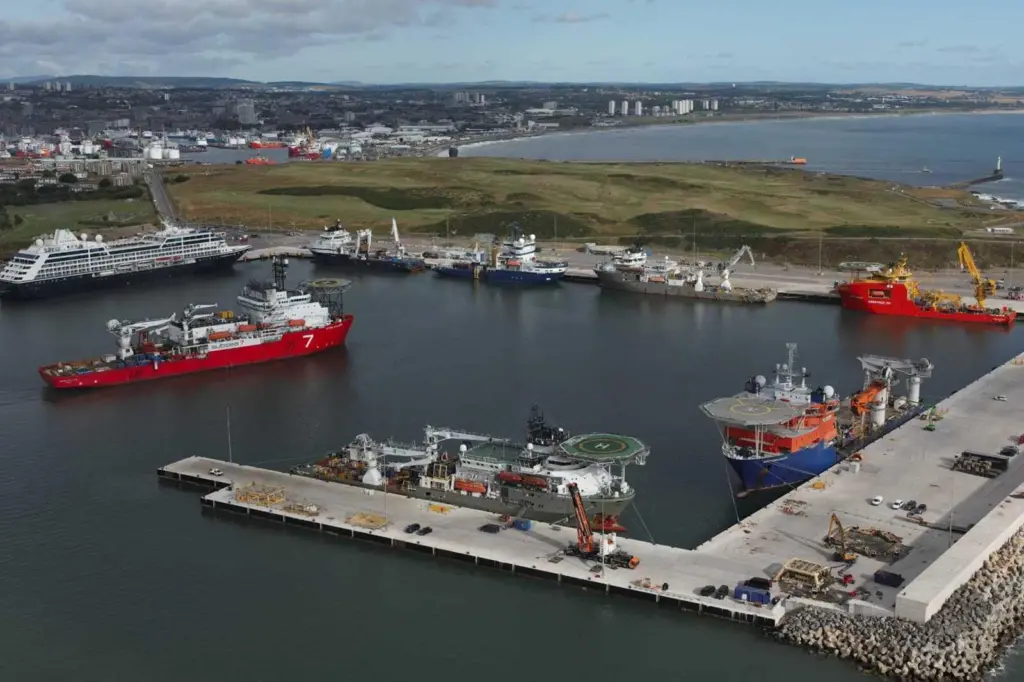
For ports such as Scotland’s Port of Aberdeen, which traditionally traded in oil and gas and now heavily rely upon the offshore renewables market, this challenge is immediate and operational.
The transition must be managed while maintaining energy security, protecting skills and sustaining the infrastructure investment required to support future low-carbon industries.
“What we’re seeing is a much more rapid decline of oil and gas activity, right across from exploration and drilling through to operations and maintenance, which is bread and butter and accounts for about 60% of our business,” says Bob Sanguinetti, chief executive, Port of Aberdeen.
“At the same time we’re seeing a delay to the arrival of offshore wind activity at scale.”
A widening gap
Mr Sanguinetti says this misalignment is creating a widening gap between legacy and future markets.
Oil and gas activity is contracting at pace, while offshore wind, hydrogen and carbon capture projects remain subject to delays in planning and consenting, infrastructure enhancements, grid connection and investment decisions.
For ports like Aberdeen that have invested heavily in infrastructure to support renewables, the timing mismatch is particularly acute.
“We have invested significantly in the energy transition through the construction of South Harbour,” Mr Sanguinetti explains.
“That’s a GB£420 million project which we think places us very firmly in the bracket for supporting a large number of offshore windfarms off the northeast coast of Scotland.
“But we still rely very heavily on oil and gas activity for our revenues, with very limited revenues generated through offshore wind at this stage,despite seeing around 600 vessels every year.”
Managing the transition
Mr Sanguinetti says that managing the transition is not a short-term fluctuation but a structural challenge.
“We’ve always known that this period would be the most challenging one,” Mr Sanguinetti says, “as we see a downsizing of one sector before the ramping up of another, while we need to service our loan and grow the new business on which South Harbour was predicated.”
For ports seeking to reposition themselves, Mr Sanguinetti says that the first challenge is infrastructure.
Offshore wind and alternative fuels place very different demands on port estates, yet requirements are not always clear when investment decisions must be made.
“We need to make sure that we invest in the right infrastructure,” he says, “but that’s difficult when you don’t have a clear understanding of what the new sector demands in terms of depth, quayside length, space and access.”
This uncertainty complicates investment decisions. “You need confidence that you’re going to get a return,” Mr Sanguinetti continues.
“Some of the upfront costs are significant, and ports need more clarity and confidence in the pipeline of projects that will come not just to Aberdeen, but to ports up and down the coast.”
Collaboration and confidence
In this uncertain environment, collaboration becomes essential.
This is why Mr Sanguinetti believes ports, developers and the wider supply chain must engage earlier and more closely.
“If there are sufficient projects for everyone, then let’s collaborate,” he says.
“We’re doing that already, but perhaps we need to do it better and closer with developers and the wider supply chain.”
The implications extend well beyond ports.
“Companies across the country need to make investment decisions, recruit people and ensure they have the right skills to meet offshore wind demand as it gathers momentum,” he adds.
Skills, stability and risk
A recurring theme in the conversation with Mr Sanguinetti’s is the need to treat energy holistically.
“At the highest level we need to treat energy as a single industry, going right across from oil and gas to renewables, including decommissioning,” he says.
He is clear that oil and gas will remain part of the mix for decades.
“We’re going to need oil and gas for decades alongside renewables because there is no alternative and energy demand continues to grow,” he explains.
“We either extract it ourselves in an environmentally conscious way or import it at greater cost and with far higher environmental impact.”
This perspective is closely tied to energy security. “If we lose control over those resources, it impacts national energy security.”
In addition Mr Sanguinetti says that a stable environment is essential for continued investment.
“We need a stable environment where oil and gas companies have confidence to invest,” he says.
“That generates economic activity, creates jobs and it’s those very skills that will accelerate the transition to renewable energy.”
Without that stability, the consequences are serious. “Without it, we risk a cliff edge,” Mr Sanguinetti warns. “Those skills will go elsewhere, where the return is more widely recognised and they will be lost forever.”
The role of government
Government has a critical role to play in supporting both strands of the transition and that includes tackling structural barriers.
“We need clarity on timelines for offshore wind, hydrogen and carbon capture,” he says. “We need to understand what will be required over the next 15 to 25 years, because that makes business cases easier to write.”
“It’s not just offshore wind projects,” he explains. “It’s the grid, connectivity and consenting, which at the moment is too slow and too cumbersome.”
Mr Sanguinetti believes government should enable, not replace, private investment. “Innovation will be delivered by the private sector,” he says, “but government needs to provide the framework to incentivise that.”
He points to the challenge of upfront costs. “Some infrastructure is too expensive for a single port or developer,” he explains. “Government could take a stake in upfront investment and recover that over the life of the asset.”
Diversification and resilience
Alongside energy, diversification is central to Aberdeen’s strategy forward.
“The more we diversify, the more resilience we build into a business that’s been around for almost 900 years,” Mr Sanguinetti says.
“South Harbour has also been future-proofed. We’ve built a service trench along the length of the quaysides,” he explains. “That allows for future delivery of hydrogen, synthetic fuels or methanol without major disruption.”
The port has set out an ambitious environmental strategy including its intent to become the UK’s first net zero port by 2040.
Actions already taken include switching to renewable energy, converting workboats to HVO fuel, electrifying vehicles and upgrading lighting.
The port has also invested in shore power. “We now have the largest operational shore power system anywhere in the UK,” he says. “Ships can plug in and switch off their diesel generators while alongside.”
Partnership for delivery
Looking ahead, Mr Sanguinetti is clear that ports cannot deliver the transition alone.
“We can’t do this in isolation,” he says. “We need partnership with the private sector and support from government.”
For ports that have traditionally serviced oil and gas, the challenge is not choosing between old and new, but managing the space between them he says.
Stability, clarity and collaboration, Mr Sanguinetti argues, will determine whether ports successfully navigate this delicate point in the energy transition.
Related Articles
 ALTERNATIVE FUELS GREENPORT
 ENERGY & TECHNOLOGY GREENPORT
 PROJECTS & INITIATIVES GREENPORT