



EXCLUSIVE: Africa’s IMO-driven decarbonisation projects
Deployment of renewable energy technology and a port call data-sharing platform will support three African ports to move closer to achieving the IMO GHG emission reduction goals.

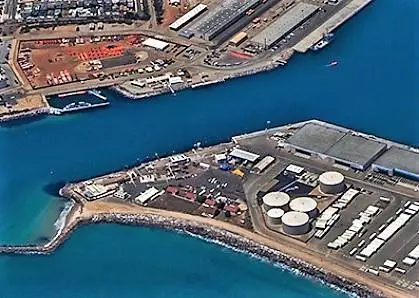
Port Louis in Mauritius and Walvis Bay and Lüderitz ports in Namibia are set to implement the two separate projects that could contribute to their capacity to reduce carbon emissions under the IMO’s Coordinated Actions to Reduce Emissions from Shipping (CARES) maritime technology global challenge.
“Combating climate change through emission reduction requires dedicated effort at every port and for even the smallest vessels throughout the world,” Anton Rhodes, CARES project manager, IMO.
“It is vital to support developing countries, in particular the small island developing states and least developed countries, in this journey and to help facilitate access to technologies.”
Modernisation challenges
Both Namibia and Mauritius are among developing countries grappling with the challenge of mobilising adequate investments for the modernisation of their maritime transportation network including transitioning to energy-efficient and climate-resilient port infrastructure, according to previous reports by the International Association of Ports and Harbors (IAPH).
Many developing countries, IAPH says, are under “unprecedented pressure on maritime seaport infrastructure.”
“The ports in these countries serve as vital nodes for the international trade network, facilitating the movement of goods and services that drive economic growth; sometimes, they are also the only lifeline for the local economy,” the Association has said.
The renewable energy solution and the port call data sharing platform concepts, with guidance from the regional MTCCs in Africa and the Caribbean, are being developed into in-depth technical proposals for implementation at the ports.
For Namibia and Mauritius, the Kenya-based Maritime Technology Cooperation Centre for Africa (MTCC-Africa), will spearhead the deployment of both the renewable energy solution at Port Louis and port call data sharing platform at the Namibian maritime gateways.
The MTCC-Africa is based at the Kenya-based Jomo Kenyatta University of Agriculture and Technology, Mombasa Campus.
At Port Louis, the focus will be on clean marine shipping (CMS) where organic waste will be converted into renewable energy in support of Mauritius’ GHG emission reduction strategy.
A 2.4 MW BioH2Energy system will be developed at the port to convert at least two tons of organic waste to supply 100 KW per hour hence reduce the current electricity grid consumption from thermal sources at the port. Mauritius hopes to eliminate an estimated 482 t CO2e per annum through utilisation of the organic waste as a source of energy.
Data sharing
At the ports of Walvis Bay and Lüderitz in Namibia, the port call data sharing platform PERSUS developed by German-based BM Bergmann Marine GmbH, a maritime consultancy and advisory service firm recently acquired by Cyprus-based Marine-Fields Holding Ltd, will be deployed as a Software-as-a-Service (SaaS) concept.
This will allow port users to be electronically inter-connected and be able to utilize relevant cloud-based applications over the internet for all their port operation transactions.
“The project proposes to customise the PERSEUS data sharing platform to allow all actors in the port and the port State authorities to gain direct access to port call data, which is a prerequisite for implementing ‘Just-In-Time’ operations and automated reporting,” says the IMO.
With the deployment of the PERSEUS system, the two Namibian ports will “reduce total turnaround time, improve port facility utilisation and reduce associated GHG emissions.” IMO anticipates a reduction of at least 10% GHG emission in one year.
The Port of Point Lisas in Trinidad and Tobago will undertake a similar GHG emission mitigation project.
UN Trade & Development (UNCTAD) says African ports have an opportunity to create jobs, reduce emissions and improve their competitiveness “by embracing the energy transition” such as deploying energy efficient technologies and relying on renewable energy sources.
IMO has previously committed to cutting emissions from shipping to net zero by around 2050 with short term and medium term checkpoints being a 20% to 30% reduction by 2030 and 70% to 80% by 2040.
Related Articles
 ENERGY & TECHNOLOGY GREENPORT
 NEWS GREENPORT
 PROJECTS & INITIATIVES GREENPORT