![GreenPort[PortStrategy]](https://www.portstrategy.com/greenport/wp-content/uploads/sites/4/2026/09/GreenPortPortStrategy.svg)
Helping ports attract green investors
In this article, Dr Arjan Hijdra, founder of the not-for-profit initiative Vital Ports explains how port authorities can fund their green port development projects
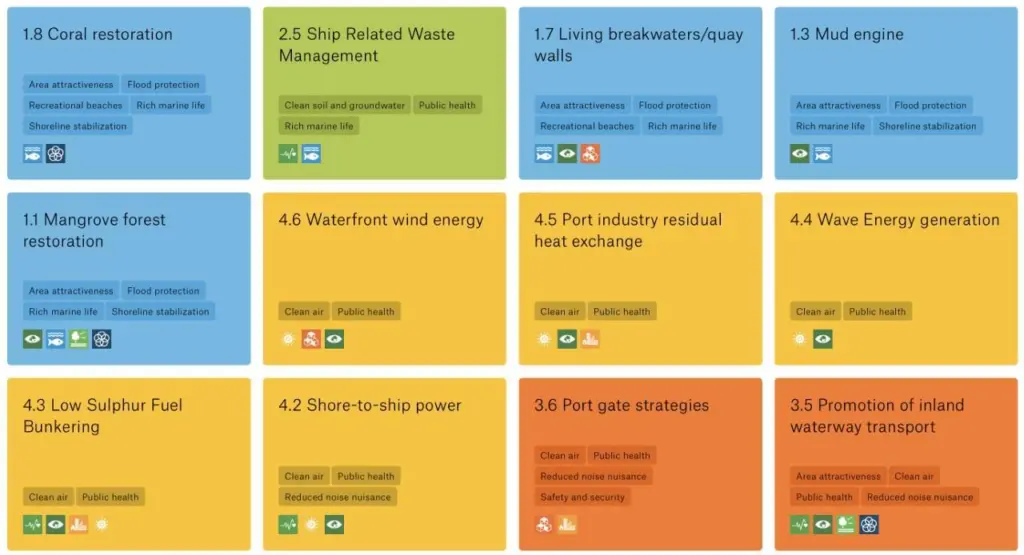
The basic idea of Vital Ports is to bridge the gap between the many available solutions and the green investment community seeking such opportunities. By building green revenue streams, sustainability as a cost can be converted to sustainability as a source of revenues. Sustainable development becomes healthy business, which in its turn helps to accelerate the uptake of green projects and scaling.
As logical as this might seem, it still proves to be an open field where much work is to be done. The current circumstances caused by Covid-19 provides an extra trigger to explore this field. Green revenue streams diversify income for port authorities decreasing their economic vulnerability.
Scientific research leading to practical initiative
The Vital Ports initiative can be seen as the result of journey from practice to science and back. After two decades in the field of port and waterway development, some fundamental questions became itchy for me. Many, if not most, of the projects followed a path of rich initial plans which gradually erode towards ‘bare to the basics’ cost efficient designs. And yet, everyone can mention a few examples of exceptional infrastructural projects where people, planet and profits are being served together. So why is this? And why is this not scaling?
With these questions in mind I joined the research group of infrastructure planning at the University of Groningen (Netherlands) and started a research project in 2010. I investigated many port and waterway projects in the world, worked as a visiting scholar at MIT and at the US Army Corps of engineers. It brought fundamental insights on decision making and micro-economics mechanisms in port and waterway development.
These results were shared in various publications in the scientific community. However, the proof of the pudding would be in applying those insights for real life impact. When discussing these results in a World Economic Forum working group things really started to accelerate. The Swiss MAVA foundation and the International Institute for Sustainable Development in Geneva jumped in as they were keen on new ideas on infrastructure and finance and showed interest in exploring the port sector for their sustainable impact potential. Both the financial sector and engineering sector are striving for ‘greenification’ but struggle to achieve real world impact at scale.
Ports appeared to be of particular interest as these are crucial for many economic systems. As a fragmented sector ports are largely overlooked by institutional investors. In other words; ports can be agents of change towards a green economy but need wind in the sails to live up to this potential. The initiative of Vital Ports, a partnership a various organisations, was born, linking all scientific insights to a practical approach.
The green port investment paradox
In the Swiss conversations, both fund managers and infrastructure specialists sat together. A paradox became apparent. Plenty of proven sustainable solutions are readily available. At the same time institutional investors are searching for suitable investment opportunities but cannot find enough of them. It is like fuel and oxygen without a spark.
Ports happen to be one of the most outspoken examples of the available solutions and funding paradox. Trade dynamics, energy transitions, sea level rise, urbanisation; all are drivers for major port investments. Simultaneously improvements of air and water quality, coastal ecosystems, working and living conditions are needed. And even beyond the port area itself, ports substantially influence transport systems, urban systems, energy systems and coastal systems. This position offers great potential to generate societal value in line with the sustainable development goals. In short this means there is plenty of green progress to be made, but influx of capital is needed for change at scale.
Hurdles for green investment
The discussions with various stakeholders, large capital owners amongst those, showed there are quite a few hurdles to address to accelerate green investments. First of all, outside the national or local public funding agencies, familiarity with the sector is low. Ports represent a fragmented sector with many small entities operating in many geographical setting under different regulatory regimes. Projects are diverse as well, ranging from breakwater expansion to land reclamation to hinterland connectivity. Lacking of a uniform widely acknowledged investment framework is not helping either. This is needed to funnel capital to port assets and maybe even build an entire new asset class for investors.
Perhaps the most important hurdle is that many of the green port projects lack a robust identifiable revenue stream. Investing in clean air is helpful for public health, but who is picking up the bill and can they expect a return on investment? As this is the first step to take, this is where the efforts of Vital Ports is focused on.
Generating green revenues
Without revenue streams, sustainable development remains tightly dependent on public funding, goodwill or internal resources. Flipping this mechanism to an investment driven healthy business primarily needs building revenue streams. The Vital Ports initiative uses state-of-the-art economic and financial mechanisms to help out where needed. Impact is generated by providing easy to use guidance for sustainable port development through a simple philosophy;
- Identify suitable proven solutions. All are characterised in terms of sustainable issue, SDGs, and benefits to society. Through a free to use online tool port authorities can see which solutions provide the best fit for their ambition or situation
- Linking the benefits to value capturing mechanisms. Value from sustainable solutions can or cannot be captured dependent on the institutional setting of a port. A municipal port has different options than a fully privatised port and a land-lord model has different options than a full-service model. An online tool guides ports authorities through this process to get a first impression of the potential themselves.
- Provide workshops to build a tailor-made plan for green revenues. If the former two steps triggered interest, a dedicated plan to generate green revenues can be made. This is done by either an online workshop or, when circumstance allow this again, in a live workshop. Interactively we build a tailor-made overview of the top green opportunities including the pathway to realise associated green revenues.
Re-use of dredged materials
A good example of a green opportunity at ports is the portential re-use of dredged sediments. For many ports maintaining navigation depth in port areas require regular dredging. Disposing these sediments is environmentally challenging as it easily disturbs ecosystems. Reuse of these dredged materials, for instance by creating new bird islands or wetland restoration can be a desirable solution. However, extra costs have to be covered.
The value proposition in such cases can play out as follows. Re-use of the dredged material does provide a variety of societal benefits, but in terms of value capturing only a few are suitable for value capturing. Ecotourism might be one, but the highest value can be found in the increased attractiveness of the area having a small, but significant, influence on real estate value. If the port happens to be a municipal port, a direct effect will follow through real-estate taxes. If the port authority is institutionally isolated from such tax-streams, a dedicated arrangement with the municipality is needed to unlock this synergy and share revenues. Such arrangements in their turn open the door for outside investors attracted by a predictable return on investment.
Key take-away
Real green progress for ports can only be realised at scale on the foundation of healthy business. The secret to this is the application of state-of-the-art synergetic arrangements that utilise green societal value to build solid revenue streams to provide a return on investment.
The Vital Ports initiative offers practical guidance for port authorities to carve out a pathway to generated such revenues, opening the door for green investments. More info at vitalports.org
Related Articles
 ALTERNATIVE FUELS GREENPORT
 ENERGY & TECHNOLOGY GREENPORT
 PROJECTS & INITIATIVES GREENPORT