![PortStrategy[GreenPort]](https://www.portstrategy.com/wp-content/uploads/2026/09/PortStrategyGreenPort.svg)





The smart way to aid navigation
Before investing in navigation aids, make sure theres not a better alternative, advises Stevie Knight
You may have paid a lot of money for a first-class port consultant’s advice on your channel development project, but when it comes to navigational aids, it might pay to ignore their recommendations.
In this niche field, consultants are not always ‘in the know’, warns a United Arab Emirates’ based specialist. “Ports shouldn’t just go with what they are given from a consultant’s specification for Aids to Navigation (AtoN),” says Warren Malherbe of AMRO. “AtoN is a niche field, you have to be on top of the innovation – and in most cases, ports could usually save tens of thousands just by making sure they have appropriate, up-to-date technology.”
Modern SOLAS requirements have transformed the accuracy of onboard navigation so while buoys will always have a place, he says “shipping doesn’t need to rely on AtoN visibility as much as it used to”.
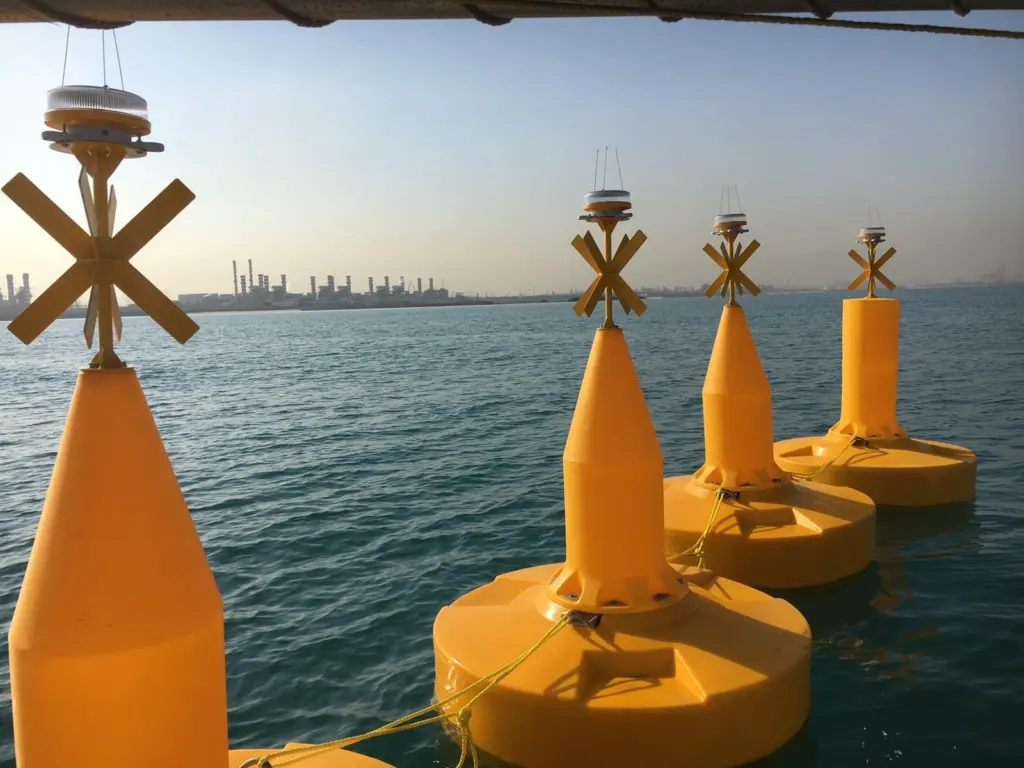
In fact, he adds, most, if not all of the specs AMRO sees are outdated, with ports asking for things like steel buoys of a certain focal plane and width, instead of specifying ‘must-see’ light range, day time visibility or polyethylene-type (PE), foam filled varieties. In short, they are missing a trick: modern construction methods have resulted in longer maintenance intervals and their light weight means they are more cost effective both to install and transport. More, “they are not ‘ship wreckers’ if there’s contact” adds Mr Malherbe. He pegs the total cost of ownership over 20 years at 30% to 50% lower for PE buoys compared with steel.
Despite this, it’s not always easy to make the point that there might be a better, cost-effective alternative. One Middle Eastern facility was ploughing ahead with an over-spec navigational aids project and it was only “a very good, longstanding relationship with the harbour master that resulted in a U-turn” says Mr Malherbe, which he reckons saved the port around half of its navigational aids budget.
Cost savings
There are other changes that can be made too to keep costs in check. Depending on location, visual aids can sometimes be moved onto land: although it needs specialist assessment, it does keep costs down. However, if the situation requires a buoy in the water, there are now less hefty, more compact alternatives for the whole kit, such as self-contained lanterns with high-intensity LEDs running from solar-powered batteries which result in smaller buoys and lighter moorings.
John Caskey of Hydrosphere adds that a modular approach helps keep costs in check as navigational aids are, he says, “typically a low-volume production product… and therefore relatively expensive”. This modular approach has been particularly useful for ABP’s facility in Southampton, UK, he says: “Like many ports they’ve got a limited AtoN budget, so while ABP has recently purchased a few plastic buoys, they’ve also swapped the daymarks on top of some of their older steel versions for new ones… and they can keep those going when they get around to changing the rest of the hulls.”
Despite centuries of fairly leisurely evolution, innovation has recently begun to pick up speed “and a light is hardly ever just a light anymore”, says Mr Caskey. For example, navigational aids can now give out ‘virtual AIS’ which doesn’t just tell you where and what it is, but also transmits a signal that appears to come from other, nearby buoys: “That way you only need to buy one AIS beacon and it will send identifying data for the whole set,” he explains.
There’s another, converging technology that’s making a ripple: “Remote monitoring by satellite is now cost-effective,” says Mr Malherbe. In fact, manufacturers’ web portals are getting more sophisticated, not just keeping an eye on location but also light hours, the battery’s state of charge and so on.
There are two benefits he says: firstly, safety has been improved because you can interrogate navigational aids by phone or laptop instead of climbing onboard and carrying out manual checks. Secondly, “maintenance intervals can potentially be extended and requirements better defined with the use of accurate data”.
Finnish innovation
Finland is taking this smart approach one stage further. Rauma, one of Finland’s busiest ports, has installed adjustable beams on its navigational aids so that pilots can increase their brightness in difficult conditions, and there is more innovation to come.
Jorma Timonen of the Finnish Transport Agency (FTA) says the organisation is currently piloting two new services: a current profiler and a navigational aid-mounted device able to measure wave heights. More, as not all areas are covered by a tide gauge, his organisation and the Finnish Meteorological Institute are piloting a predictive water-level tracker.
Alongside this, the FTA has been working with bathymetric data to generate a topographic model of the seafloor. The aim is to improve situational awareness and give the users better knowledge about the underwater characteristics of the fairway.
What this means for Rauma – and potentially other ports – goes far beyond just making life a little easier. Rauma has just deepened its fairway from 10 metres to 12 metres, doubling the scale of the feeders that are the lifeblood of the region. This smart fairway promises to make the most of its new depth, explains Mr Timonen.
The point he makes is “that the combination of bathymetric model and real-time water level data could tell the user how much depth there is in the fairway or … for example, how much will there be tomorrow morning”, raising the cargo limit for safe navigation.
Thomas Erlund of Meritaito (which provided the buoys for Rauma), is also looking to a smarter future. While he admits that the price of the technology is still high, “if you can spare between half or an hour on a port visit, that adds up on a yearly basis: 10 hours a month saved means 120 hours a year, that makes for a whole extra call,” he points out.
Conflict of interest
Despite all this, there’s a small fly in the ointment. Mr Malherbe adds that occasionally he’s come across “a clash of interest”. He explains: “If AtoN specialist organisations are both specifying and maintaining the buoys, they aren’t always in favour of new technology as, to be honest, they know very low-maintenance polyethylene buoys won’t be good for their own added value.”
Even with everyone on the same side, hitting the balance between cost-effectiveness and investment isn’t easy as just a few navigational aids marking a fairway can easily cost tens of thousands of dollars. And although these modern buoys aren’t really sinkable, if something untoward happens – such as a seagull attack on the light or the charging system, or someone steals one, which, according to Mr Caskey, has happened – getting everything in working order again might prove expensive.
As a result, Meritaito is now beginning to look at offering the whole navigational aids business as a service, spreading the budget and taking the sting out of any unexpected issues. “The ports wouldn’t own the buoys, they’d simply lease them from us, for example on a five-year agreement – we’d take the risk so the fairway owner doesn’t have to,” says Mr Erlund.
In future, it’s possible that manufacturers could use satellite connectivity to stitch a number of elements together: Meritaito, for instance, has a range of electronic charts “which means we could also take over the port’s hydrographic measurements”, he explains, giving customers the option of a fully digitised ‘package’. “We are already looking at a web portal that would give a full, visual situational awareness picture, and licences so that the ports can provide the same for their own customers, the lines themselves. Everyone would get more out of it.”
SIZE STILL MATTERS
One of the biggest drivers of navigational aids size today isn’t visibility, it is energy, according to Hydrosphere’s John Caskey.
“Lights with built-in satellite monitoring just report twice a day, once when the light gets turned on, once when it goes off… although it will also fire off an alarm if it moves too far out of position.”
However, he says: “Putting wave and meteorological data onto navigation buoys is a very different game… the wave sensors, in particular, use a lot of energy as you are transmitting real-time data. Finding a suitable power source – a solar cell and battery combination – has been challenging.”
He points out more northerly installations present their own issues: shorter winter days means there’s not so much light to charge the cells, while at the same time, longer nights require extended running time.
In fact, Hydrosphere’s installation in Aberdeen, Scotland has had to be kitted out with an 800Ah battery, and 800W of solar panels “because we want the buoy to be able to run for at least a month with no sunlight at all” although he adds the pressure on size and cost will change as both battery and photovoltaic development are “pointing in the right direction”.
Related Articles
 CONTAINER & CARGO HANDLING
 CONTAINER & CARGO HANDLING
 BULK HANDLING