![PortStrategy[GreenPort]](https://www.portstrategy.com/wp-content/uploads/2026/09/PortStrategyGreenPort.svg)






UKMPG offers glimpse into “port of the future”
Digitalisation, augmentation, automation, and the continued evolution of physical assets of ports, their hinterlands and their connectivity topped the results of a survey on development that could shape the port of the future.
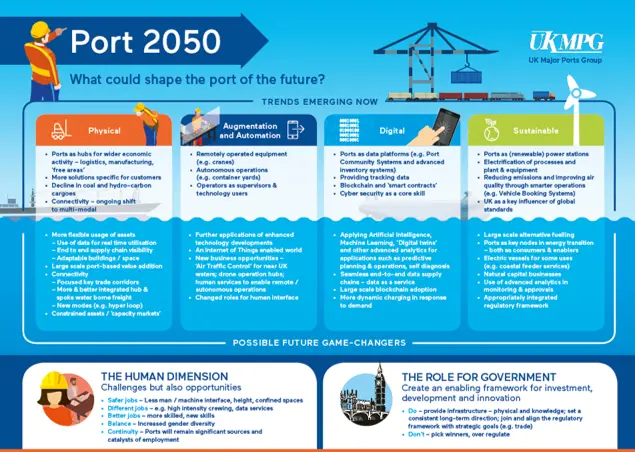
The survey, undertaken by the UK Major Ports Group (UKMPG), informed the association’s response to the UK Government’s call for evidence, which closed in mid-May, for Maritime 2050, a long-term, UK Government strategy to secure the country’s maritime sector’s future.
The survey of the UK’s largest port owners and operators threw up five key findings.
Firstly, UKMPG explained that already, real, commercial-scale examples in the UK’s major ports of what some might characterise as a future state — for example, transition to a low-carbon future, remotely-operated equipment and sophisticated data platforms — can be identified.
Secondly, the organisation claimed, the UK’s major ports see significant possibility for the greater availability and use of data to drive more efficiency and create new businesses and services for customers. Here, advanced analytics can bring predictive power to logistics chains, operations and maintenance, while the generation and facilitation of data streams will be an increasingly central component of customer propositions. The UK’s major ports can act as global gateways for both data and physical cargoes.
Thirdly, the augmentation of human operations is driving continued improvements in productivity — productivity that, in many cases, full automation struggles to match — with additional possibility for increased augmentation.
Fourth, economy-wide developments, like major technological changes, pose questions for ports, and these challenges need to be addressed responsibly, but there are opportunities arising from technological change and ports will stay as important sources of jobs and catalysts of broader employment.
Finally, UKMPG said that 2050 is a long time ahead and that the future for ports is hard to predict with total confidence, but it is important for there to be “a flexible policy and regulatory framework, beneath a consistent pro-trade and pro-investment direction of travel, that allows port owners and operators to react to opportunities and challenges as they emerge”.
Commenting on the findings, Tim Morris, UKMPG chief executive, said: “At the heart of our input to government is a determination that ports will play as crucial a role in the fourth industrial revolution as they have in its predecessors, enabling the UK to trade with the world.”
Respondents to the survey noted that any change must occur within an environment of sustainability and responsibility, the UKMPG added.
Taken together, and with the right enabling pre-trade and pro-investment policy frameworks from UK Government, the developments that could shape the future port would further construct “the powerhouse ports needed for Brexit Britain”, the trade association claimed.
Related Articles
 PORT & TERMINAL NEWS
 EXPANSION & DEVELOPMENT
 PORT & TERMINAL NEWS