![PortStrategy[GreenPort]](https://www.portstrategy.com/wp-content/uploads/2026/09/PortStrategyGreenPort.svg)






Rebounding Russia returns from past volume volatility
Container penetration in Russia remains relatively low, but 2017 and 2018were good years for its ports
“Russia remains a strategically important market to serve. Access can be gained via Russia’s own ports, but also through other gateway and hub options,” stated Steve Wray, Associate Director of WSP’s Maritime Advisory team.
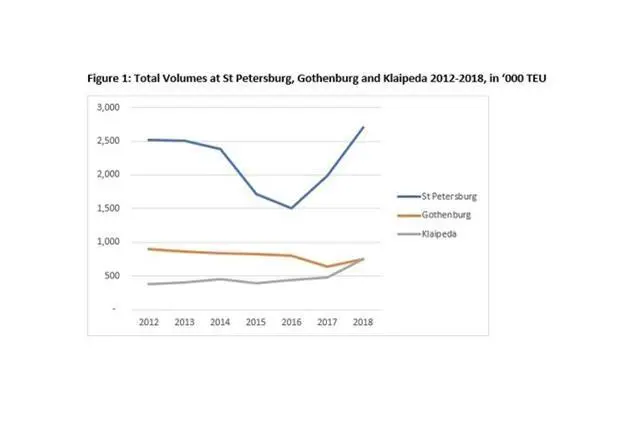
Total volumes have certainly been volatile at St Petersburg, as Figure 1 shows. Decreases between 2014 and 2016 due to weak economic conditions occurred, but stronger increases for 2017 and 2018.
In comparison, the dip caused by labour issues in Gothenburg and growth in Klaipeda show both ports still well behind Russian activity. First Container Terminal is offering increases from improved operational efficiencies as it reaches maximum build-out, with expansion occurring at Berths 49-50 (Petrolesport) where 365m of quay and equipment is part of a 5.5ha project giving around 375,000 TEU to the container space available.
From 2020 Fourth Container Terminal has known, but unconfirmed, timescales to add 1.05 million TEU. Ust-Luga is developing a Phase II expansion, whereby annual container capacity will reach 2.2 million TEU per annum, with a reported third phase, bringing total capacity to 2.9 million TEU per annum – however, timescales remain unconfirmed.
There remain, of course, access issues to the port due to the weather with ice ensuring that non-ice-strengthened ships are unable to reach terminals for up to six months per year, leaving Russian hinterlands targeted through other Baltic countries.
The current estimated capacity at the port of 3.1 million TEU is due to increase to 4.7 million TEU by 2020 and eventually reach 6.6 million TEU. However, the ports will hope that no weakening economic uncertainty will negatively impact the positive traction gained in 2017 and 2018.
Related Articles
 PORT & TERMINAL NEWS
 EXPANSION & DEVELOPMENT
 PORT & TERMINAL NEWS