![PortStrategy[GreenPort]](https://www.portstrategy.com/wp-content/uploads/2026/09/PortStrategyGreenPort.svg)





PAVING THE WAY AHEAD FOR TERMINALS
Iain MacIntyre discovers how heavy-duty paving solutions for container terminals requiresanalysis of individual load types, weights and volumes versus capital and maintenance costs
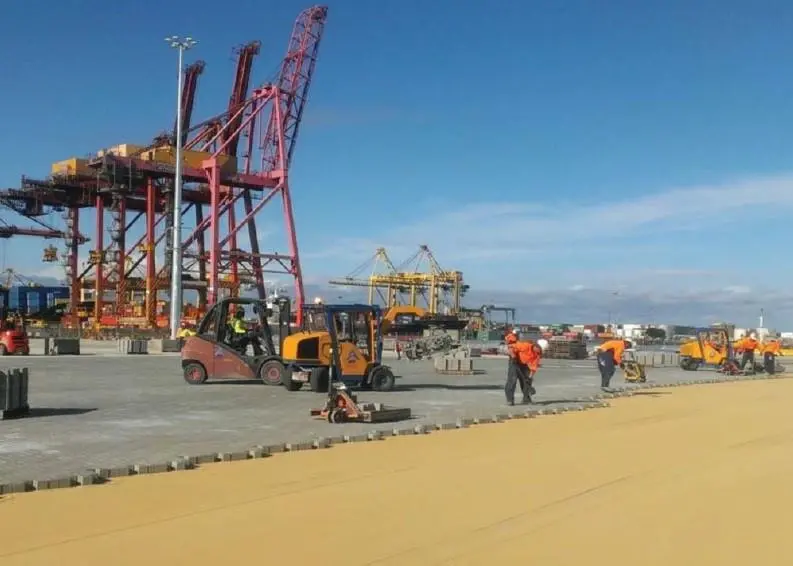
Operators must adhere to prescribed maintenance schedules to avoid potentially costly downtime, while simultaneously being tempted to skirt potential operational disruption.
That’s the balancing act to be faced, according to various industry experts. While numerous factors are noted to influence the cost to surface a given hardstand area, of the popular options it appears concrete is the most expensive, with rough estimates putting concrete block paving (CBP) and asphalt at about 10% and 30% cheaper, respectively.
Royal HaskoningDHV port paving expert Alex MacAulay provides the following assessment of the best matches of those typical surfaces to specific terminal setups. “Concrete paving is suitable for areas trafficked by heavy, channelised wheel loads,” he says, adding, “Therefore, this type of paving lends itself to use in terminals employing equipment
such as straddle carriers and rubber-tyred gantries (RTGs). It is also a popular choice on quayside areas.”
CBP generally can be adopted for container storage and for pavements subjected to heavy wheel loads. Compared to concrete paving, it is better able to cope with some settlements, being semi rigid rather than rigid. If repetitive channelised wheel loads are anticipated in areas, some terminals adopt concrete paving instead of block paving as it tends to be more resistant.” Mr. MacAuley adds to this point by stating, “Asphalt paving can be relatively cheap to construct and to maintain, but can be susceptible to damage from containers’ corner castings.”
Fulton Hogan business development and construction general manager, Eugene Cheah, adds that various materials make up a port pavement structure, from the running surface
through to the native ground.
“The pavement material and structure will depend on a number of factors such as ground conditions, traffic and loading,” he says, and further explains, “Useful life and cost budgets are also key determinants. Each pavement structure has its own pros and cons, so consultation with experienced pavement designers and contractors is critical to seek the optimal solution.”
Port pavements are designed to a range of lifespans, with between ten to 25 years typically described, of which WSP port planning director Jonathan Tyler’s experience has more
commonly been at the 25-year end.
“This is not to say that it will fall apart on the first day of year 26, but that keeping the pavement in a safe and serviceable condition may become increasingly costly and possibly uneconomic,” he says.
“For asphalt pavements in ports the following is usually anticipated – resurfacing of heavily-trafficked areas every five to seven years, partial reconstruction of heavily-trafficked areas after 12 to 15 years, total reconstruction after 25 years. Concrete, when properly maintained, has often proven to last decades beyond the design life. And block paving sits somewhere in between asphalt and concrete,” confirms Mr Tyler.
Nigel Nixon and Partners Inc. chairperson, Nigel Nixon, emphasises that, although intended for specific lifespans, pavements will not achieve such numbers without due care.
“They all need maintenance during the design period,” he says, also adding that design life will be derived from such factors as the number of equipment repetitions over the planned life, plant dynamics, weight distribution, box size mix and percentage of empty and laden containers.
In a typical reach stacker container terminal, with assumption of no construction defects, Mr. Cheah describes the different surface behaviours/maintenance as likely to include:
- concrete – periodic re-caulking between slab joints and filling any developing cracks with a repair mortar, alongside particular diligence to detecting any design or construction deficiencies
- CBP – panels needing removal and replacement as the eventually break up and lose their interlock, with the bedding sand topped up and recompacted
- asphalt – milling off the upper layer and replacing with fresh asphalt where container corner castings have indented significantly
Mr Cheah adds to this matter too, stating, “It is often forgotten that the cost of maintenance is not only the repair costs but the cost of operational downtime – of not being able to use valuable real estate to move containers. Before undertaking any significant maintenance activity, consider whether the pavement structure is at or approaching the end of its service life and is due for rehabilitation or reconstruction.”
While the experts agree that ports will be aware of the recommended maintenance requirements for paving, it is different in a real-life operation. Mr Nixon, whose firm proposes a 12-step maintenance protocol, says the requirements of the paving are often sacrificed to avoid operational disruption.
“Unfortunately, terminal owners tend to veer away from creating a paving maintenance regime – (a) because the planned funds aren’t often available in preference to other perceived more important operating expenditure items and (b) they often aren’t aware of the timing of the repair intervention to extend the asset’s life.
“Sadly, this is all too common – reactive maintenance takes preference to proactive maintenance” and he reports having frequently witnessed straddle drivers either repeatedly
traversing potholes or swerving to avoid them – both actions raise the potential for accident and injury. “It is up to people like us to help advise owners from falling into the trap of what may be regarded as a cheap solution [but which] often results in a very expensive one,” Mr Cheah states.
Mr Tyler observes that the importance of paving maintenance may present as less obvious to a terminal operator than, for example, maintaining the operability of quay cranes.
“You can cone off and drive around a pothole, but you can’t drive a crane around a defective rail. Pavement deterioration is usually gradual and progressive over several years and, thankfully, not normally spontaneous and life-threatening.
“This means that it is difficult to look back to see if more should have been spent on preventative maintenance. This then means that it is possibly harder to look ahead and justify more preventative maintenance (which requires a bigger budget).”
Emphasising the relevance of “stitch in time” intervention, Mr Cheah nonetheless says some operators will leave their pavement until it fails – “thus risking safety, operational downtime and a very expensive fix”.
“Our more sophisticated customers have come to understand the value in monitoring and maintaining pavements,” he stated. “Early identification and intervention has resulted in improved safety, improved pavement availability and reduced repair costs and time. Programmed annual maintenance sees funds being available within the businesses and outages being planned at the operator’s convenience.”
As a parting thought, Mr Cheah notes that as ports demand higher productivity and greater value for money from their infrastructure, so the need to identify their optimal infrastructure solution becomes increasingly important.
“Port infrastructure owners should not only look at the immediate capital cost but also the maintenance costs over the whole of asset life and the financial impact of operational
downtime by not maintaining their assets.
“Comparing options over the whole of the infrastructure life with differing variables can be difficult. One method is to calculate a net present value (NPV) of each infrastructure option which captures all variables including capital cost, maintenance cost, and income generated and lost from downtime time. This calculation is performed over the life of the asset and will assist in identifying the solution with the optimal value.”
While noting that maintenance budgets “understandably always come under scrutiny,” Mr Tyler also champions the early problem-solving approach. “Assessing when to do early
maintenance is cheap and easy. At its simplest level, all it requires is a visual walk-over survey not less than annually, to identify any cracks, potholes and the like in need of repair and joints in need of cleaning and resealing.
“Water is often the most destructive force in maintaining pavement condition, so it is vitally important to keep storm water drainage networks free running, stop water from entering the pavement (seal surface cracks, repair potholes, re-seal joints), and make sure pavement subsurface drainage is not blocked.”
Related Articles
 CONTAINER & CARGO HANDLING
 CONTAINER & CARGO HANDLING
 BULK HANDLING