![PortStrategy[GreenPort]](https://www.portstrategy.com/wp-content/uploads/2026/09/PortStrategyGreenPort.svg)





MOVING ON FROM THE 1970s
Hamburg is pressing on with infrastructure upgrades to keep its position as Germany’s primary container port, as Michael Mackey discovers.
Hamburg is not anxious about its key markets longer term, except one, but is bracing itself for waves of disruption caused by COVID-19.
“For Europe and Asia I am quite confident there will be recovery quite soon. The biggest headache I have is the US, they are not prepared for this type of health emergency,” Axel Mattern, CEO of HHM, the marketing company for the Port of Hamburg said in an interview with Port Strategy.
Hamburg is very major destination for Asian shipping lines with many direct services and more than a third just China alone, he explained. Not that Hamburg plans to use this to pause its infrastructure programme or its development – not at all.
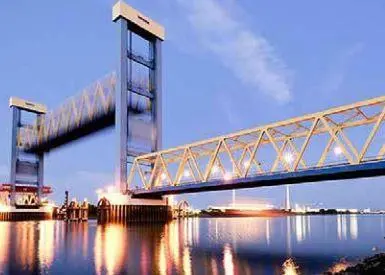
These initiatives remain important for Hamburg, especially the Kattwyk Rail Bridge which is “going to be doubled,” Mattern declared to Port Strategy. The improved Kattwyk, which will allow a more efficient movement of cargo, is typical of Hamburg’s strategy of finetuning a facility already in good working order.
This is also true of the Burchardkai Link, a new rail connection to Hamburg’s biggest container terminal, which is about using the same bridge to simplify the system and move traffic from the roads to rail.
Still to be decided though is the renewing of the Koehlbrand Bridge which connects two parts of the port. This bridge was built back in the 1970s when trucks were smaller and much fewer in number. Needing to rebuild for the needs of the 2020s has opened up the possibility of replacing it with a tunnel. Engineers favour a tunnel which would allow both road and rail transport.
“Drilling is much easier than building a bridge, which then should be twenty metres higher (than the current, dated one,)” explained Mattern. There is another practical (and big) problem though, namely cost. “Everyone is hoping the decision will be a tunnel but it’s a financial issue of course. It is a little bit more expensive to build a tunnel,” said Mattern.
It’s very much a case of watch this space as a decision is expected, or needed, very soon as it will take 10 years to build the tunnel.
Hamburg does not tend to shy away from big infrastructure building or indeed any kind of big project and has just finished a major widening and deepening of the River Elbe, albeit after many years of legal issues and delays.
The new wider River Elbe will allow double the numbers of ships of more than 14,000 TEU it can take from its current 600- 900 ships to 1,800. However, as Mattern said “that’s theoretical.” There are only so many ships of that size in the market and Hamburg will not have to deal with them all at once. “The deepening is going to be finished next year” Mattern added. That’s less about capacity but more about “flexibility on the operational side.” Alongside hardware, there is also interesting development relating to technology with Hamburg one of the test fields for 5G and drones.
The port has also just bought a water surface drone to perform semi-autonomous hydrographic tasks in its waters. Being talked about are underwater drones to monitor quay walls and Elbe sediment in future, along with airborne drones to be used, possibly, to inspect the load-bearing cables of the Koehlbrand Bridge.
The 5G testbed, an initiative with Deutsche Telekom and Nokia, stretched across some 8,000 hectares of port area with a base station installed on Hamburg’s television tower, over 150 metres up in the air.
The testbed had been set up to test 5G applications in an industrial environment. Hamburg is currently waiting for the telecommunication companies to establish a nationwide 5G infrastructure.
Related Articles
 PORT & TERMINAL NEWS
 EXPANSION & DEVELOPMENT
 PORT & TERMINAL NEWS